

AEO in 2026: Writing Content That Gets Cited by AI, Not Just Clicked
If you want content cited by AI in 2026, write for extraction before persuasion.
That means giving AI systems clear answers, strong evidence, easy-to-quote phrasing, and structure that works for both humans and machines. Pages that are easier to cite usually do four things well: they answer fast, format cleanly, support claims, and stay consistent from heading to conclusion.
If your team is turning expert ideas into LinkedIn content with that kind of clarity, Dynal is built as an AI LinkedIn agent to help shape drafts with brand context before you publish. It can be a useful place to test the angle while keeping the output easy to refine.
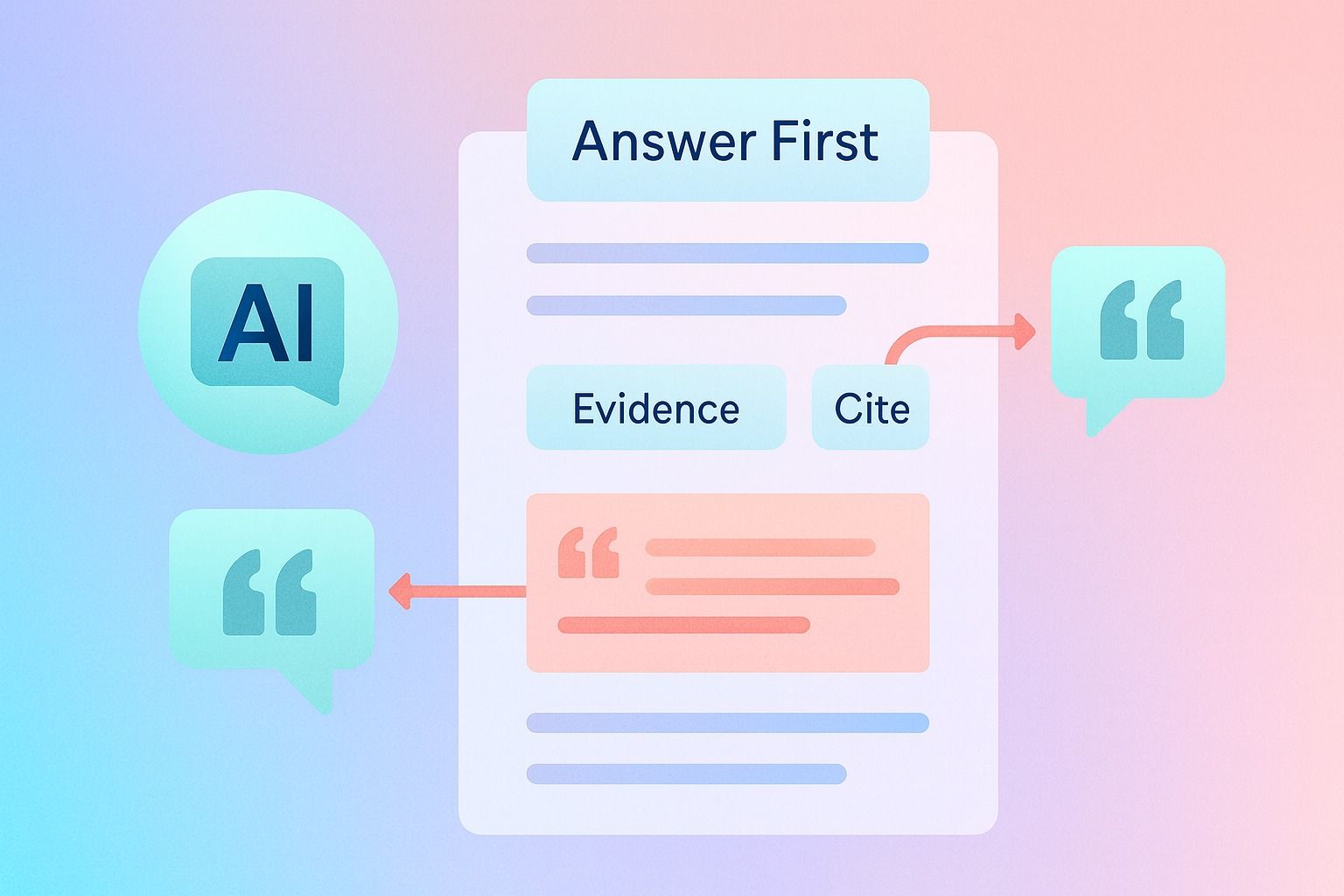
Clicks still matter. But in AI search, being the source behind the answer is now part of the job.
A simple rule: if a human can scan your page in 20 seconds and find the exact answer, an LLM may also have a better chance of quoting it accurately.
Quick takeaways:
- Put the direct answer near the top of the page, not buried after a long intro.
- Use headings, lists, tables, and short paragraphs so AI can extract clean chunks.
- Back important claims with specifics: examples, definitions, dates, numbers, or cited sources.
- Optimize for featured snippets and AI citations together; the formatting overlap is real.
- Write naturally enough for humans, but explicitly enough for machines.
What AEO means in 2026
AEO, or answer engine optimization, is the practice of structuring content so search engines and AI systems can more easily identify, extract, summarize, and cite it.
In 2026, that can include:
- AI overviews and AI search results
- Featured snippets
- Conversational answer engines
- LLM-powered assistants that synthesize web content
Traditional SEO asks, "How do I rank and earn the click?"
AEO asks, "How do I become the source that gets quoted, summarized, or cited?"
The best pages usually do both.
That same balance is what Dynal aims to support for LinkedIn: an AI LinkedIn agent that helps you draft with more structure while keeping the voice consistent. If you want to explore that workflow, see Dynal.
How do I write content that gets cited in AI overviews and AI search results?
Start with a page that is easy to trust and easy to parse.
AI systems tend to prefer content that is:
- Directly relevant to the query
- Structurally clear
- Semantically explicit
- Supported by evidence
- Consistent in wording and intent
In practice, that means:
1. Lead with an answer-first intro
Open with a short, explicit answer to the main query. Avoid suspense.
Bad:
Content optimization has changed a lot in recent years. As search evolves, marketers need to rethink old assumptions.
Better:
To improve AI citation potential, place a concise answer near the top of the page, support it with evidence, and format the page with headings, lists, and scannable sections that LLMs can extract accurately.
That second version is easier to lift into an AI overview or snippet.
2. Match one page to one primary intent
A page trying to rank for five different questions often gets cited for none of them.
Pick a dominant intent:
- definition
- how-to
- comparison
- checklist
- troubleshooting
- template
Then support nearby secondary questions in subheads.
3. State claims in quotable language
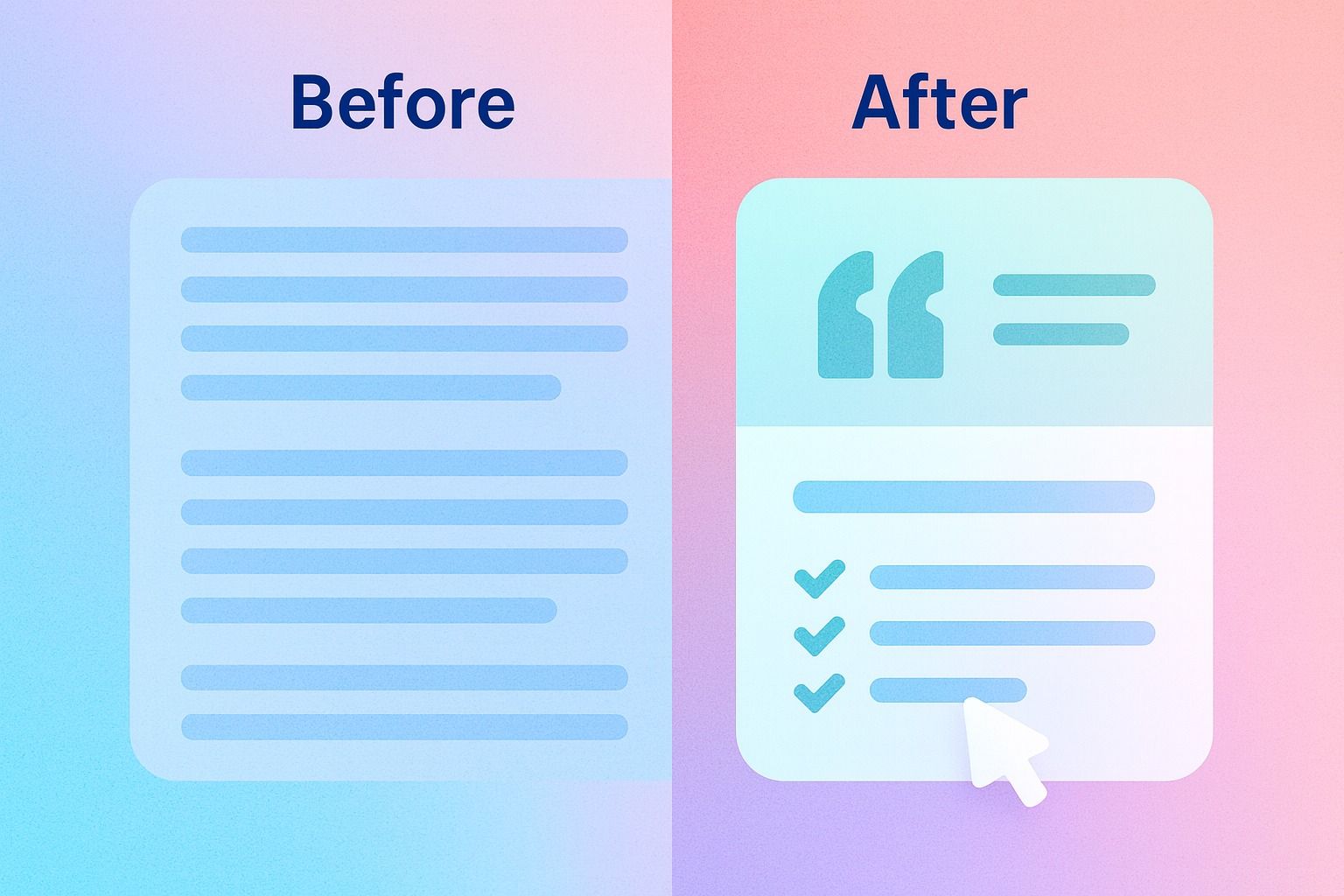
AI systems extract compact statements better than vague marketing prose.
Weak:
Good formatting can really help a lot.
Strong:
Pages with short answer blocks, descriptive subheads, and ordered steps are easier for AI systems to extract and summarize accurately.
4. Add evidence close to the claim
If you make an assertion, support it nearby with:
- a source
- a definition
- a statistic
- an example
- a date or version context
- first-hand methodology
The shorter the distance between claim and support, the better the extraction quality tends to be.
What formatting increases the chance of featured snippets and AI citations?
Formatting does not guarantee citations, but it can improve extractability.
Here are the highest-value formats.
Use definition blocks
For definitional queries, give a 40 to 60 word answer directly below the heading.
Example:
What is AEO?
AEO, or answer engine optimization, is the practice of creating content that helps search engines and AI systems find, extract, summarize, and cite clear answers to user questions.
Why it works:
- concise
- self-contained
- easy to quote
- aligned to featured snippet patterns
Use ordered steps for procedural queries
For "how to" intent, use numbered steps with one action per step.
Example:
- Identify the exact question you want the page to answer.
- Write a 1 to 2 sentence direct answer at the top.
- Expand with examples, edge cases, and supporting evidence.
- Format key sections with lists, tables, and descriptive subheads.
- Review whether each section can stand alone if quoted by AI.
Use comparison tables
Tables help both humans and machines evaluate differences quickly.
| Format | Best for | Citation potential |
|---|---|---|
| Short definition | What is / why is | High |
| Ordered steps | How to | High |
| Bullet checklist | Best practices / audits | High |
| Comparison table | Vs / alternatives / criteria | Medium to high |
| Long narrative | Thought leadership only | Lower unless broken into clear answer blocks |
Use descriptive headings
Weak heading:
A few thoughts
Better heading:
Which content structures help LLMs extract and quote answers accurately?
Descriptive headings improve retrieval, extraction, and user scanning.
Use short paragraphs and clean bullets
Dense walls of text are harder to quote cleanly.
Aim for:
- paragraphs of 1 to 4 lines
- bullets grouped by one idea
- one core point per section
Add FAQ sections carefully
FAQ blocks can help if the questions reflect real search intent. They hurt when they repeat the page without adding value.
Use FAQs for:
- edge cases
- misconceptions
- definitions
- implementation details
Which content structures help LLMs extract and quote answers accurately?
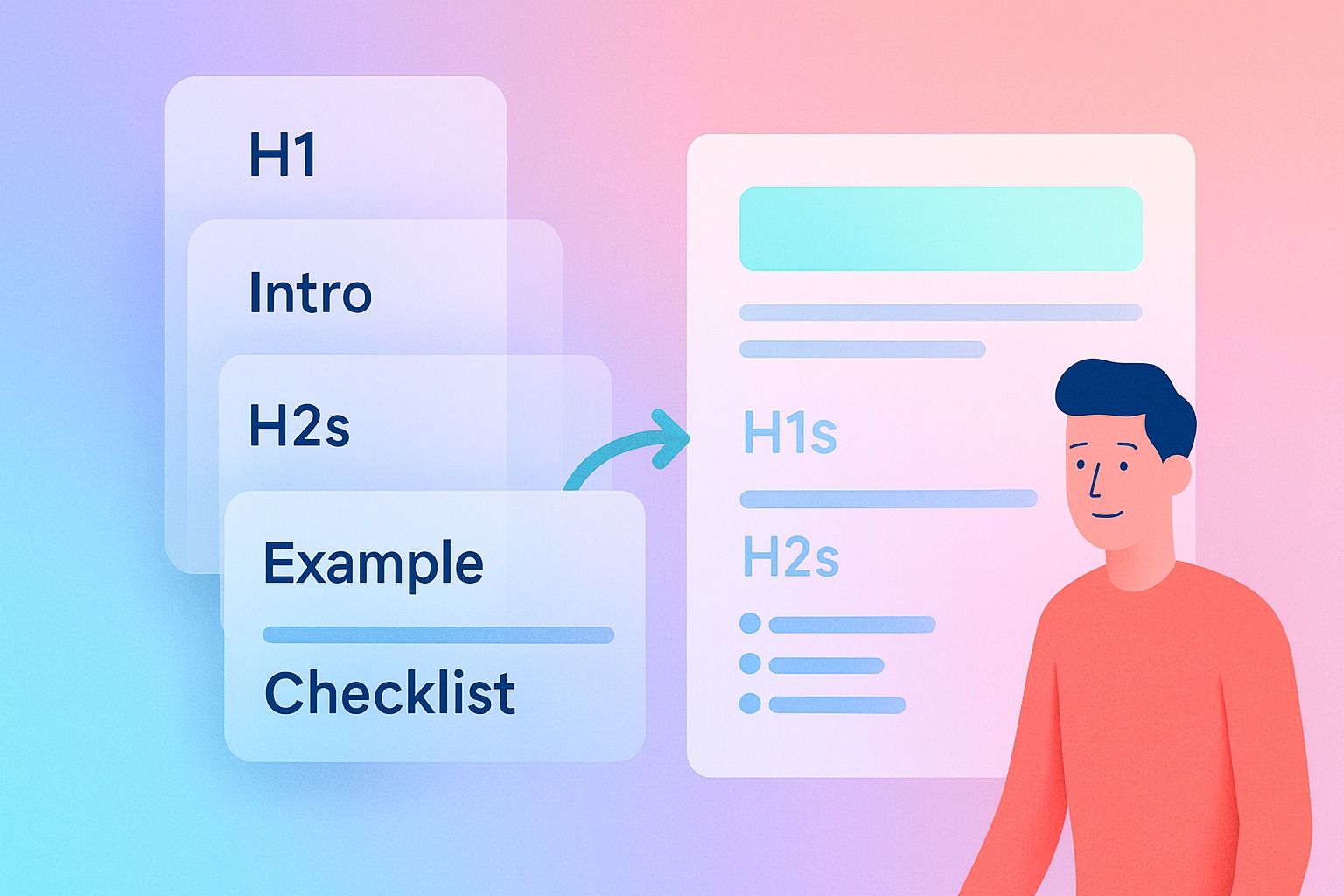
The most citation-friendly structure is usually:
- Clear H1 aligned to the main query
- Answer-first introduction
- Short summary bullets
- Question-based H2s
- Concise answer block under each H2
- Examples, proof, and nuance after the direct answer
- Checklist or template near the end
Here is a simple page template you can reuse.
A citation-friendly article template
H1
Use the exact problem or topic.
Example: How to Write Content That Gets Cited by AI
Intro
Answer the main question in 2 to 4 sentences.
Quick summary
Add 3 to 5 bullets with the core takeaways.
H2: What is it?
Give the definition.
H2: How to do it
Use numbered steps.
H2: Best formatting
Use bullets or a table.
H2: Common mistakes
Show what breaks extraction.
H2: Example
Give a before-and-after rewrite.
H2: Checklist
Summarize implementation points.
This structure works because it separates the "answer" from the "explanation." That makes the page easier for AI systems to quote without losing context.
For teams applying that structure to LinkedIn thought leadership, Dynal can help organize source material into a cleaner drafting flow as an AI LinkedIn agent. It fits well when you want the answer up front and the nuance behind it.
How do I optimize pages for AEO without hurting human readability?
This is where many teams overcorrect.
AEO does not mean writing robotic copy. It means making your meaning easier to extract.
Use this balance:
Keep the top layer concise
Your first sentence under a heading should answer the question directly.
Keep the second layer human
After the answer, add:
- context
- examples
- nuance
- objections
- implications
That gives humans depth without making extraction harder.
Write in modular sections
Each section should make sense on its own.
Ask:
- If an AI quoted only this section, would it still be accurate?
- Does the heading clearly tell the reader what the section answers?
- Is the key point stated early enough?
Avoid over-styling
Human readability drops when every section becomes gimmicky.
Avoid too much:
- clever but vague headlines
- long scene-setting intros
- excessive metaphors
- hidden answers inside stories
Storytelling still works. Just place the answer before the story, not instead of it.
What evidence, schema, or on-page signals can help AI citation rates?
No markup can force an AI citation. But several signals can improve trust, clarity, and machine readability.
Evidence that helps
Prioritize:
- first-hand examples
- original frameworks with clear definitions
- current data with dates
- named sources
- visible author expertise
- consistent terminology across the page
When possible, include:
- who said it
- when it was published
- what was tested
- how the conclusion was reached
On-page signals that help
Useful signals include:
- clear title and heading hierarchy
- descriptive subheads
- concise answer blocks
- internal consistency in terms and definitions
- updated timestamps when relevant
- author bylines and trust cues
- pages that avoid contradictory statements
Schema considerations
Schema is supportive, not magical.
Depending on the page type, useful structured data may include:
- Article
- FAQPage
- HowTo
- Organization
- Person
- BreadcrumbList
Use schema to clarify the page, not to stuff keywords.
A practical rule: if your visible page content is unclear, schema will not save it.
Step-by-step: A practical AEO workflow for content teams
Here is a simple process you can apply to new or existing pages.
Step 1: Pick one core question
Example:
- How do I write content that gets cited in AI search?
Step 2: Draft the answer block first
Write 40 to 80 words that answer the question directly.
Example:
To improve AI citation potential, create a page with a direct answer near the top, clear headings, extractable formatting, and supporting evidence that makes each claim easier to trust and quote.
Step 3: Build supporting sections around real follow-up questions
Use H2s like:
- What formatting helps AI extract answers?
- Which structures help LLMs quote accurately?
- How do I balance AEO with readability?
Step 4: Add proof and examples
Show:
- before vs after rewrites
- examples of good headings
- checklists
- source-backed claims
Step 5: Tighten formatting
Check for:
- short paragraphs
- lists where useful
- descriptive subheads
- no bloated intro
- no duplicated sections
Step 6: Review for extractability
Ask your editor:
- Can each section stand alone?
- Is the answer obvious in the first sentence?
- Could a machine quote this without mangling meaning?
Example: turning a click-driven paragraph into a citation-friendly answer
Before
AI search is changing content marketing quickly, and brands need to keep up with new search behaviors if they want to stay competitive in the future and continue building visibility in evolving search environments.
After
To stay visible in AI search, brands should publish pages with direct answers, clear formatting, and evidence-supported claims that AI systems can extract and cite confidently.
Why the second version works better:
- the subject is explicit
- the recommendation is specific
- the sentence is self-contained
- the wording is easier to quote
Common mistakes that reduce AI citations, and how to fix them
Mistake 1: Burying the answer
Problem: The page takes 600 words to get to the point.
Fix: Put a concise answer in the intro and below relevant headings.
Mistake 2: Writing vague headings
Problem: Subheads do not match real user questions.
Fix: Rewrite headings as explicit questions or outcomes.
Mistake 3: Using unsupported claims
Problem: The page sounds confident but shows no evidence.
Fix: Add examples, named sources, dates, or clear reasoning.
Mistake 4: Mixing too many intents
Problem: One page tries to define, compare, sell, and tutorialize at once.
Fix: Choose one primary intent and support it with closely related subtopics.
Mistake 5: Over-optimizing for bots
Problem: The content becomes repetitive and awkward.
Fix: Keep the answer crisp, then write the explanation like a human.
AEO checklist for 2026
Use this before publishing.
- Does the page answer the core query in the first 5 to 10 lines?
- Is there one clear primary intent?
- Does each heading describe a real question or subtopic?
- Is the first sentence under each heading quotable on its own?
- Are important claims supported by evidence or examples?
- Are lists, steps, and tables used where they improve clarity?
- Are paragraphs short and easy to scan?
- Is terminology consistent across the page?
- Is schema aligned with the visible content?
- Would the page still make sense if one section were quoted out of context?
Decision criteria: what to prioritize first if your team has limited time
If you cannot overhaul every page, prioritize in this order:
- Pages already ranking on page one but not winning snippets
- High-intent educational pages that answer clear questions
- Comparison and how-to pages with strong commercial relevance
- Definition pages for terms your audience searches often
- Aging posts with weak structure but strong backlinks
The fastest gains usually come from reformatting existing winners, not publishing net-new content blindly.
Where Dynal fits in the workflow
If your team is creating thought leadership for LinkedIn and wants a more structured way to turn expertise into clear, citation-friendly content angles, Dynal can help at the ideation and drafting stage.
Dynal is an AI LinkedIn agent, not a generic writing tool. In its Workspace & Chat, you can shape draft ideas from prompts and source materials, adjust tone and language, and work through content in a chat-based creation flow before moving selected outputs into Publishing.
That matters for AEO because strong source handling and clear structure often start upstream. If your raw ideas are messy, your final article usually is too.
A practical use case:
- gather notes, links, and expert points
- use Dynal's content creation workspace to organize the angle
- draft a concise LinkedIn post that tests the framing
- expand the winning angle into a full article with citation-friendly sections
For teams building a consistent expert voice, Dynal's Brand DNA can also help maintain clearer brand context while you create LinkedIn content around recurring topics. The point is not to automate judgment. It is to make your workflow more consistent from idea to publish-ready draft.
When you are planning LinkedIn content over time, Planning & Calendar can help organize what to post and when, while Analytics can help review how published content performs. Those modules are helpful for keeping the workflow connected, but they do not guarantee AI citations or search visibility.
Final takeaway
In 2026, AEO is less about gaming AI systems and more about reducing ambiguity.
The content most likely to get cited is usually the content that:
- answers quickly
- structures information cleanly
- supports claims visibly
- uses quotable language
- respects the reader's time
Write pages that are easy to scan, easy to trust, and easy to extract. That is the overlap between human readability, featured snippet potential, and AI citation potential.
If you want a cleaner starting point for expert-led LinkedIn content, start with Dynal's Onboarding & Setup flow. The LinkedIn-first setup can help you get to a usable state faster, with starter brand context you can review and refine before drafting in the Workspace & Chat.
AEO may change the surface area of search, but the core rule stays the same: clear answers win.