

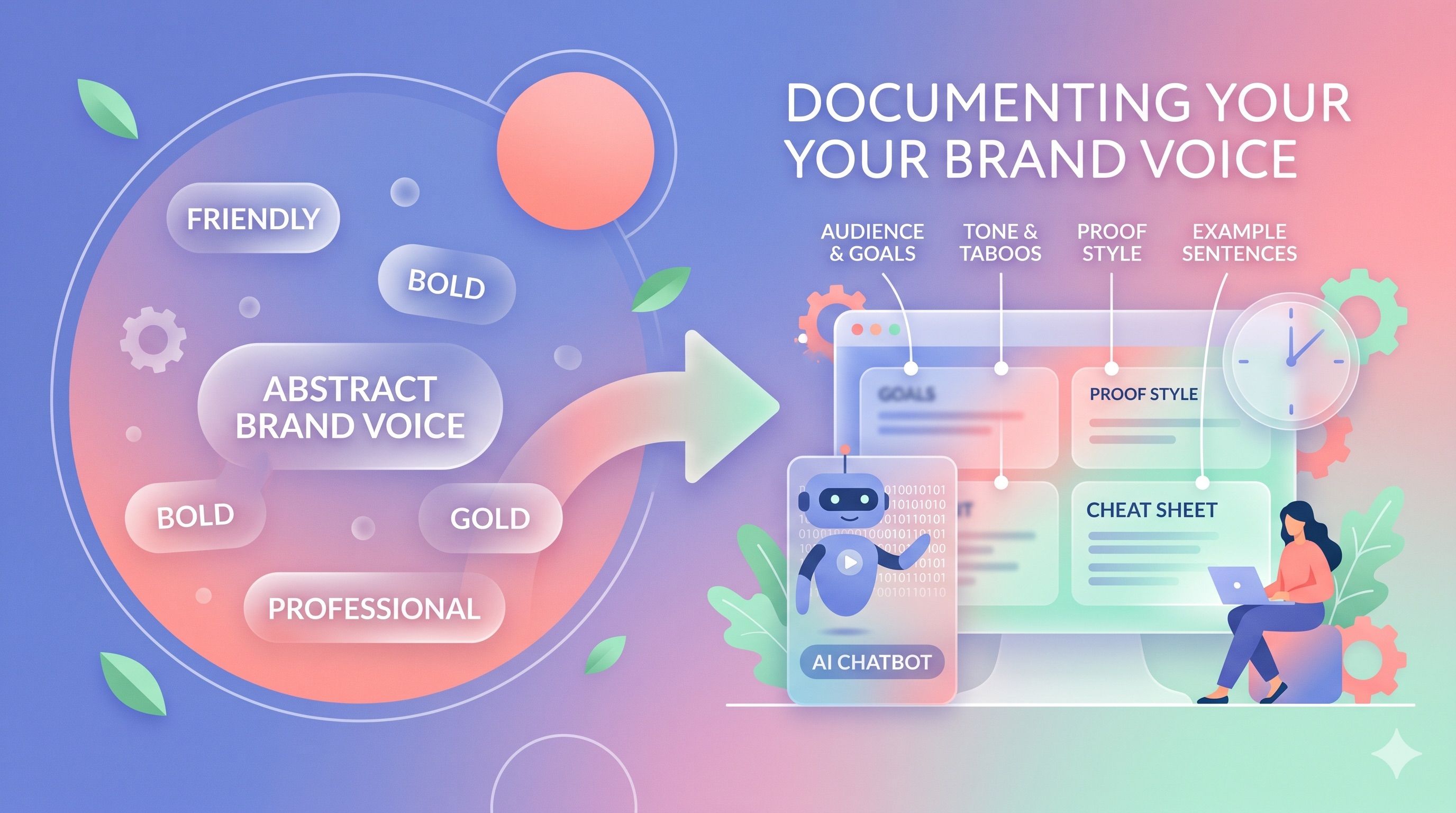
Brand Voice on LinkedIn: How to Document It So AI—and Freelancers—Stay On-Brand
1. Why brand voice drifts faster on LinkedIn than on your homepage
Corporate sites ship through web ops and approvals; feeds ship through fatigue. A founder disappears into meetings; a freelancer experiments with louder hooks because last week’s subdued post sank; marketing borrows motivational language from SaaS adverts because dashboards demanded “emotion.” Months later the profile reads like a committee hallucination—warm adjectives pasted over incompatible proof standards.
LinkedIn rewards serial publishing: small differences compound when visitors skim six months backward. Buyers skim like that before replying—they check whether you contradict yourself economically, ethically, technologically. Documentation does not extinguish originality; it prevents improvisation from masquerading as strategy.
Traditional brand books fail because nobody keeps them beside the Compose box. Winning teams maintain living micro-specs: one or two concise pages—not marketing fluff, but behavioural rules that survive Friday afternoon shipping.
2. Separate voice from vibes: what belongs in usable guidance
Acquisition psychology still matters when you document voice: see how prospects evaluate credibility so your proof grammar matches fiduciary expectations.
Forget lists of synonyms for “trusted.” Operational voice guidance spells constraints:
Audience anthropology anchors everything. Interview customers and paste short quotes describing risk budget—what embarrassment they fear politically if your product fails—not demographic filler. Mention whether procurement expects crisp language versus founder-to-founder slang.
Stance versus competitors states whether you refuse comparative mudslinging entirely, allow category-level critique, or require disclaimers.
Taboo narratives include regulatory minefields, exaggerated earnings claims, geopolitical punditry your compliance officer would shred. Naming taboos plainly saves freelance writers from discovering them after invoicing.
Proof grammar dictates how anecdotes appear: anonymised numbers allowed or banned; whether pipeline claims require caveats.
Structural habits articulate sentence budgets, paragraph density, acronym frequency, swear tolerance, emoji policy—even declaring “minimal emojis.”
Annotated exemplars outperform abstract rules. Provide three positives resembling posts you would reshare verbatim; provide two near-miss flops illustrating seductive tonal failures your team recognises—without naming individuals unless counsel approves.
Circulate drafts among stakeholders early—conflict should surface internally before publishing.
3. Turning your sheet into collaborator prompts
Freelancers translate briefs oddly when examples remain abstract. Paste sentence-level fragments they should mimic—how you open, how you escalate proof, how you invite comments. Explain what not to imitate simultaneously—celebrity founder myth incompatible with CIO readers.
Operational handoffs include versioning: date, owner, what changed (ICP shift, legal nuance, cultural moment). Store alongside note-to-post workflows so raw research does not rewrite voice accidentally when summarised.
4. AI assistance: constraints before creativity soup
General-purpose models default to generic uplift tone unless you supply structure. Feed audience block + taboo list + proof grammar + exemplar snippet before asking for variations. Document refusal patterns—phrases the model should never produce (grandiose absolutes, fake casualness, manipulative hook chains). This mirrors how Dynal treats Brand DNA as structured guardrails your team verifies over time—not mythical secret memory. Vendor shopping usually compares LinkedIn AI Writer depth versus LinkedIn Content System orchestration; contrast undifferentiated assistants with Dynal vs ChatGPT; reconcile budget with pricing. AI may draft outlines; factual claims about roadmap timing require human corroboration; sensitive geopolitical analogies escalate to communications leadership. Tie automation layering to ethical automation on LinkedIn—not whether technology can imitate voice, but whether doing so survives accountability.
Humans skim examples first—they trust proof before eloquence. Show bad outputs alongside critique; pattern recognition beats negative bullet lists without juxtaposition.
Review loops that honour voice without bottlenecking forever
Establish tiered QA: self-check against the sheet; editor verifies proof fidelity; escalation when posts mention customers or financial outlooks. SLAs matter emotionally—delayed approvals push teams toward generic safe language contradictory to edgy aspirations. Scheduling windows from solo calendar guidance should leave buffer so rushed approvals do not degrade tone.
Quarterly retrospective: gather posts illustrating drift toward generic AI cadence. Rewrite exemplars when positioning shifts—downstream collaborators learn from artefacts more than buried chat pronouncements.
Voice intersects organisational politics: align executive visibility with profile versus Page doctrine to avoid jarring divergence where personal posts sound anarchic while Page posts sound robotic—or the reverse. Document whether executive personal posts allow candidness moderated differently than entity voice.
Track partly qualitative signals—does commenter vocabulary align with your jargon choices, or degrade into generic debate tone because posts stopped anchoring lexical anchors?
Legal and HR deserve explicit entries: insider trading boundaries when discussing filings; prohibition on implying employment outcomes; sensitivity around personnel narratives—explicit “do not riff” categories prevent storytellers harming humans.
Freelancers juggling clients should maintain distinct sheet copies per client—never improvisational mental mixing.
Multilingual teams should declare authority language, translation ownership, and whether posts are native-authored versus translated—translations alter rhythm and persuasion; disclaim expectations.
Psychological realism: acknowledge occasional slips—document repair posture admitting mistakes cleanly without performative martyrdom.
Thought leadership arcs benefit from coherence—lesson posts followed by methodology followed by retrospective—preventing tonal whiplash when readers encounter disconnected genre experiments daily.
Audience fatigue appears when earnest education alternates days later with cynical hot takes signalling algorithm games—explicit policy naming forbidden tonal whiplash helps.
Executive ghostwriting needs declared boundaries between lived experience narration and outsourced reflective voice—moral clarity buyers sense when intimacy claims mismatch behaviour.
Synthetic media policies may eventually need lines on voice cloning—prohibit non-consensual mimicry even jokingly as anticipatory clarity.
Cadence interplay with newsletters matters when long arcs coexist with feed bursts—adjust proof density; see newsletters versus feed posts when packaging diverges materially.
5. What buyers infer from inconsistency—and where tone becomes liability
Procurement-minded readers rarely articulate “your brand voice feels off.” They experience doubt as execution risk: if public narrative wobbles weekly, might implementation wobble too? Buyers map rhetorical reliability to delivery reliability heuristically—even unfairly. Consistent voice lowers cognitive overhead in competitive evaluations where evaluators already juggle security reviews, reference calls, and rogue spreadsheet models. Documented voice is therefore not vanity; it is decision friction reduction for anyone defending your selection internally.
Some verticals punish casual irreverence loudly—banking infrastructure, clinical tooling, education access. Others reward iconoclasm—devtool upstarts, creative marketplaces. Guidelines should name where playfulness dies not because legal said so generically, but because your ICP humour tolerance is thin. Conversely, if you sell to practitioners exhausted by corporate euphemism, euphemistic voice harms you—authorise plain speech patterns with examples so well-meaning reviewers do not sand your edges into oatmeal.
6. Operationalising voice inside approval tools
Whether you route posts through email, docs, or specialised software, embed checklist hooks directly: taboo scan, proof category, audience line, exemplar pointer. Approvers should not improvise philosophy per post—otherwise late-night expeditions rewrite brand by fatigue. If you use AI drafting, store versioned prompt suffixes tying to the same numbered voice document revision (v1.4, v1.5) so future forensics explain odd shifts without guessing which prompt ghost haunted March.
7. Agency scale without tone dilution
When multiple agencies contribute, centralise exemplars and circulate diff reviews—show new draft side-by-side against approved exemplar paragraphs highlighting divergent moves. Contractually cap revision rounds while defining voice breach triggers (unapproved superlatives, banned competitor naming) to keep relationships professional, not adversarial. Agency writers juggle clients; your per-slug sheet copy reduces cognitive bleed.
8. Training that sticks, employer brand overlays, and long-run governance
Workshops and before/after rituals
People forget slide decks; they remember before/after edits critiqued line-by-line in front of the team. Quarterly, review one post that shipped, one that did not, dissecting voice deltas. Celebrate improvements; avoid blame theatre. Link training back to hooks without clickbait and types of posts so voice lessons connect to structure not floating in abstract adjective clouds.
Pipeline versus hiring voice
Employer branding tones tuned for careers portals—warm, exuberant storytelling for applicants—often clash with product leadership voices aimed at sceptical buyers guarding budget. Document dual-track relationships: when LinkedIn warmth serves recruiting versus when clarity serves pipeline. Clarify overlays—corporate hashtag bursts versus authentic executive observations—so founders are not pressured into HR vocabulary because dashboards reward it temporarily.
Employees beyond executives need scaffolding: permissible cultural posts without exposing colleagues; boundaries preventing roadmap leaks through enthusiastic transparency. Institutional memory captured once prevents improvised crisis responses every quarter.
Regulated categories—Healthcare-adjacent storytelling, government contracting—need sharper prohibitions on illustrative patient scenarios or export-adjacent anecdotes that read well yet court disaster legally.
Vertical tone diverges: manufacturing-heavy firms may favour floor-level credibility language; cloud brands may avoid overwrought Silicon Valley transplants that annoy legacy buyers operating outside coastal tech bubbles.
Regional rhetorical norms differ—American assertive urgency sometimes reads harsh to European readers—document translation expectations when regional leaders publish through centralised approvals.
Partnership posts featuring external logos swing voice—balance collaborative generosity against competitive dilution.
Governance should correct drift without purity policing—articulate humane escalation, not shame spirals that kill psychological safety for authors.
Sales leaders occasionally publish under personal profiles with voice distinct from corporate marketing—fine if deliberate. Conflict erupts when AE posts promise product behaviours misaligned with roadmap reality because enablement skipped voice syncing. Embed truth alignment checkpoints tying voice claims to changelog reality monthly—minimal ceremony, maximal prevention of reputational ruptures surfaced in demos after optimistic posts aged poorly.
Closing operational reminders: revisit guidance after rebrands, financing rounds, or geopolitical disruptions that shift audience anxiety—silent iteration invites drift analogous to unattended dependency rot.
Conclusion
Documented LinkedIn voice is infrastructure: audience clarity, proof patterns, outlawed sensationalism, and annotated exemplars keep freelancers, assistants, and language models rowing together—not stamping individuality out, but preventing tonal collisions that read like organisational dissociation when buyers scroll months of history. Maintain living briefs centrally; timestamp revisions whenever ICP narratives shift materially; wire voice checks into scheduling and campaign cadences so tonal drift cannot hide inside analytics dashboards that only trumpet vanity spikes. Tie voice maintenance to substantive programmes—thought leadership arcs, pragmatic hook craft, acquisition storytelling in the playbook—because tone divorced from usefulness becomes hollow polish even at the “perfect” minute to post. Voice documentation also accelerates onboarding: new hires read examples before they copy-edit their first thread, reducing the awkward first month where enthusiasm outruns guardrails. External partners benefit equally—agency leads spend less meeting time re-litigating irony budgets when refusal lines appear beside exemplars labelled do imitate versus near miss. Iterate the living document quarterly at minimum—not only annually when a rebrand panic forces improvised rewrites nobody rehearsed.
---
Frequently asked questions
How concise can voice guidelines be—and do adjectives alone work?
Two dense pages with do / do-not exemplars outperform fifty-slide decks nobody consults when authors are live on LinkedIn nightly. Adjectives without scenes fail because models and contractors guess what “punchy” means; pair every label with a short paragraph showing embodied tone. Revisit content quarterly or immediately after major positioning, geography, or buyer lexicon shifts—or your doc becomes decorative shelfware.
How should teams handle founder conflict, humour boundaries, and freelancer drift?
Resolve disagreements through an explicit hierarchy buyers can sense in the feed—consensus theater prolongs fractures. Humour can coexist with enterprise sobriety if you define acceptable play versus sarcasm mocking categories you still sell into. Forbidden-phrase inventories plus operational vignettes stop freelancers from drifting into competitor cadence clones; auditor comments over time beat vibes-only policing.
What about AI ingestion of heritage PDFs, emoji policy, multilingual authority, quantitative audits, and crises?
Uploading old brand manuals helps brainstorming only—verify every rule models absorb because hallucinated nuance can leak into claims. Emoji density budgets should match CFO-grade optics when CFOs vote; multilingual posts need declared authority over translation—not literal gloss pretending global unity. Periodic audits comparing shipped posts versus exemplars catch drift silently eroding differentiation. Ghostwriting disclosures should match cultural expectations for leaders buyers eventually meet offline. Competitor hostility deserves pre-scripted calm rather than improvised adrenaline warfare.
---
Narrative operational guidance only—for binding legal, regulatory, employment, or securities rules, work with qualified counsel; documentation does not replace professional review where stakes warrant.