

Content Ops Benchmarks 2026: Cadence, Review Time, and Approval Bottlenecks
If you want a practical content ops benchmark for 2026, start with the basics: predictable cycle time, fewer review loops, and clear approval ownership.
A good benchmark is not just how many posts ship. It is how quickly a team can move from brief to approved draft to scheduled publish without quality dropping.
For most content marketing workflows, review and approval are the slowest stages.

If you are tightening a LinkedIn workflow around those stages, Dynal can help you keep brand context and the draft-to-publish path organized in one AI LinkedIn agent workspace. That makes it easier to move from draft to review without turning the process into a string of disconnected handoffs.
LinkedIn-led teams usually gain the most from tighter handoffs, fewer reviewers, clearer voice guardrails, and a connected workflow.
That matters because consistency and speed both matter on LinkedIn, but every post still needs human judgment.
In this guide, we answer the core benchmark questions for 2026 and show how to reduce editorial cycle time with less chaos.
- Benchmark speed and consistency together, not speed alone.
- Review time often becomes the real bottleneck, not drafting.
- The best metrics combine throughput, quality, approval efficiency, and post-performance.
- Teams usually improve faster by fixing workflow design than by adding more meetings.
What is a good content ops benchmark for editorial cycle time in 2026?
A good 2026 benchmark for editorial cycle time is the time it takes to move one content asset from idea or brief to approved, scheduled, or published status.
For most teams, a healthy benchmark looks like this:
- Simple LinkedIn post: same day to 3 business days
- Thought-leadership post with stakeholder input: 2 to 5 business days
- Multi-approver or compliance-sensitive post: 4 to 10 business days
- Larger content asset repurposed into LinkedIn content: 3 to 7 business days for adaptation and approval
These are not universal laws. They are practical planning ranges.
What matters more is whether your cycle time is:
- Consistent
- Visible by stage
- Improving quarter over quarter
If one post takes 2 days and the next takes 12 because nobody owns final approval, your problem is not content quality. It is operational design.
The 2026 standard: benchmark by stage, not just total time
Instead of asking, "How long does content take?" break it into stages:
- Brief or request intake
- Draft creation
- Internal review
- Stakeholder approval
- Final edits
- Scheduling or publishing
This makes bottlenecks measurable.
When teams want that structure for LinkedIn specifically, Dynal acts as an AI LinkedIn agent with Brand DNA and publishing flow connected in the same workspace. It supports clearer handoffs without adding another separate tool.
A 6-day cycle time can be acceptable if creation takes 1 day and approval takes 5 only for regulated topics. It is a red flag if every post loses 4 days waiting for feedback.
How long does content review and approval usually take in a content marketing workflow?
For many teams, content review and approval usually takes longer than drafting.
A practical benchmark by stage:
| Workflow stage | Typical benchmark |
|---|---|
| First internal review | 4 to 24 hours |
| Revision round | Same day to 2 business days |
| Final stakeholder approval | 1 to 3 business days |
| Compliance or legal review, where required | 2 to 5 business days |
For lightweight LinkedIn workflows, teams often aim for one review round and one final approval.
If your process needs:
- 4+ reviewers
- multiple asynchronous comment threads
- repeated voice rewrites
- no clear final approver
then approval time can easily exceed drafting time by 2x to 5x.
That is why review speed is one of the most useful content marketing metrics to benchmark in 2026.
If review speed is a priority, Dynal can fit into a LinkedIn-first process where brand context, drafting, and publishing stay connected. That can make it easier to keep approvals moving while still leaving human judgment in place.
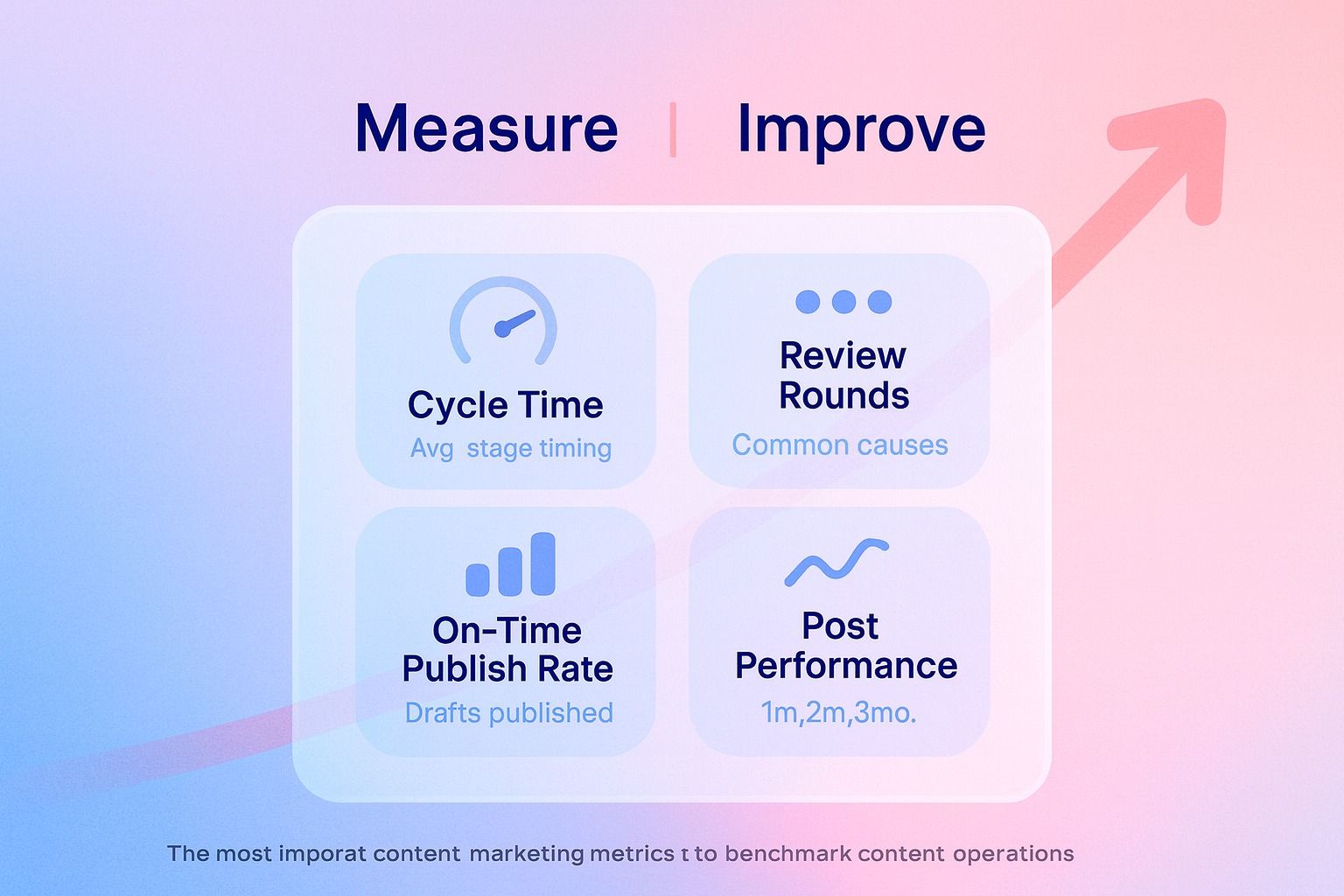
The most important content marketing metrics to benchmark content operations
If you only benchmark output volume, you will miss the real story.
Here are the most useful operational metrics to track.
1. Editorial cycle time
Total elapsed time from intake to approved, scheduled, or published content.
2. Review time
Time spent waiting for feedback after a draft is ready.
3. Approval time
Time from final draft submission to sign-off.
4. Number of review rounds
How many revision cycles a typical asset requires.
5. On-time publish rate
Percentage of planned content published on or before the target date.
6. Content cadence
How consistently the team ships content by week or month.
7. Draft-to-publish conversion rate
How many drafted assets actually make it to scheduled or published status.
8. Time in queue
Idle time between stages, especially between review and approval.
9. Quality hold rate
Percentage of assets delayed because they fail messaging, brand voice, or risk checks.
10. Performance by content type
Basic output metrics still matter after publishing, such as engagement rate, impressions, and audience response by post format.
The right benchmark mix usually includes:
- Operational metrics: speed, throughput, review efficiency
- Quality metrics: revision rate, rejected drafts, voice consistency
- Performance metrics: engagement and post-level results after publish
Where are the biggest bottlenecks in content approval workflows?
In 2026, the biggest approval bottlenecks are usually not technical. They are structural.
Common bottlenecks
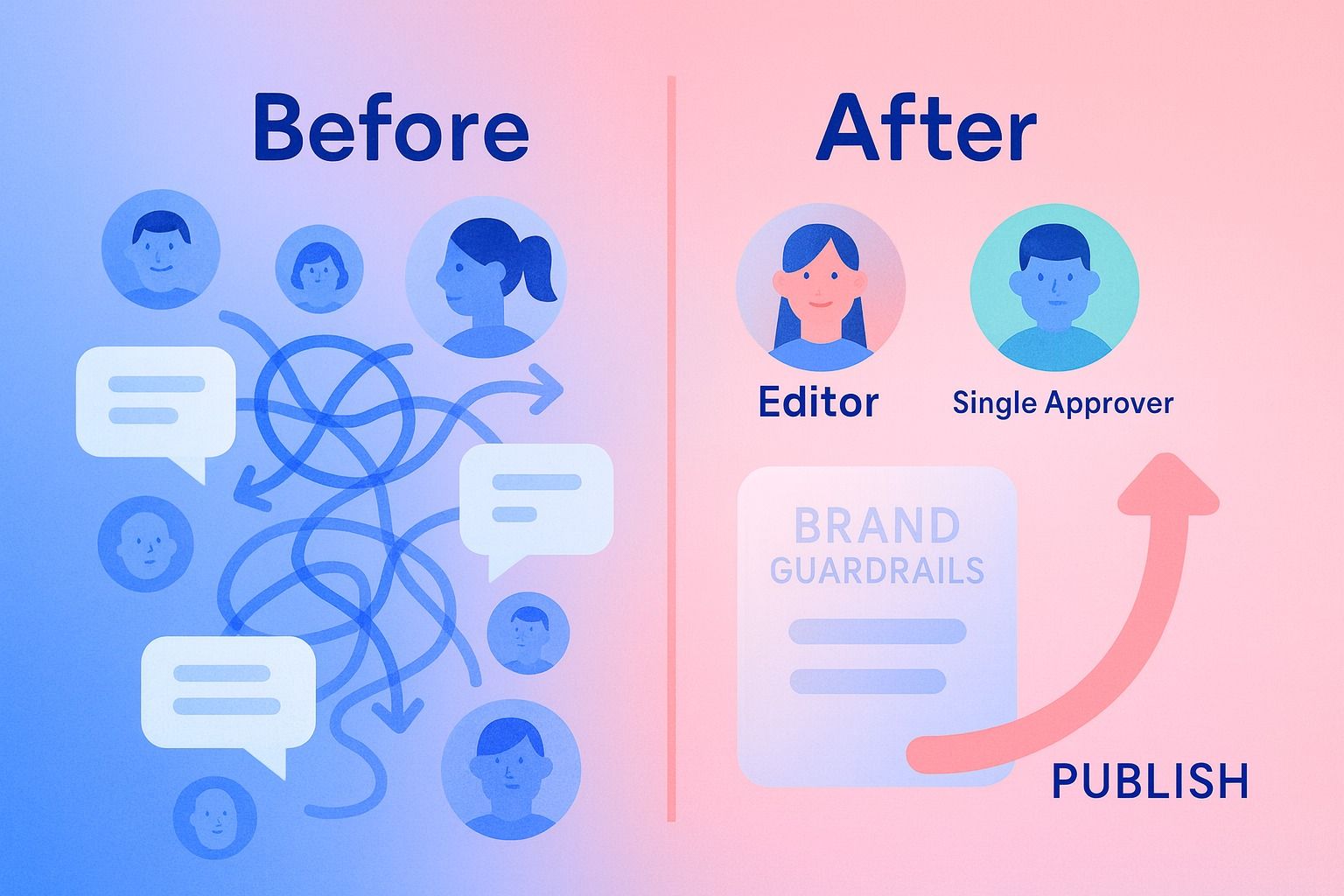
1. Too many reviewers
More reviewers often means slower decisions, conflicting edits, and diluted messaging.
Fix: Define one editor, one approver, and optional specialist review only when needed.
2. No approval owner
When everyone can approve, nobody feels responsible for approving quickly.
Fix: Assign a single final approver for each content stream.
3. Weak brand context
If writers and reviewers do not share the same voice, audience, and topic guardrails, every draft becomes a debate.
Fix: Document voice, audience, and boundaries before drafting starts.
4. Feedback scattered across tools
Comments in email, chat, docs, and meetings create delays and version confusion.
Fix: Keep creation, review, and publishing steps as connected as possible.
5. Last-minute stakeholder rewrites
Late executive edits often restart the process.
Fix: Align on intent, audience, and angle early, not after the final draft.
6. Compliance review too late in the workflow
If risk checks happen only at the end, teams waste time polishing content that may need major changes.
Fix: Apply topic guardrails during planning and drafting.
A simple benchmark model for content ops teams
If you need a starting scorecard, use this checklist.
Content ops benchmark checklist
- Do we know our median editorial cycle time?
- Do we track cycle time by content type?
- Do we know how long review takes versus approval?
- Do we know how many review rounds a post usually needs?
- Do we have a named final approver?
- Do we publish on schedule at least 80% of the time?
- Do we have documented voice, audience, and topic boundaries?
- Do we know which stage causes the most waiting?
- Do we review post-performance after publishing?
If you answered "no" to 3 or more, your benchmark system is probably too weak to improve workflow consistently.
How can teams reduce editorial cycle time without losing quality or compliance?
The goal is not to remove review. The goal is to remove unnecessary delay.
Here is a practical step-by-step process.
Step-by-step process to reduce editorial cycle time
Step 1: Define one workflow for one content type
Start with your most frequent asset, often LinkedIn posts.
Map the current stages:
- Idea or source input
- Draft creation
- Review
- Approval
- Schedule or publish
Do not optimize everything at once.
Step 2: Set time targets for each stage
Example targets for a standard LinkedIn post:
- Draft within 24 hours
- Review within 24 hours
- Approval within 24 hours
- Schedule same day after approval
This creates service-level expectations without pretending every post is identical.
Step 3: Reduce reviewer count
If three people are editing tone, you do not have review. You have redundancy.
Use this decision rule:
- Editor: improves clarity and structure
- Approver: checks strategic fit and signs off
- Specialist reviewer: only for claims, legal, or technical accuracy when needed
Step 4: Standardize brand context before drafting
When teams agree on voice, audience, and boundaries up front, drafts move faster.
This is where a structured system helps. In Dynal, Brand DNA provides brand context through voice, audience, boundaries, and reusable source knowledge so content creation starts with clearer guardrails.
Step 5: Keep draft-to-publish connected
Disconnected workflows create delay.
For LinkedIn teams, it helps to move from creation into scheduling in the same operational path. Dynal's Projects & Publishing surface supports a project-based content thread and lets users move selected content into publish or schedule actions from the same flow.
That does not replace human review, but it can reduce handoff friction between drafting and distribution.
Step 6: Measure revision causes, not just revision counts
Not all revisions are equal.
Track why drafts are being changed:
- Wrong audience
- Weak hook
- Off-brand voice
- Compliance concern
- Executive preference
- Missing source support
This tells you what to fix upstream.
Step 7: Review post-performance separately from approval speed
Fast publishing is not enough if weak posts go live.
After publishing, review lightweight performance metrics such as engagement and audience response. That helps you improve quality without slowing every approval path.
Example benchmark templates for 2026
Here are simple templates teams can adapt.
Template 1: Lean LinkedIn content team
- Cadence: 3 to 5 posts per week
- Median editorial cycle time: 1 to 3 business days
- Review rounds: 1 to 2
- Final approval: same day or next business day
- On-time publish rate: 85%+
Template 2: Executive thought leadership workflow
- Cadence: 2 to 3 posts per week
- Median editorial cycle time: 2 to 5 business days
- Review rounds: 2 to 3
- Final approval: within 48 hours
- Common bottleneck: executive availability
Template 3: Compliance-sensitive B2B team
- Cadence: 2 to 4 posts per week
- Median editorial cycle time: 4 to 10 business days
- Review rounds: 2 to 4
- Final approval: 2 to 5 business days
- Common bottleneck: legal or technical review queue
The right benchmark depends on risk, complexity, and stakeholder count. A good benchmark is one your team can hit consistently while maintaining quality.
Common mistakes that make benchmarks useless
Mistake 1: Benchmarking volume only
A team can publish more and still have poor operations.
Fix: Pair cadence with cycle time and approval time.
Mistake 2: Averaging everything together
A blog post, customer story, and LinkedIn post do not belong in one timing bucket.
Fix: Benchmark by content type.
Mistake 3: Ignoring waiting time
Idle time is often the largest hidden cost.
Fix: Measure time in queue between stages.
Mistake 4: Treating all review as value-add
Some review improves quality. Some just repeats the same comments.
Fix: Audit reviewer roles and remove overlap.
Mistake 5: Trying to automate judgment
Teams get into trouble when they attempt to skip editorial judgment for speed.
Fix: Use structured workflows and human approval, especially for LinkedIn thought leadership and compliance-sensitive content.
How to choose the right benchmark for your team
Use these decision criteria.
Choose tighter benchmarks if:
- You publish high-frequency LinkedIn content
- Your topics are low risk
- One editor and one approver can handle most assets
- You already have defined voice and audience guidance
Choose slower, more flexible benchmarks if:
- Posts require executive input
- Claims need technical validation
- Compliance review is mandatory
- Source material arrives late or incomplete
The benchmark should reflect reality, but it should also challenge avoidable delay.
The 2026 benchmark takeaway
A strong content ops benchmark for 2026 is not just a publishing target. It is a workflow target.
The most useful teams will benchmark:
- editorial cycle time
- review time
- approval time
- review rounds
- on-time publish rate
- post-performance after publish
And the biggest gains will usually come from:
- fewer handoffs
- clearer approval ownership
- better brand context
- a connected workflow from draft to publish or schedule
For LinkedIn teams, that means building a process where content is easier to create, easier to review, and easier to schedule without losing editorial control.
Get your LinkedIn workflow into a usable state faster
If your team is refining how LinkedIn content moves from draft to approval to scheduled publish, start with a setup that creates clearer structure from the beginning.
Dynal is an AI LinkedIn agent with a chat-centered creation workspace, Brand DNA for structured brand context, and Projects & Publishing to connect drafts to publish or schedule actions.
To get started, use Onboarding & Setup and the LinkedIn-first connection path to guide your initial brand context before you begin planning and publishing.