

From Idea to Draft in 30 Minutes: A Repeatable Workflow That Stays Factual and On-Brand
Yes, you can go from a rough idea to a solid first draft in 30 minutes without turning your writing into generic fluff.
The key is not to "write faster" in the abstract. It is to use a repeatable content workflow: define the angle, collect only the facts you need, build a tight outline, then draft section by section with clear writing prompts.
If you use AI, speed comes from structure, not from asking it to "write the whole post" in one shot.
For LinkedIn-focused teams and professionals, Dynal’s AI LinkedIn agent can help keep your source material, drafting flow, and brand context in one place so you can move faster without losing control.
If you want that kind of workflow in one place, Dynal is an AI LinkedIn agent built for this use case: https://dynal.ai/. It helps keep sources, brand context, and drafting flow connected as you move from idea to draft.
In this guide, I will show you a practical 30-minute workflow, the prompts to use, and how to keep the draft factual and on-brand.
- Start with one sharp idea, not five half-formed ones.
- Turn research into claims, evidence, and audience takeaways before outlining.
- Draft in blocks, not as one giant generation.
- Review for facts, voice, and clarity before you call it done.
Why most drafts take too long
Most slow drafting happens because the writer is trying to do four jobs at once:
- Decide the angle.
- Search for supporting facts.
- Figure out the structure.
- Write polished sentences.
That creates hesitation and rework.
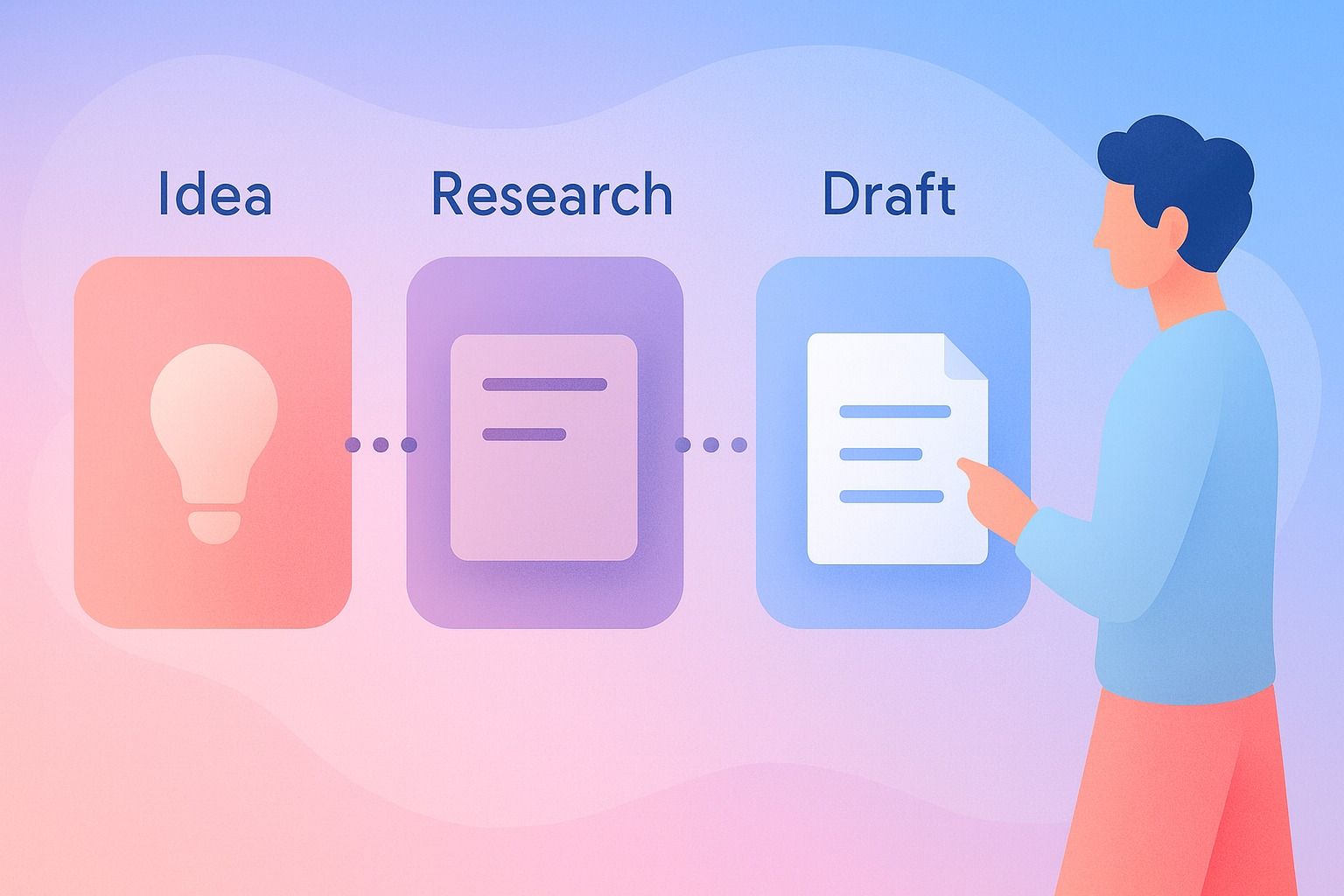
A faster writing process separates those jobs into short stages. Each stage has a clear output:
- Idea stage: one audience-specific angle
- Research stage: a few usable facts or examples
- Outlining stage: section-by-section argument flow
- Draft stage: a workable first version
- Review stage: factual, clear, and aligned with your brand context
That is the core of an effective content workflow.
That’s also where Dynal’s Workspace & Chat can be useful in practice. It gives you a chat-centered creation surface where you can start from a prompt, add multiple source materials, and shape the drafting flow in one place instead of scattering it across tabs.
The 30-minute content workflow
Here is the full workflow first. Then I will break it down with prompts.
Minute 0-5: Lock the angle
Your goal is not to pick a broad topic. Your goal is to pick a specific promise.

Use this formula:
Topic + audience + problem + outcome
Example:
- Weak idea: "How to write faster"
- Better idea: "How B2B marketers can turn rough research into a first draft in 30 minutes"
Ask:
- Who is this for?
- What problem are they trying to solve right now?
- What will they be able to do after reading?
Minute 5-10: Gather only the source material you need
Do not over-research.
For a fast first draft, you usually need just 3-5 inputs:
- one primary point of view
- two or three supporting facts, examples, or observations
- one practical framework, checklist, or process
This is also where AI can either help or hurt.
If you give it vague context, you will get vague writing back. If you give it focused inputs, the draft becomes much stronger.
In Dynal’s Workspace & Chat, you can start from a prompt, add multiple source materials, and shape the drafting flow inside a chat-centered creation surface. That matters because your sources, prompts, and edits stay connected instead of getting scattered across tabs.
Minute 10-15: Turn research into an outline

Before drafting, reduce your source material into three buckets:
- Claims: what you want to say
- Evidence: what supports it
- Action: what the reader should do next
Now create a simple outline:
- Opening answer
- Why this matters
- Step-by-step process
- Examples or templates
- Mistakes to avoid
- Final takeaway and CTA
Minute 15-25: Draft section by section
Do not generate the whole article at once.
Draft in blocks:
- intro
- key framework
- steps
- examples
- mistakes
- conclusion
This gives you better factual control, cleaner transitions, and easier editing.
Minute 25-30: Review for quality
A first draft is only fast if it does not create an hour of cleanup later.
If you want to keep that cleanup small, Dynal’s AI LinkedIn agent can help you stay anchored to your sources and brand context as you draft: https://dynal.ai/. That makes the review step less about rewriting and more about tightening.
Check for:
- factual accuracy
- repeated ideas
- generic phrasing
- off-brand wording
- weak transitions
- missing examples
If you use AI, the review step is where quality is protected.
Step-by-step: how to go from idea to first draft in 30 minutes without losing quality
This section directly answers the most important question: How do I go from idea to first draft in 30 minutes without losing quality?
The answer is to compress decisions, not standards.
Step 1: Define the draft outcome
Write one sentence:
"By the end of this piece, the reader should understand ___ and be able to ___ ."
Example:
"By the end of this piece, the reader should understand a repeatable 30-minute writing process and be able to use prompts to go from idea to outline to first draft faster."
This sentence keeps the draft focused.
Step 2: Build a minimum viable research set
You do not need a full research memo for every blog post.
Use this simple rule:
- 1 core viewpoint
- 2-3 proof points
- 1 example
- 1 counterpoint or caution
That is enough for a useful first draft.
Step 3: Create a working outline, not a perfect outline
A fast outline should answer:
- What is the main point?
- In what order should the reader understand it?
- Where will proof and examples appear?
- What action should the reader take?
A workable outline beats a clever outline.
Step 4: Draft with prompts that tell the model its job
Bad prompt:
"Write me a blog post about content workflow."
Better prompt:
"Create a practical outline for a blog post aimed at B2B marketers on how to go from idea to first draft in 30 minutes. Keep the structure instructional, include a step-by-step workflow, one checklist, common mistakes, and short examples. Prioritize clarity over hype."
The more specific the job, the better the output.
Step 5: Review against brand and facts
Fast content fails when the final pass is skipped.
Use a simple review lens:
- Is every claim supported?
- Is the language consistent with our voice?
- Is the advice specific enough to be useful?
- Did AI invent anything?
- Would I publish this under my name as-is?
If the answer to the last question is no, it is not done.
The fastest content workflow for turning research into an outline and draft
If your bottleneck is moving from notes to structure, use this compression method.
The research-to-outline method
Take your notes and sort them into this template:
What the reader needs to know
- core insight 1
- core insight 2
- core insight 3
What proves it
- source, stat, example, anecdote, or observation
What the reader should do
- step
- checklist
- decision rule
From there, turn the material into headings.
Example:
Raw note:
- Writers waste time switching between research, outlining, and drafting.
- AI outputs get generic when prompts are vague.
- Section-by-section drafting improves control.
Outline:
- Why drafting takes longer than it should
- The 30-minute workflow
- Prompts for outlining and drafting
- How to keep AI output factual and on-brand
- Common mistakes to avoid
This is usually the fastest route from research to draft because it removes the need to "discover the structure while writing."
Writing prompts that speed up outlining and drafting
This section answers: What writing prompts help speed up outlining and drafting for blog posts?
The best writing prompts are role-based, task-specific, and constrained.
Prompt 1: Turn an idea into angles
"I have a topic: [topic]. Give me 5 specific article angles for [audience]. For each angle, include the reader problem, desired outcome, and a strong working headline. Keep the ideas practical and non-generic."
Prompt 2: Turn research into a structure
"Using these notes, organize the material into three buckets: claims, evidence, and actions. Then create a blog outline with an answer-first introduction, 4-6 H2 sections, and a conclusion. Flag any claims that need verification before drafting."
Prompt 3: Build a tight outline
"Create a detailed outline for a post targeting [audience] around the keyword [keyword]. Include the main argument for each section, what evidence should appear there, and what practical takeaway the reader should leave with."
Prompt 4: Draft one section at a time
"Write the section called [heading] in a clear, practical style. Use short paragraphs, avoid filler, and stay consistent with this brand voice: [voice guidance]. Only use information from the notes provided. If something is uncertain, mark it instead of inventing details."
Prompt 5: Improve clarity without changing meaning
"Revise this section for clarity and flow. Keep all facts unchanged. Remove repetition, tighten weak sentences, and preserve the original point of view and tone."
Prompt 6: Check for factual risk
"Review this draft and list any statements that sound unsupported, overly broad, or potentially invented. Separate them into: verify, soften, or remove."
A reusable prompt workflow you can use every time
If you want one repeatable system, use this sequence.
Stage 1: Angle prompt
Goal: choose the right version of the topic.
"Help me narrow this topic for [audience]. I want one clear problem, one practical promise, and one strong angle that can be explained in under 1,500 words."
Stage 2: Source compression prompt
Goal: turn messy notes into usable inputs.
"Summarize these notes into key insights, supporting evidence, open questions, and missing proof. Keep it concise and actionable."
Stage 3: Outlining prompt
Goal: create a draftable structure.
"Build an outline from these inputs. Use an answer-first introduction, a step-by-step process, a checklist, examples, and common mistakes."
Stage 4: Section drafting prompt
Goal: write without losing control.
"Draft only the next section. Stay faithful to the outline and source material. Keep the tone [tone]. Do not add unsupported claims."
Stage 5: Editorial review prompt
Goal: clean up the draft.
"Edit this draft for clarity, flow, and consistency. Keep it factual, practical, and aligned with the brand voice. Flag any sentence that needs human verification."
This is the repeatable prompt workflow most teams need. It is simple enough to use every week and structured enough to improve speed consistently.
How to keep a draft factual and on-brand while using AI to write faster
This is where many fast workflows fall apart.
AI can accelerate drafting, but it should not replace judgment. The safest process is to give the model brand context, source constraints, and a clearly defined task.
Use brand context before drafting
If your voice changes from draft to draft, the issue is usually not the model. It is missing guidance.
A good setup includes:
- target audience
- voice guidance
- topics to avoid
- examples of acceptable framing
- source material for the current piece
In Dynal, this is where Brand DNA supports consistency. It is a structured brand context system with voice, audience, boundaries, and reusable source knowledge that helps shape output. That does not replace your editorial judgment, but it does help reduce drift.
Keep source material attached to the draft
To stay factual:
- work from your notes, links, and approved source material
- ask the model to flag uncertainty instead of filling gaps
- review broad claims manually
- soften statements that go beyond what the evidence supports
In practice, this works best when your prompt, sources, and draft live in the same creation flow. A chat-based workspace is useful here because it keeps the context visible while you draft and revise.
Use a factual review checklist
Before publishing, ask:
- Did I verify all numbers, dates, and named references?
- Did the draft overstate benefits or certainty?
- Did I accidentally turn an opinion into a fact claim?
- Does the language match our voice and audience?
- Are there any sections that sound polished but say very little?
That final question catches a lot of AI fluff.
Checklist: your repeatable faster-writing system
Use this every time you need to move quickly.
Pre-draft checklist
- I can explain the article in one sentence.
- I know who the reader is.
- I have 3-5 relevant inputs.
- I know the one practical takeaway.
- I know what proof I can actually support.
Outline checklist
- The introduction answers the core question early.
- Each section has one job.
- Examples appear where the reader needs them.
- The order feels logical, not just complete.
- The conclusion tells the reader what to do next.
Draft checklist
- I drafted section by section.
- I avoided unsupported claims.
- I cut repetition.
- I kept paragraphs short and readable.
- I reviewed the piece for voice and factual accuracy.
Common mistakes that slow down drafting, and how to fix them
Mistake 1: Starting with a broad topic
Problem: You spend half the session deciding what the piece is really about.
Fix: Narrow the topic to one audience, one problem, and one promise.
Mistake 2: Researching without a stopping rule
Problem: You collect far more information than the draft needs.
Fix: Stop when you have enough to support the central argument and one useful example.
Mistake 3: Asking AI for a full article too early
Problem: You get generic structure, weak logic, and more editing work.
Fix: Use AI first for angles, note compression, and outlining. Draft one section at a time.
Mistake 4: Forgetting brand context
Problem: The piece sounds technically fine but not like you.
Fix: Include voice, audience, and topic guardrails in the prompt or in your drafting environment.
Mistake 5: Skipping the verification pass
Problem: Fast output creates slow cleanup later.
Fix: Review claims, examples, and tone before you move forward.
Decision criteria: when this workflow is the right fit
This workflow works best when:
- you already have a rough idea or research starting point
- you need a strong first draft, not a final polished piece in one step
- you want consistency across repeated content production
- you care about factual control and brand alignment
It is less effective when:
- the topic requires deep original reporting
- the source material is incomplete or unreliable
- multiple stakeholders need to shape the message before drafting
In those cases, the workflow still helps, but the 30-minute target may need to become 45 or 60 minutes.
A simple example: from idea to outline to draft
Let us say your idea is: "AI helps marketers write faster."
That is too broad.
Better angle
"How small marketing teams can use a repeatable content workflow to turn research into a first draft in 30 minutes."
Source inputs
- internal notes on drafting bottlenecks
- two examples of vague prompts vs specific prompts
- one checklist used by the content team
Outline
- Why drafting is slow
- The 30-minute workflow
- Prompts for each stage
- How to stay factual and on-brand
- Mistakes to avoid
Drafting approach
- write intro from the promise
- write workflow steps
- add prompt templates
- add checklist
- run factual and voice review
That is the system in practice.
Final takeaway
The fastest way to write better is not to push AI harder. It is to give your process more structure.
A good content workflow reduces switching costs, improves outlining, and makes faster writing possible without lowering the bar on quality.
If you want a repeatable way to do that for LinkedIn-led content, use an AI LinkedIn agent that keeps your brand context, source material, and drafting flow connected. Dynal’s Workspace & Chat is built for that chat-based creation flow, helping you move from prompt and sources toward a usable draft in one place.
And if you want stronger consistency, start with Onboarding & Setup so you can use the LinkedIn-first connection path to set up your brand context faster before you begin drafting.
FAQ
How do I go from idea to first draft in 30 minutes without losing quality?
Use a staged process: narrow the angle, gather minimal source material, build a simple outline, draft section by section, and finish with a factual and voice review.
What is the fastest content workflow for turning research into an outline and draft?
The fastest workflow is to sort research into claims, evidence, and actions, then turn those into a practical outline before drafting. This prevents structure problems later.
What writing prompts help speed up outlining and drafting for blog posts?
The most useful prompts are those that ask for angles, source compression, structured outlines, section-only drafts, and factual review. They work better than one broad "write the article" prompt.
How do I keep a draft factual and on-brand while using AI to write faster?
Give the model clear brand context, use approved source material, ask it to flag uncertainty, and run a final verification pass. Do not let it fill factual gaps with confident wording.
What repeatable prompt workflow can I use to write content faster every time?
Use the same five stages each time: angle, source compression, outlining, section drafting, and editorial review. That repeatable process is what creates speed.