

How to Build a Content Engine With 2 People Without Burning Out
Yes, a 2-person team can build a real content engine.
The catch: you do not build it by trying to publish everywhere, reinvent every asset, or run a complicated content ops stack. You build it by narrowing scope, standardizing repeatable steps, batching work, and using a system that connects planning, drafting, and publishing.
For most small team marketing setups, the goal is not "more content." It is a repeatable workflow that helps two people publish consistently without becoming full-time project managers.
If your focus is LinkedIn, that means creating a lightweight engine that turns a few strong ideas into publish-ready assets, then moves them through review and scheduling with minimal friction.
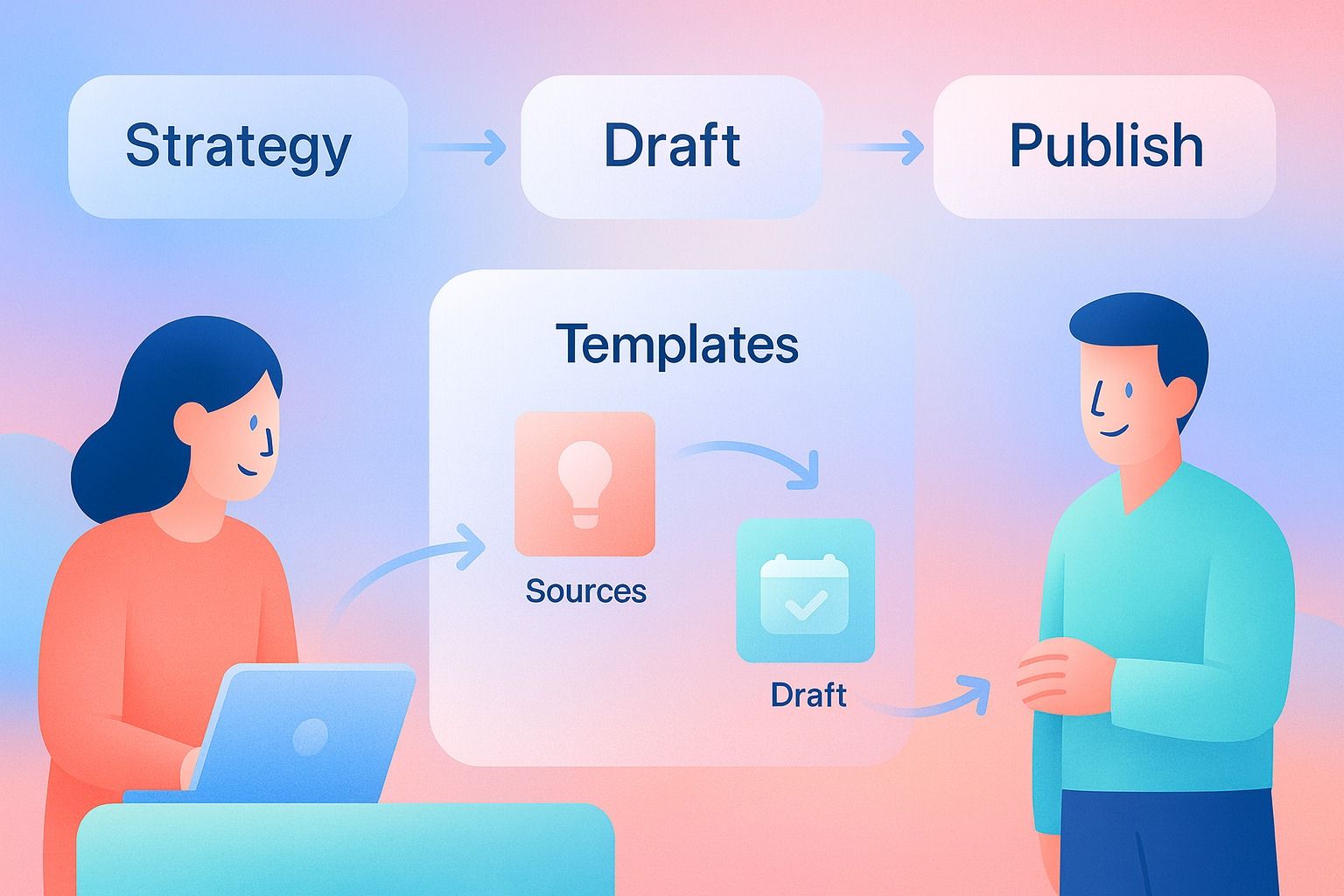
If your team wants a LinkedIn-first workflow, Dynal can help as an AI LinkedIn agent that keeps planning, creation, and publishing tied together. See how it fits at Dynal.
In short:
- Start with one channel and one audience.
- Build around reusable formats, not endless new ideas.
- Use clear content ops rules so work does not sprawl.
- Batch creation and distribution separately.
- Keep review simple and publishing structured.
What a content engine actually means for a 2-person team
A content engine is not a giant editorial machine.
For a small team, it simply means you have a reliable way to go from idea to published post without chaos. The system should make it easier to repeat quality work, not create more admin.
A healthy 2-person content engine usually has five parts:
- Strategy constraints: who you are speaking to, which topics matter, and what is out of scope.
- Input collection: ideas, customer questions, notes, calls, documents, and links.
- Creation workflow: drafting, editing, format selection, and packaging.
- Publishing rhythm: scheduling, review, and posting windows.
- Feedback loop: lightweight analytics to see what deserves to be reused.
That is the answer to the first research question: you build a content engine with a small team without burning out by reducing decisions, reducing handoffs, and reducing original work per post.
That same idea is what an AI LinkedIn agent is meant to support: fewer handoffs, more repeatable steps, and a clearer path from source material to scheduled post. If you want to explore that kind of setup, visit Dynal.
The best content ops process for a 2-person marketing team
The best content ops process is usually the simplest one your team will actually follow every week.
For two people, a strong model looks like this:
Person 1: strategist-editor
- Owns topic priorities
- Defines audience, voice, and boundaries
- Reviews drafts
- Decides what gets published now vs. later
Person 2: producer-operator
- Turns source material into draft inputs
- Generates first-pass content
- Packages assets
- Schedules and tracks publishing
If both people are doing everything, burnout happens fast. Role clarity matters more than seniority.
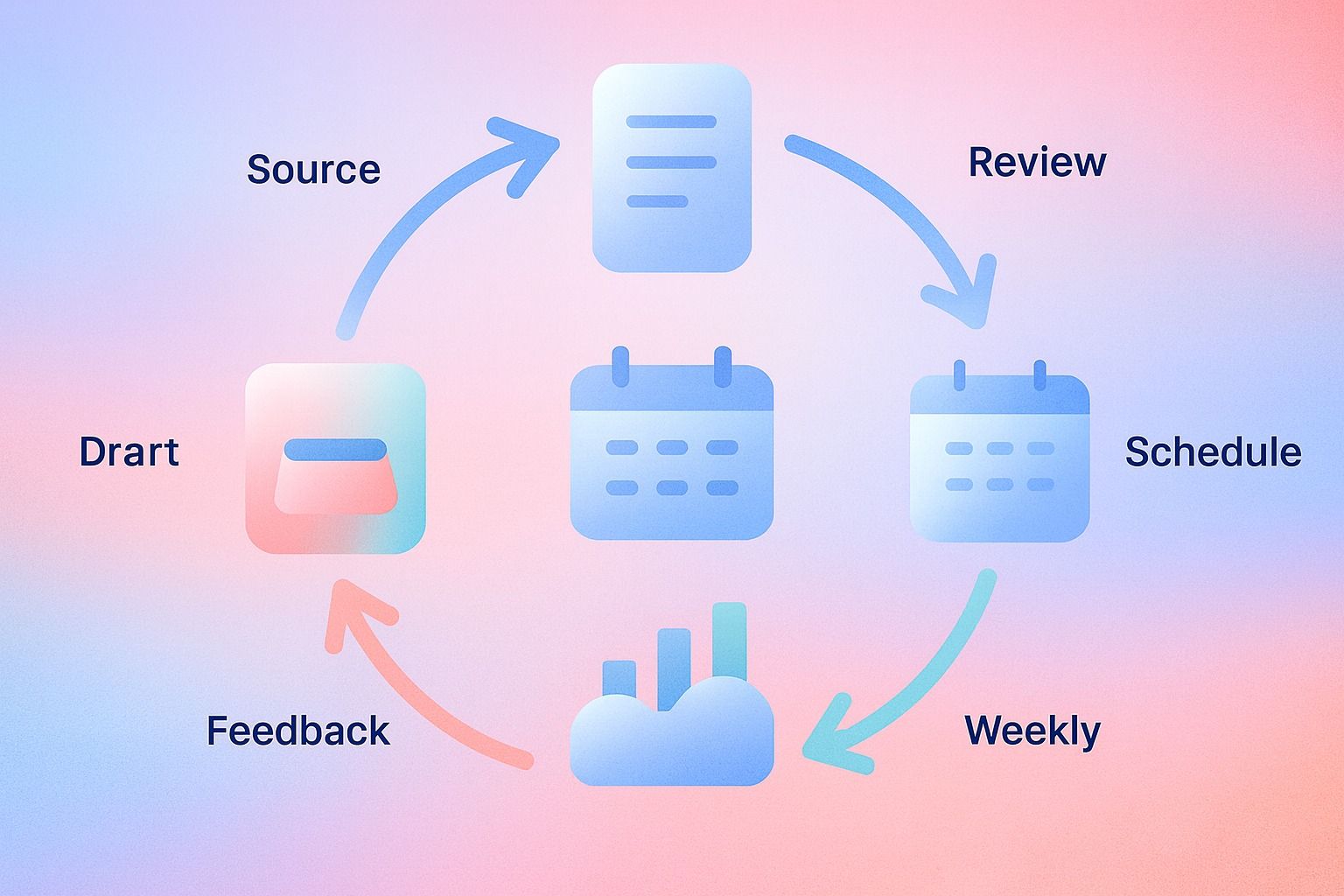
A practical weekly content ops flow
Monday: plan and prioritize
- Review business priorities
- Choose 3 to 5 post angles for the week or next two weeks
- Kill anything that does not fit current goals
- Assign one primary format per idea
Tuesday: batch source collection
- Pull notes from calls, docs, Slack threads, founder voice notes, or customer FAQs
- Save examples, stories, and links in one place
- Group similar ideas together
Wednesday: batch drafting
- Draft multiple posts in one sitting
- Reuse the same format for similar topics
- Keep first drafts rough but structurally complete
Thursday: review and refine
- Tighten hooks
- Remove repetition
- Check audience fit and topic guardrails
- Prepare final versions for publishing or scheduling
Friday: publish, schedule, and review signals
- Publish the highest-priority post
- Schedule the next posts
- Review basic performance patterns
- Note what can be repurposed next week
This is the best answer to the second research question: the best content ops process for a 2-person team is a simple weekly cycle with clear ownership, batched creation, and a short review path.
Step-by-step: how to build a content engine with 2 people
Here is a practical setup you can implement without hiring more people.
Step 1: cut your scope aggressively
Most small teams do not have a production problem. They have a scope problem.
Before you create anything, define:
- One primary channel
- One primary audience
- Three to five core topics
- Two to three repeatable post formats
- One publishing cadence you can sustain for 8 to 12 weeks
A realistic example:
- Channel: LinkedIn
- Audience: mid-market founders
- Topics: positioning, hiring, category education, lessons from execution
- Formats: founder story, contrarian lesson, simple framework
- Cadence: 3 posts per week
That is enough.
If you are trying to do LinkedIn, X, newsletter, blog, short video, and webinars with two people, you do not need a better content engine. You need a smaller one.
Step 2: build your source system before your publishing system
Small teams burn out when every post starts from a blank page.
Instead, create a small source pipeline:
- customer questions
- sales call notes
- founder comments in meetings
- team Slack messages
- internal docs
- product updates
- useful external articles and reports
The goal is simple: each week, your team should pull from existing material instead of inventing ideas from scratch.
A content engine is really an input engine first.
Step 3: standardize 3 to 4 post templates
This is where productivity jumps.
You do not need 25 formats. You need a few templates that match your audience and can be reused.
Template 1: The insight post
Hook: One surprising truth about your market
Body:
- why most people get it wrong
- what your team has observed
- one practical takeaway
CTA: ask for perspective or invite discussion
Template 2: The mini-framework post
Hook: A problem your audience keeps running into
Body:
- name the framework
- give 3 steps or 3 checks
- explain when to use it
CTA: offer a simple next action
Template 3: The story-to-lesson post
Hook: A brief story, mistake, or turning point
Body:
- what happened
- what changed
- what others can learn from it
CTA: ask if others have seen the same pattern
Template 4: The myth vs. reality post
Hook: A common belief
Body:
- myth
- reality
- evidence or experience
- what to do instead
CTA: invite agreement or pushback
This answers the third research question directly: small teams publish consistently by batching around templates and reusing structures, not by writing every post from scratch.
Step 4: separate creation from distribution
Many teams blend drafting, editing, design, review, and scheduling into one messy session.
That slows everything down.
Instead, split your workflow into two blocks:
Creation block
- gather source material
- draft content
- refine messaging
- finalize copy
Distribution block
- choose publish dates
- schedule posts
- confirm assets
- review what actually went live
This is exactly why a connected workflow matters.
With Dynal, the useful angle is not just drafting. Dynal is an AI LinkedIn agent built around a LinkedIn workflow: brand context, creation, planning, and publishing. If your team is already operating on LinkedIn, using Projects and Publishing helps connect project-based content conversations to a draft-to-publish workflow, so your team is not copying content between disconnected tools just to get a post scheduled.
Dynal is built to help with that connected workflow as an AI LinkedIn agent, so the work stays in one place from draft to publish. Learn more at Dynal.
That is especially helpful for two-person teams because context stays tied to the work instead of living across random docs and chat threads.
Step 5: create a lightweight review system
A 2-person team does not need a complex approval chain.
But it does need a standard review checklist.
Use this before anything gets scheduled:
Review checklist
- Is this for our primary audience?
- Does it fit one of our core topics?
- Is the hook clear in the first two lines?
- Does the post sound like our actual voice?
- Is there one clear takeaway?
- Is the CTA simple?
- Should this be published now, scheduled later, or cut?
If a post fails two or more checks, revise it or drop it.
Step 6: use a calendar only after your process is stable
A calendar is helpful, but it cannot save a weak process.
Only schedule ahead when:
- your topics are defined
- your templates are working
- your review checklist is being used
- your weekly cadence is realistic
Once those pieces exist, a scheduling calendar becomes useful because it removes day-to-day decision fatigue.
A simple content ops model for strict scope control
The fourth research question asks how a small team can manage content creation and distribution with strict scope control.
The answer is to create rules that make saying "no" automatic.
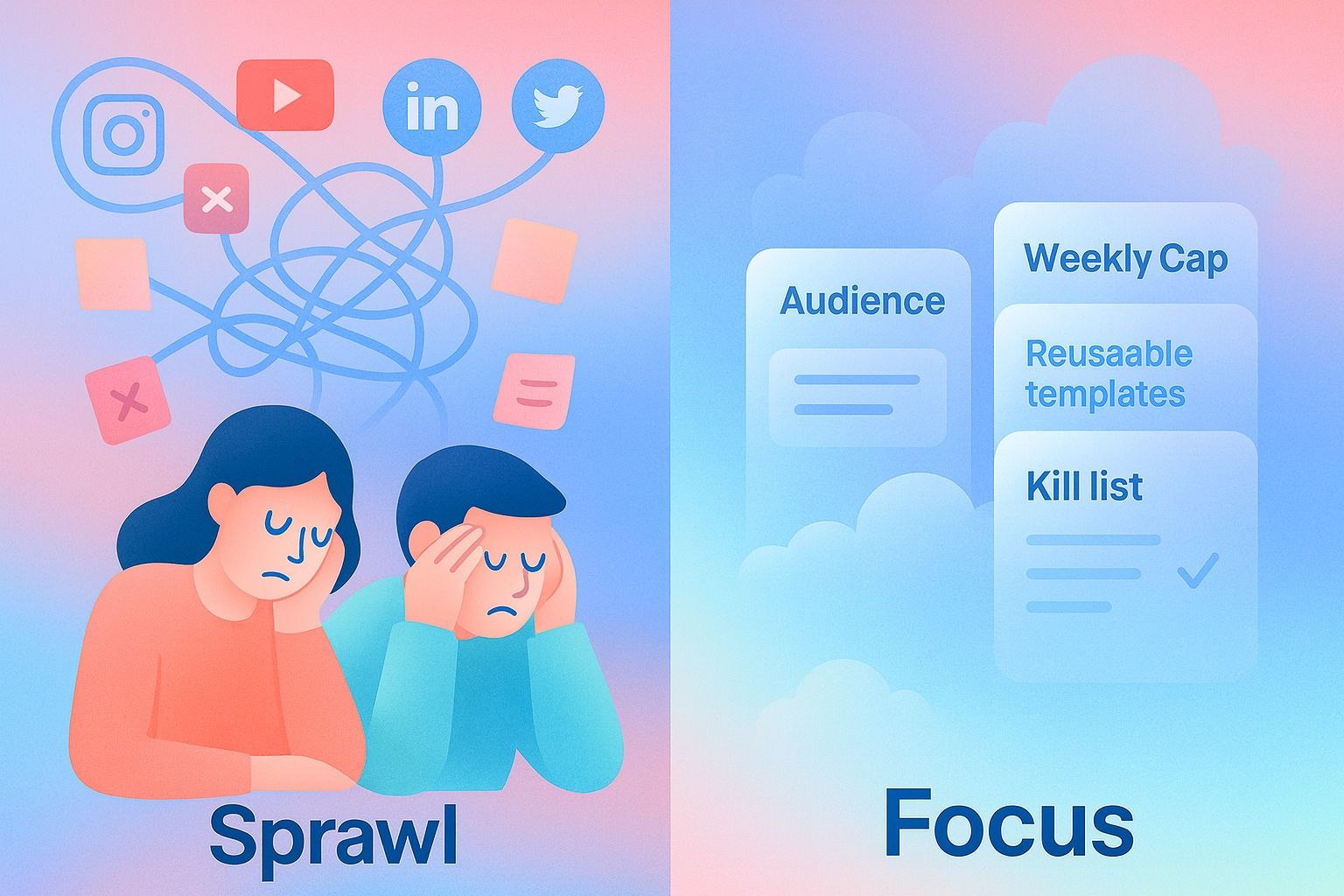
Use these scope rules:
Scope rule 1: one audience per quarter
Do not create for everyone. Pick one primary audience and optimize for relevance.
Scope rule 2: one main channel
If LinkedIn is the engine, treat other channels as optional repurposing, not mandatory production lines.
Scope rule 3: one source pool per week
Do not pull from 20 places. Choose one or two source buckets each week, such as customer calls and founder notes.
Scope rule 4: one format decision per post
A post should be a story, framework, lesson, or opinion piece. Not all four.
Scope rule 5: fixed weekly cap
Set a hard cap, such as 3 published posts and 2 scheduled posts. More is not always better.
Scope rule 6: kill list required
Every planning session should include ideas you intentionally reject.
Strict scope is not restrictive. It is what protects consistency.
Example: a 2-person content engine in practice
Here is what this can look like in real life.
Team structure
- Person A: marketing lead/editor
- Person B: content producer
Weekly inputs
- 2 sales calls
- 1 customer success recap
- founder voice memo
- 1 industry article
Weekly output goal
- 3 LinkedIn posts
- 2 scheduled drafts for next week
Workflow
Monday
- choose three angles from source material
- map each angle to a template
Tuesday
- generate rough drafts
- group by audience relevance
Wednesday
- edit for clarity and voice
- cut weak drafts
Thursday
- move approved posts into publishing
- schedule two for next week
Friday
- check post performance patterns
- save best hooks and themes for reuse
This is a sustainable content engine because it is designed around repeatability, not heroics.
Tools that help a small team marketing workflow stay productive
The fifth research question is about tools.
The best tools for small team marketing are the ones that reduce handoffs and keep the workflow simple.
Look for tools that help with:
- storing brand context
- turning source material into drafts
- keeping conversations tied to projects
- moving drafts into publish or schedule flows
- giving you lightweight analytics after publishing
If LinkedIn is your primary channel, that is where Dynal fits well as an AI LinkedIn agent rather than a generic writing tool. A useful setup is:
- Brand DNA to define voice, audience, and topic boundaries
- Workspace for chat-based creation from prompts and sources
- Projects and Publishing to move selected content from creation into publish-now or schedule-later actions
- Analytics for a lightweight view of what is working after posts go live
For a two-person team, that kind of connected flow matters more than stacking five separate apps that each solve only one narrow step.
Common mistakes that burn out small teams
If your content engine feels heavy, one of these is usually the cause.
Mistake 1: publishing cadence set by ambition, not capacity
Fix: choose a cadence you can maintain for 12 weeks.
Mistake 2: every post is treated as net-new creative work
Fix: build from source material and templates.
Mistake 3: strategy lives in one person’s head
Fix: document voice, audience, and topic boundaries clearly.
Mistake 4: review standards change every week
Fix: use the same checklist every time.
Mistake 5: too many channels too early
Fix: earn consistency on one channel first.
Mistake 6: no distinction between drafts and publish-ready content
Fix: create clear stages: create, review, publish, schedule.
Decision criteria: is your content engine actually sustainable?
Use these questions to judge your setup:
- Can two people produce next week’s content in one or two focused work sessions?
- Can a draft be created from existing source material instead of a blank page?
- Does every post fit a defined audience and topic?
- Can your team explain the workflow in under two minutes?
- Can approved content move into scheduling without extra tool switching?
- Can you keep the system running even during a busy week?
If the answer is "no" to most of these, simplify the engine before you scale it.
A practical checklist for building your 2-person content engine
Use this checklist as your starting point:
- Pick one primary channel
- Define one primary audience
- Set three to five content themes
- Create three to four reusable templates
- Build one weekly source collection routine
- Assign clear roles for strategy and production
- Use one review checklist
- Cap weekly publishing volume
- Separate creation time from scheduling time
- Track simple performance signals to guide reuse
Final takeaway
A strong content engine for a 2-person team is not built on constant hustle.
It is built on constraints, templates, source reuse, and a clear content ops rhythm. If your team can capture ideas, shape them with consistent brand context, and move them into a structured publishing flow, you can publish consistently without burning out.
If LinkedIn is your main channel, keep the system LinkedIn-first. That makes it easier to stay focused, protect quality, and avoid operational sprawl.
Get your setup right before you scale
If you want a cleaner starting point, begin with Onboarding and Setup in Dynal. The LinkedIn-first connection helps you get to a usable brand context faster, so your team can move from setup into planning, creation, and publishing with less friction.
From there, use Dynal as your AI LinkedIn agent to organize brand context, create in a chat-based workspace, and move approved drafts through Projects and Publishing.
Consistency gets easier when the workflow is designed to be repeated.