

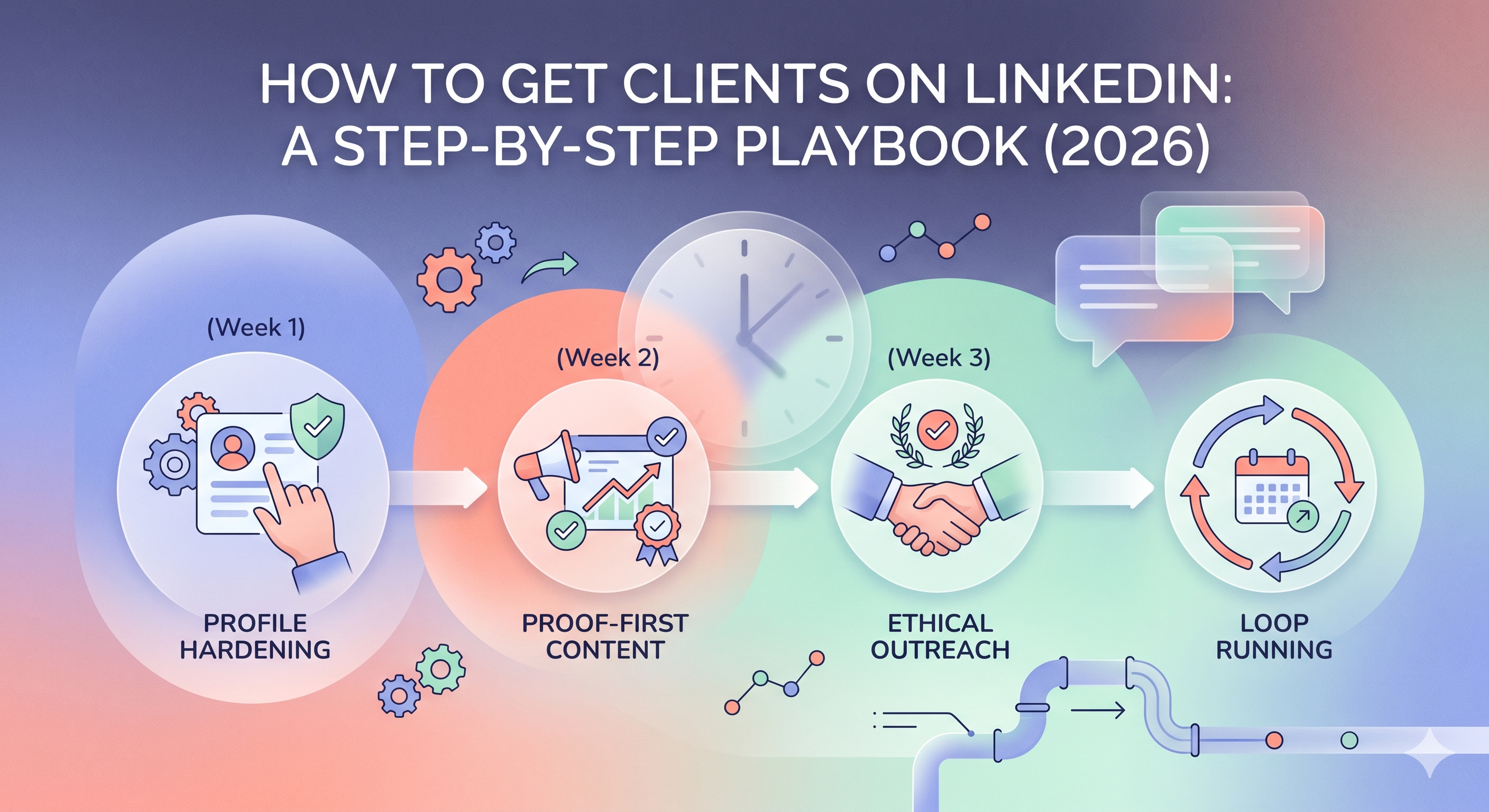
How to Get Clients on LinkedIn: A Step-by-Step Playbook (2026)
“Get clients” is never one tip. It is a sequence you rehearse until boring—help the right people find you, believe enough to talk, then book controlled next steps you own. Companion posts cover credibility systems, formats, hooks, notes-to-post workflows, ethical DMs, and solo calendars—URLs appear as each step below demands them.
Operational cadence also intersects with LinkedIn’s documented surfaces—see Get started with posting on LinkedIn—but buttons do not schedule courage. This playbook supplies that.
Psychological friction appears when operators compare themselves to creators posting multiple times daily despite different resource stacks—benchmark against your own prior month, not influencer highlight reels whose business models include attention itself as product.
Documenting why you pivot an experiment—audience mismatch vs creative fatigue—preserves organizational memory when leadership rotates or agencies churn.
---
1. Step zero — Name the client you want before you tweak fonts
Positioning vocabulary still starts in how to get clients on LinkedIn; this playbook adds weekly choreography. Carry formats alongside types of LinkedIn posts; refine openings with hooks without clickbait; translate artefacts through posts from notes and PDFs; escalate private conversations using B2B DMs without spam; mirror monthly scaffolding with our solo content calendar template.
Answer in one ruthless sentence: who signs, for what outcome, under what constraints? “B2B founders” invites mush; “Series A–B SaaS founders hiring their first full-stack marketer in North America who must prove pipeline in two quarters” lets you search bios, recognize pain in threads, and refuse opportunities that waste both sides. If two ICPs genuinely warrant separate offers, consider separate profiles or landing links—blur confuses both funnels.
Your headline and About mirror that sentence—not because keyword stuffing fools people, but because disciplined language trains you to smell off-topic vanity projects early.
The feed blends first-degree relationships, follows, interests, and broader recommendations—explained in LinkedIn’s Feed ranking overview—so clarity helps the right humans self-select faster than ambiguous polish ever could. Public profiles and durable assets often answer name queries better than ephemeral feed arguments—keep site copy aligned.
---
2. Step one — Profile as a decision surface, not résumé archaeology
Visitors decide in seconds. Force the headline to pair outcome language with who it is for beyond your title alone. Hang a banner and featured asset that offer one obvious proof path—customer story, talk, newsletter, or booking link—so nobody hunts through tabs. Craft About so the first screen answers “Why you?” and “What changes if we work together?” without demanding a novel. Tighten experience bullets around problems solved, not every task stacked since college.
If you serve multiple segments, consider rotating emphasis monthly rather than speaking to everyone simultaneously—which often reads as speaking to no one. Featured links can change when campaign focus shifts without rewriting your entire history.
Consistency across LinkedIn and your canonical website signals one coherent entity—particularly important when skeptical buyers compare claims. Google’s reminder to write helpful, people-first content echoes the same intolerance for throat-clearing.
When biography work feels narcissistic, reframe it as buyer risk reduction. You are not polishing vanity; you are lowering the probability that a serious prospect defects because your profile sounded like five different consultants stitched together. Sales colleagues should recognize the same nouns and outcomes they hear on live calls—discord between external marketing language and internal qualification vocabulary quietly poisons trust.
---
3. Step two — Publish for evaluation, not applause
Buyers scroll in evaluation mode: scanning for competence, specificity, and emotional steadiness. Lead with tension before throat-clearing—only the first lines appear before See more on many devices—and carry proof after the fold. Rotate point-of-view writing that names tradeoffs responsibly, how-to fragments scoped to plausible contexts your reader inhabits Monday morning, and case-style arcs honest about anonymization boundaries. If you stare at a blank composer, dump raw bullet notes into a scratch document first—translation from meeting brain to reader brain is the hidden labor; our notes-to-posts guide formalizes that migration without pretending one prompt solves judgment.
You can summarize intent mixtures in planning documents; one compact planning grid keeps editorial meetings sane without devolving entirely into spreadsheets: point-of-view arguments stress stakes, procedural posts stress motion, narratives stress accountability. Match carrier format to evidence after intent is clear—per the types article—instead of defaulting to PDF because design finished first.
Link policy remains principled, not superstitious: earn attention in text before optional destinations; place URLs in comments or featured sections when compliance prefers. Document posts and short natively hosted video matter when demonstration is the claim—teardowns, redacted before/after flows—otherwise you pay production tax without buying believability.
Platform direction—summarized by engineering writing on next-generation feed understanding—continues to favor meaningful discussion over coordinated vanity. Translation: invest in reply depth you can sustain. If your calendar cannot support replies, scale posting volume down until it can—silent authors train audiences to treat content as broadcast, not dialogue.
---
4. Step three — Convert attention into conversation you would not dread receiving
Commenting on peer threads often outperforms cold blast volume because you borrow an audience temporarily while proving thinking speed. Contribute one net-new angle, one sharp follow-up question, or one referenced detail from the parent post—never performative cheerleading.
Direct messages succeed when short, contextual, earned—they mention work the recipient published, a mutual connection with integrity, or a crisp non-generic reason for interrupting. If reading aloud to a tired stranger feels cruel, rewrite. Heavy automation erodes trust and edges toward behavior Professional Community Policies implicitly discourage when engagement looks inauthentic.
Ethical social selling welds helpful public presence to sparse private outreach—never a conveyor belt of identical intros.
Operational discipline extends to territory collisions: if marketing runs the page while executives own personal narratives, write a one-page routing table—who announces pricing experiments, product incidents, roadmap hints—preventing contradictory posts that torch weeks of nuanced trust-building overnight.
---
5. Step four — Move commitment to systems you control
LinkedIn remains a venue, not your contract repository. When interest turns serious, offer explicit next actions: bounded discovery call, paid audit, standardized scope doc—hosted on domains and calendars you govern so procurement, legal review, and payment flow stay legible.
Confirm expectations in writing so “client” definitions stay mutual—especially critical when stakeholders multiply mid-thread.
Mirror the same language in your lightweight CRM or pipeline view—even a spreadsheet column for “how they found us” and “what they think they’re buying”—so downstream nurture and outbound do not contradict the story the feed established. The goal is one narrative thread from first comment to signature, not a dazzling post that resets when someone forwards an email.
---
6. Four rolling weeks you can rerun monthly
Treat the following rhythm as scaffolding—swap intensity when travel or launches intrude—but never zero out commenting entirely without replacing it with another trust signal equivalent.
Week one emphasizes foundation: tighten headline plus opening About lines for exactly one priority ICP—not three—because dilution broadcasts insecurity. Refresh featured proof—a case PDF, loom walkthrough landing page, keynote recording—matching that ICP’s buying questions rather than boasting generically. Publish two differentiated posts: one argumentative POV tethered to stakes you genuinely defend, another tightly scoped procedural fragment someone could execute Tuesday morning without heroic resources. Maintain daily bounded commenting—perhaps fifteen guarded minutes—not endless scrolling disguised as research. Aim comments at threads where economic buyers argue tradeoffs surfaced in CRM notes rather than imagined personas.
During week two, bias heavily toward evidence surplus without inventing melodrama you cannot support in diligence. Narrate arcs with identifiable decision points—even anonymized—admit uncertainties, quantify ranges where ethically possible, articulate what you misread initially. Add one heavier format—perhaps a restrained document carousel or subdued talking-head clip only when abstraction genuinely confuses skeptical technical buyers watching muted on mobile elevators. Maintain comment hygiene; burnout often stems less from workload than from pretending every thread deserves your genus.
Week three concentrates on conversation velocity with dignity: respond to substantive replies promptly—conversation momentum decays asymmetrically faster than embarrassment from imperfect phrasing—and send an intentionally tiny cohort of richly contextual messages (three to five exemplars if that matches sincerity capacity) respecting everything in the DM ethics article. Optional long-form publishing—newsletter episodes or articles—helps when your sales cycle truly requires serialized education; otherwise skip without guilt.
Week four is accounting without shame. List posts provoking inbound substantive questions—even two decent inquiries beat fifty hollow likes. Scrutinize qualitative profile demographics if analytics exposes them responsibly. Decide whether you double specificity on winning themes or widen evidence types because prior attempts plateaued—not because influencer screenshots showed different choreography. Iterate next cycle’s headline microcopy ruthlessly whenever leadership repositioned subtly mid-quarter.
Recovery protocols matter: executive pivot days warrant pausing outbound posts—even stash partial drafts externally—rather than contradictory tone collisions.
---
7. When the playbook stalls: diagnostic questions before you blame the algorithm
If Month One produced nothing but vanity metrics, interrogate ICP speech alignment first—does your claimed buyer actually say these pains out loud on calls? Second, examine proof class mismatch: maybe you ship opinions while buyers need implementation receipts. Third, review comment reciprocity—did you vanish from threads after posting? Fourth, consider offer clarity—does “book a call” mean different scopes to you versus prospects? Only after those fail does tuning posting time deserve energy—see scheduling and time zones for mature nuance. Fifth, sanity-check whether your calendar tool actually reflects availability—nothing erodes credibility faster than ghosted bookings after energetic posting weeks. Sixth, enlist one monthly external reader unfamiliar with internal lore to flag jargon blind spots quietly killing comprehension.
---
8. How Dynal can accelerate execution (approval stays human)
Dynal pitches an AI LinkedIn agent: structured Brand DNA capturing voice and boundaries, ingestion paths for scattered notes URLs files, drafts with hooks transitions CTAs planning views and human approvals before publishing aligned with positioning in dynal-features documentation emphasizing review—not unsupervised autopost folklore. Lightweight generation positioning appears on LinkedIn post generator; broader orchestration language appears with LinkedIn Content System. Compare chat-general tools via Dynal vs ChatGPT; evaluate commercial fit on pricing. Persona overlays such as founder CEO use-case contextualize typical operator constraints.
Acceleration cannot invent positioning discipline you skip.
Many teams under-invest in lightweight retrospective journaling between months—three bullet honest notes beat ten vanity dashboards when memory is fallible. Seasonality matters: fiscal-year budgeting windows shift evaluation urgency—note those rhythms beside generic posting schedules.
---
Conclusion
Client acquisition via LinkedIn rewards scheduled visible competence, not sporadic brilliance—strong openings, substantive bodies, conversational replies behaving like accountable humans. Iterate this rolling month until rhythm feels almost dull; boredom often signals repeatable pipeline nutrition. When energy flags, shrink surface area—post less but comment meaningfully—rather than shipping hollow volume that trains audiences to ignore future work.
Document learnings somewhere durable—Notion, spreadsheet, even paper—so Month Three does not relearn Month One’s mistakes disguised as novelty.
Keep reading: system overview, Hooks, solo calendar template.
---
Frequently asked questions
What if I miss a whole week—or should I post every day instead?
Resume at the next planned step without shame: compounding arcs forgive short gaps more than morale-killing restarts from zero. You do not need daily posts; rhythm beats noise. Two substantive posts per week plus meaningful comments usually outperforms five shallow updates because depth signals reliability. During real crises, protect human tone and approvals before you protect a perfect calendar streak.
How do I judge success before the quarter closes?
Prioritize qualitative inbound that references specifics from your posts—log examples manually when CRM ignores LinkedIn. Watch whether profile viewers cluster in your ICP rather than chasing raw impressions. If Month One is only vanity metrics, revisit ICP speech alignment and proof class before you blame timing or the algorithm. Mid-month success is leading signals, not closed-won revenue.
What if legal limits case stories, or we run multilingual markets?
When you cannot name customers, focus on methodology, anonymized parameter bands, and decision logic you can defend—never invent drama. Multilingual teams need separate narrative tracks per language: translation without local proof and nuance usually underperforms culturally aware pipeline work. Keep legal review lanes explicit so marketing speed does not outrun what counsel will sign.
Does this playbook replace cold email or other channels?
No—channels integrate. LinkedIn often warms trust so later email or calls feel expected rather than cold. Use this rolling month to create recognizable expertise and conversation hooks that downstream sequences can reference. The playbook owns what to do on LinkedIn each week; your wider GTM stack still owns sequencing, territories, and offer design.
Can agencies reuse this verbatim, and how do interns or SDRs align?
Avoid copy-pasting the same cadence with mismatched voice per client—you will confuse markets unless you adapt ICP language and proof. Interns should not solo mid-funnel steps without voice governance and escalation paths; they amplify drift. Give SDRs a living map from post themes to objection handles so outreach cites the same narratives you publish, not orphaned claims.
When does paid amplification make sense—if ever—on top of organic?
Paid can amplify already credible narratives—typically after organic posts prove messaging clears basic scrutiny. Spending to mask vague positioning trains expensive irrelevance into your funnel. Evaluate boost decisions against whether the underlying post would survive public critique from sophisticated buyers—not whether vanity metrics dipped for a week.
---
Guidance only—no business outcome guarantee. Align with internal policy, market ethics, and contracts. LinkedIn features evolve—verify using LinkedIn Help and your analytics.