

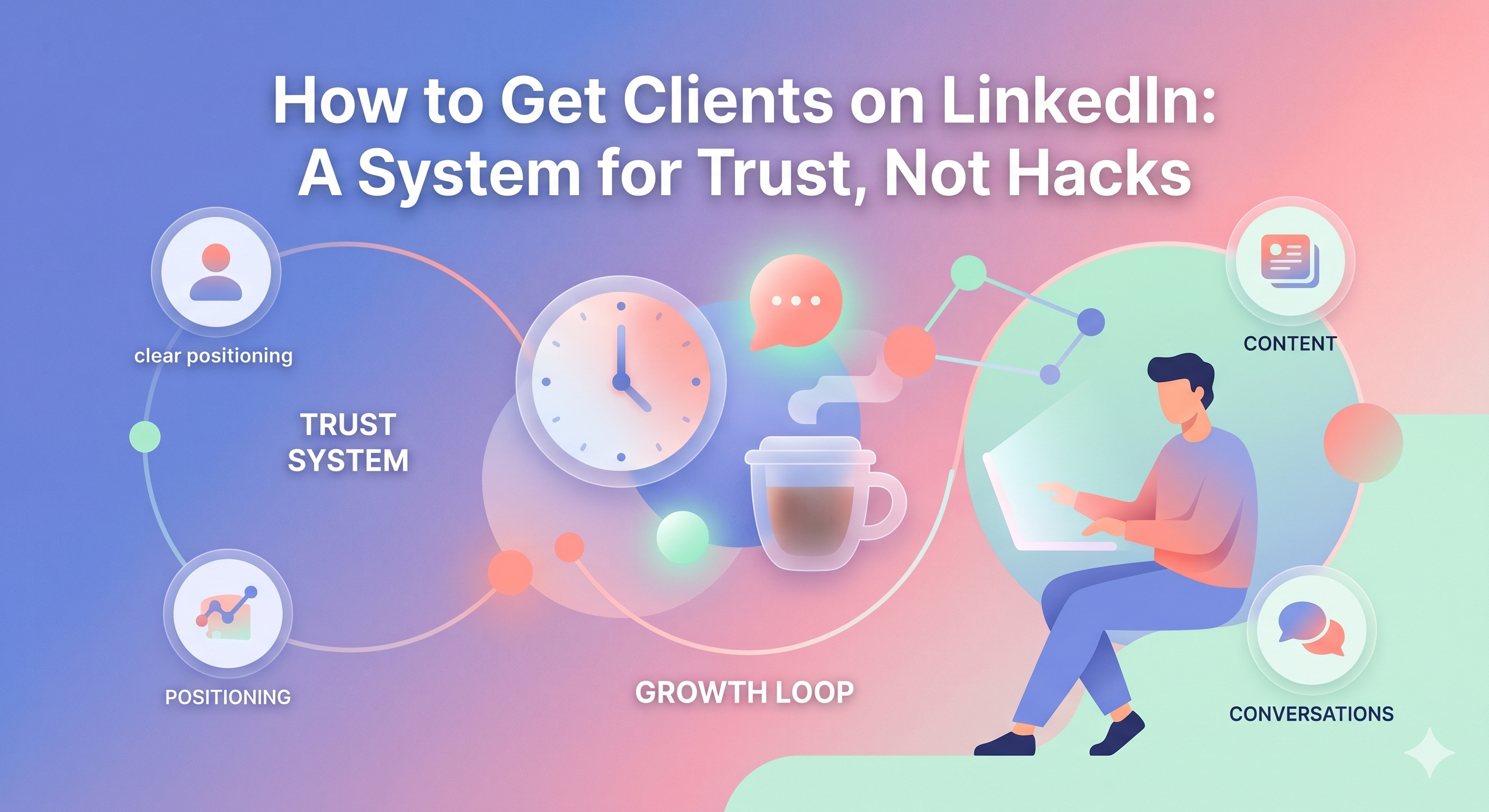
How to Get Clients on LinkedIn: A System for Trust, Not Hacks
If you skim search results today, two genres dominate: velocity playbooks that promise speed through templates, and counter-hacks that warn the feed is noisy and leave you with anxiety but no operating model. Both can contain truth fragments. Neither replaces a repeatable loop grounded in positioning, observable proof, ethically earned conversation, and honest measurement. LinkedIn’s own how the Feed ranks content states clearly that relevance draws on context, signals about profiles and networks, and behavior—not a single mythical frequency dial. Engineers have also articulated next-generation LinkedIn Feed priorities around understanding content more deeply and resisting shallow engagement traps—useful framing when someone on your team claims “pods are the math.” Separately, Google’s creating helpful content for people mantra applies indirectly: feeds and search both punish thin repetition audiences could get anywhere else.
This piece maps positioning → proof → cadence → conversation → commitment off-platform; companion posts tackle formats, weekly playbook rhythms, hooks, ingestion, DMs, and calendar blocking—linked where each topic earns a paragraph below.
Treat LinkedIn as one persuasive surface alongside email nurture, webinars, outbound sequences, and product-led onboarding—not a slot machine owed revenue. Channels reinforce each other: a sharp feed post gives your SDRs something specific to cite; a case study emailed after a demo gives buyers language to articulate internal risk reduction. Misaligned expectations—“We posted Tuesday; where is the PO?”—usually trace to unclear ICP geography or unrealistic sales cycle math, not the absence of gimmicks described below.
---
1. What “getting a client” actually means in a B2B LinkedIn context
“Client” is not a vanity follower count. In service and complex-product contexts, it usually means someone who books a discovery call, signs a statement of work, or starts a paid trial after enough trust that saying yes feels less risky than doing nothing. The journey rarely looks like a straight line in analytics tools. It more often resembles discovery through search, a comment thread, a mutual connection, or algorithmic surfacing; evaluation through your profile, three or four posts, and maybe an asset; conversation through comments or a direct message that someone answers with care; and commitment when they move to email, calendar, or your site where contracts and procurement live.
Vanity metrics masquerade as pipeline. Impressions can rise when you argue with strangers; that does not mean qualified evaluation rose. A smaller, well-aligned audience that converts beats a large, random one that applauds and vanishes. The information gain of this section is the explicit insistence on evaluative attention—buyers quietly asking whether you are competent, specific, and safe to engage—rather than treating LinkedIn as a popularity scoreboard.
---
2. Positioning: say who you help before you debate carousel templates
Before you fight about document posts versus short video, compress your offer into one breath that a tired executive could repeat at dinner. Your headline and About are not SEO ornaments alone; they are the fastest answer to “Why should I care?” Specificity sounds like industry, acute problem, and method—not “I help businesses grow.” That same spine should whisper through banner, featured resources, and the first sentence of substantive posts.
Consistency between profile and canonical website matters for humans and entity-style discovery; short feed posts are imperfect SEO vehicles on their own, but your public profile and evergreen assets still answer name queries better than ephemeral updates. Scattershot keywords signal evasive positioning; restraint signals confidence.
Teams aligned with Dynal-style use cases—founders scaling presence without a full-time content desk—still need this sentence-level clarity before any AI-assisted drafting layer. Brand context products only reduce blank-page friction once you know what promise is actually on offer.
---
3. Proof beats polish when buyers evaluate you in minutes
Prospects scrolling between meetings are not hoping for immaculate personal-brand theater. They are sampling whether you demonstrate judgment tied to lived work. Patterns that routinely help include point-of-view writing that names tradeoffs honestly; how-to or framework writing scoped to contexts your buyer inhabits—not generic curricula; anonymized narratives with situation, decision, result, and what you would do differently next time; and occasionally video or document formats when demonstration matters more than assertion. Pull research from sloppy notes cleanly—see posts from notes and PDFs.
Ranking nuance echoes here: Feed ranking basics foreground meaningful engagement—comments that hold substance—not hashtag clouds. Practical implication: optimize the first visible lines before See more (hook craft in hooks without clickbait), then repay the expansion with specificity. For format choice after intent is clear, lean on the post types field guide.
Link placement is a workflow and governance choice, not superstition. If a destination is essential, earn the click in text first; some teams keep the update self-contained and place URLs in comments or profile fields when policy allows.
---
4. Cadence and calendar reality: presence people can rely on
One-off virality does not pay rent for consultancies. Predictable, sane cadence does—enough that when a serious prospect visits your profile after a referral, they see continuity of thought, not a desert followed by a desperate manifesto. A sustainable weekly rhythm for independents might pair one deeper analytical post, one proof-rich story, and daily short participation in threads where buyers already argue—quality-restricted time blocks beat quantity theater; block time consciously with the four-week LinkedIn calendar template. Week-to-week sequencing that maps to pipeline lives in our LinkedIn client acquisition playbook.
Company surfaces add layers: official pages for durable news, employees amplifying with context so distribution does not imply everyone speaks for legal. Separation of voices belongs with personal profile versus company page strategy.
Calendar abstraction—seeing a week anchored to themes—not replacing judgment—is what separates systems from jittery improvisation. Narrative parallels live under LinkedIn Content System positioning for teams formalizing cadence visually.
---
5. Conversations worth having: comments and messages as trust accelerators
Comments on peers’ sharp threads often outperform cold outreach because you borrow an audience temporarily without pretending you earned an inbox relationship. The bar remains high: add one novel angle, cite one detail from the parent post, or pose one follow-up you will actually stay to read. Drive-by praise trains readers to ignore you.
Direct messages work when short, contextual, and earned—referencing work they published, a mutual with integrity, or a crisp reason not copy-pasted across a hundred personas. Ask whether reading the message aloud to a weary stranger feels bearable; if not, rewrite. Automated sequences that scrape inboxes degrade both deliverability vibes and morale; they also flirt with Professional Community Policies expectations on authentic engagement.
Ethical social selling—helpful public presence plus sparse, respectful private outreach—preserves not only compliance posture but also your sleep. For template boundaries, our DM article expands examples.
---
6. A monthly loop you can repeat without moral injury
Begin each month clarifying which buyer profile you need more of—title, company scale, acute problem language taken from sales calls, not imagination alone. Ship a small set of posts mixing point of view, proof, and at least one asset worth saving (checklist, slide, short clip) so evaluation has artifacts. Engage daily at a bounded level in communities your buyers actually inhabit; guard the cap ruthlessly or resentment curdles your tone. Review which posts earned inbound questions you would happily take on a call; double down on evidence classes that worked—not stolen cadence from a celebrity operator with a different risk appetite. Finally, route serious interest to systems you control—calendar links, forms, contract flow—so LinkedIn remains top of funnel, not your CRM of record.
No software replaces the first step’s intellectual honesty. Steps two through four fail most often because weekly execution collides with travel, hiring crises, or founder fatigue—that is where tooling can assist without pretending to think.
---
7. Pipeline signals: measuring LinkedIn without fooling yourself
Because attribution rarely attributes a closed deal to “one LinkedIn post,” teams either ignore the channel entirely or overfit to impressions. A practical middle path tracks qualitative leading indicators aligned with evaluation psychology. Notice inbound messages that cite specific sentences you wrote—those prove someone read carefully. Notice profile viewers whose titles cluster in your ICP band; sudden spikes matter less than consistent qualified curiosity over a quarter. Track meeting accepts that mention discovery source verbally even if CRM fields stay messy. None of these numbers replace downstream revenue attribution, yet they outperform treating applause reactions as forecasting tools.
Quarterly retros should ask ruthlessly whether your positioning sentence still fits what sales actually sells. When messaging drifts—even slightly—renew the headline before you pour more format experiments on top.
Execution discipline also includes knowing when silence is strategic: major funding news you cannot cite, customer chaos under embargo, reorganizations that scramble approval chains. Publishing through those windows often produces tone-deaf posts that unravel trust accumulated over months—sometimes the highest-leverage action is documenting drafts privately and returning loudly only when narratives stabilize.
---
8. Where an AI LinkedIn workflow can help (and where it cannot)
Dynal markets itself as an AI LinkedIn agent: structured Brand DNA (voice, audience, boundaries you maintain), multi-source inputs (notes, URLs, files) funneled into drafts with hooks and CTAs, calendar-style planning, and human review before publish—aligning with how dynal-features documentation describes “approval-first” positioning rather than unsupervised automation fantasy. The honest stack is multi-source input → structured draft → plan → you edit and ship. Lighter entry lives on the LinkedIn post generator solution page; deeper writing emphasis appears under LinkedIn AI Writer. Compare against generic chat using Dynal vs ChatGPT. Commercial reality: pricing.
Assistants compress iteration on outlines and variants; they do not replace ICP clarity, signed customer stories, or counsel on regulated claims. If your bottleneck is who you help, fix the headline and sales narrative before you optimize prompts. If the bottleneck is proof, spend cycles on capture and redaction—not on flashier cadence.
Tools compress iteration time; they do not fabricate trust you never demonstrated.
---
Conclusion
Getting clients on LinkedIn remains a long game of visible competence: clarity in the first screen, depth after See more, replies that sound like someone who does the work, and modest direct outreach that respects attention. Stack proof, keep cadence humane, and move deals to systems you control when seriousness appears. Software can accelerate drafting and planning within brand guardrails; it cannot harvest trust you never planted.
If nothing moves after ninety disciplined days, revisit who you hoped would care—often the bottleneck is positioning language that sounds impressive externally but matches nobody’s lived vocabulary on buying committees. Iterate the sentence, not merely posting frequency. Small language upgrades often beat doubling output when your bottleneck is recognition, not volume. Naming the pain in the buyer’s own words still outperforms jargon.
Read next: Types of LinkedIn posts for format decisions, playbook for weekly structure, hooks for openings.
---
Frequently asked questions
Is LinkedIn only for outbound sales, or can inbound evaluation matter first?
No—they usually work together. Many B2B relationships move through inbound evaluation after someone reads posts and comments long before outbound lands. Personalized outbound still works when it cites pains you already demonstrate you understand from public signal. Treat LinkedIn as a system that combines visible proof, humane cadence, and conversations you would not dread receiving—whether the first touch is a post, a comment, or a message.
Do I need a huge audience to get clients?
You need alignment more than scale. A smaller network of people with the right titles, budgets, and buying context often converts faster than a broad audience that reacts but never books. Ask whether the right readers recognize themselves in your headline and early lines before you chase impressions. When growth and relevance diverge, tighten who you hope will care before you optimize format experiments.
How often should I post, and should I gate content behind lead forms early?
Post often enough to signal continuity without burnout—two substantive posts per week plus thoughtful comments on others’ threads often beats five shallow updates. Avoid gating everything behind lead forms at the start; evaluative trust rarely survives a feed that feels like a squeeze page. Offer clear value in-feed first, then route serious interest to email or calls when intent is obvious from replies and DMs.
What should I measure when LinkedIn rarely closes a deal in one click?
Track qualitative leading indicators the platform still surfaces: inbound messages that quote specific sentences you wrote, profile viewers whose titles cluster in your ICP, and meetings that mention how they found you—even if CRM fields stay messy. Vanity reactions under forecast revenue; they can still mislead if the wrong audience is clapping. Quarterly, check whether your positioning sentence still matches what sales actually sells.
Are engagement pods worth it, and what about AI or junior-run channels?
Pods risk inauthentic patterns and policy discomfort; prefer substantive replies over choreographed applause. AI tools can speed drafting within brand guardrails, but strategy, voice, and compliance stay human—especially in regulated industries where generic outputs are unsafe. Delegating the whole channel to a junior only works with tight voice guidelines and weekly review; judgment-heavy buyers punish tonal drift faster than they reward raw volume.
How does this article differ from the client acquisition playbook?
This piece frames systems thinking: proof, positioning, cadence, and pipelines that do not fool you. The LinkedIn client acquisition playbook turns that into rolling weekly steps your team can execute on a calendar—same universe, sharper operational granularity. Read this when you argue about priorities; open the playbook when you assign tasks for Monday.
---
Practical guidance only—not a guarantee of business outcomes. Verify tactics against your market, ethics, contracts, and analytics. LinkedIn policies and product behavior evolve—check LinkedIn Help for updates.