

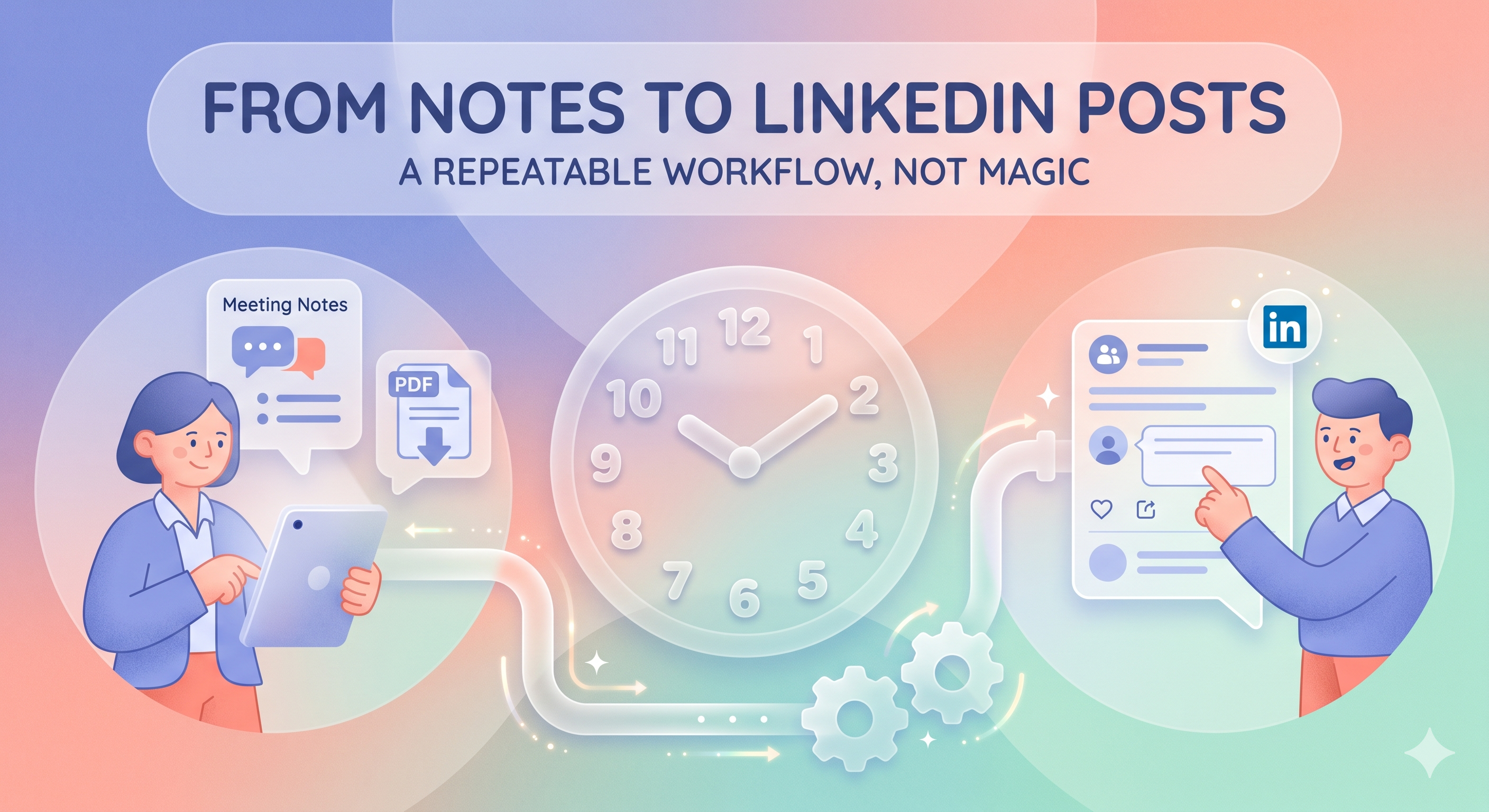
How to Turn Meeting Notes and PDFs Into LinkedIn Posts (Workflow, Not Magic)
Thought leadership rarely starts in the composer. It starts inside a cramped calendar block: someone says aloud what slide decks politely avoid; a PDF appendix contains one table that rewires your roadmap; your own bullet list from a retrospective names the failure plainly. Turning that residue into LinkedIn posts is translation work—clause by clause—before it is copywriting brilliance. Nobody watching your feed owes you fidelity to process; they owe you one honest takeaway aligned with evaluation stage outlined in how sales conversations actually progress. This article sits deliberately between the pillar types of LinkedIn posts taxonomy, the behavioural hooks playbook, and the weekly operating cadence described in our LinkedIn client acquisition playbook. When you operationalize recurrence, bolt this pipeline onto our solo content calendar template so empty weeks do not devolve into “post something” panic.
Feeds reward substance over pasted cleverness—not because LinkedIn broadcasts a secret karma score, but because members scroll with evaluation fatigue, and duplication signals nothing about your vantage point. Official guidance acknowledges that creators share varied formats—from short updates to uploads—within the broader “post content” workflows documented around posting basics and richer media such as uploaded documents (supported types, caps, inability to silently patch the uploaded file) which LinkedIn summarizes in Help under Upload and share documents. Interpret those mechanics as constraint reality: PDFs behave like published artifacts; your ethical duties remain yours. Google frames similar reader-centred instincts in creating helpful content—not identical to LinkedIn UX, complementary in spirit—prove you added understanding, not scraped pages.
Professional translation starts by refusing the implicit bargain that “anything captured must ship.” Busy operators accumulate heaps of plausible sentences; scarcity is not shortage of anecdotes but shortage of permission, clarity, and time to edit. Workflow thinking breaks that knot: capture deliberately, distill aggressively, rewrite with an audience prosecutor in mind. If orchestration overlaps with delegated drafting, reconcile expectations using what to automate—and what never should so AI accelerates structure without forging confidential nouns.
1. Why notebooks and exports beat staring at a blank post box
Creative mythologies portray inspiration striking first drafts; pragmatic revenue capture looks different—you already performed thinking during calls, annotated PDFs circled regressions analysts ignored, pasted Slack fragments logging political constraints. Recording those artifacts honestly reduces originality guilt sabotaging founders who equate usefulness with novelty. Borrowed authority fails when pasted sentences lack your structural reinterpretation—not because industry statistics offend etiquette but because unidentified statistics cannot anchor trust. Conversely, painstaking paraphrase of one chart footnote—with explicit methodological humility—beats seven motivational bullet slogans scraped from influencer threads.
Friction differs by surface: handwritten notes distort vocabulary but preserve emotional temperature—you remember who flinched crossing out a scope line. OCR’d PDF excerpts trade legibility against subtle emphasis—bold table headers vanished through conversion still shape argument ordering when you reconcile against memory. Respect each modality’s fidelity profile when selecting evidence; never pretend scan noise equals verbatim transcript truth.
Momentum compounds when reusable capture scaffolding sits adjacent to drafting context—sticky template prompts inside your notebook app, shared drive naming nobody jokes about (“2026‑Q2‑risk‑reviews”) signalling sequence for future retrieval. Rhythm matters more than tool perfectionism; the same weekly slots proposed in scheduling guidance like timezone-aware posting stabilize review windows so translation hours do not vaporize chasing emergencies.
Capture philosophy mirrors intent routing in the playbook: not every vignette belongs atop your funnel announcing category vision; granular engineering admissions might accelerate mid-funnel sceptics resisting shallow transformation hype. Matching raw scene to funnel stage preempts tonal dissonance scaring earnest mid-level operators while executives skim high-concept fluff elsewhere.
2. From capture etiquette to distillable residues
Treat meetings like evidence depositions minus theatrics—you cannot publish raw dialogue, yet you owe future selves traceable breadcrumbs. Immediately after calls (same business day preserves nuance evaporating overnight), skim your notes tagging three maximal lines an informed outsider finds surprising minus identity leaks. Surprise here means conceptual anomaly—patterns contradicting presumed vendor incentives, timelines betraying mismanaged expectations—rather than salacious anecdote fodder trading confidential atmosphere for fleeting engagement.
Tag each candidate line mentally with tentative intent scaffold: argumentative POV asserting interpretive clash, methodological how‑to unpacking sequence risk, restrained anecdote signalling vulnerability without hostage narrative dynamics. Labels need not dictate final format—they prevent lazy shoehorning anecdote arcs into argumentative templates producing stylistic tonal whiplash. Not every flagged line graduates; archiving explicitly marked “defer” lowers cognitive hoarding impulses tricking brains into overstuffed calendars.
Handling PDF reservoirs demands parallel discipline: skim executive summaries sceptically—they often varnish friction your notes already exposed. Probe appendices harbouring methodological appendices auditors might skip but specialists cherish. Identify single anchors destined for paraphrase: definitions reframing nomenclature, benchmark bands shifting investment thresholds, methodological caveats implying generalization fences. Ownership clarity precedes typography enthusiasm—determine citation rights referencing subscription agreements forbidding verbatim redistribution even when hyperlinking primary sources permissible. Prefer summarizing causal claims with methodological transparency (“survey n=… geographically limited…”) acknowledging fragility preempting armchair extrapolation critiques.
Audience variance shapes defensible abstraction depth: narrowly vertical peers tolerate acronym density if subsequent sentences scaffold first usage; heterogeneous followers reward translation bridges connecting niche metrics to transferable decision heuristics. Your voice still matters—translator identity separate from lexical substitution—signals why you hovered over appendix B instead of quoting headline CPI statistics everyone already skimmed elsewhere.
Psychological stumbling involves confusing repository volume with qualified claims pipeline—ninety mediocre bullets seldom yield nine posts if each demands distinct thesis sharpening; often one strong residue weekly outperforms daily spray dilution. Honour shelf discipline: undigested lumps warrant slower marination—even brief asynchronous voice memos debating interpretation with collaborator unlock deeper structured outline later versus premature posting regret.
Concrete translation practice pairs well with iterative hook experimentation described earlier—opening paragraph promises must align with distilled evidentiary payoff to avoid cynical comment threads dissecting discrepancy.
3. Choosing one takeaway per artifact (honest caveat table)
Shelf discipline becomes visible when articulated plainly—below pattern illustrates triage shorthand you can adapt verbally during editorial standups rather than treating as ceremonial paperwork.
| Source | One takeaway | Honest caveat |
|---|---|---|
| Call note fragment | Repeated decision heuristic across clients (anonymized) | Conscious selection bias—you saw friendly accounts first |
| PDF statistic | Boundary number forcing strategy pivot acknowledgement | Sampling limits or aging window—state both |
| Internal memo riff | Contrarian lens plus sharpest counterargument you concede upfront | Intellectual honesty invitation may attract debate heat manageably |
Whenever row selection feels forced—because caveat column empties—you lack publishable sharpening yet; defer rather than hallucinate airtight universality rhetoric undermining eventual authority accumulation.
Selecting singular thesis does not outlaw serializing sequels later—orthogonal facets emerging after comment engagement warrant follow-on posts deepening arc rather than duplicating scaffolding.
4. Translating distillate through hook, spine, carrier format hookup
Previously captured residue still demands shaping before greeting social feed scrutiny. Compose opening tension adhering to behavioural guidance in our hooks without clickbait article—the first text lines earn expansion taps before remainder reveals architecture. Decide structural spine aligning intent categories enumerated within formats taxonomy discussion—compare diagnostic narrative versus enumerated checklist philosophy—carrier choice follows substance rather than trend chasing.
Dense conceptual nuance arguing macro regime shift may blossom through sustained prose paragraphs sparing readers needless swipe gymnastics; structured visual metaphor scaffolding multi-stage pivot logic suits multi-slide exposition—particularly when sequential ordering clarifies interplay better than chronological prose labyrinth. Plain text remains underrated—not every argument demands asset packaging overhead risking polish disproportionate intellectual payload. Conversely, thoughtfully curated excerpts inside native document carousel—where LinkedIn exposes supported file modalities and behavioural constraints (100MB ceiling, inability to stealth-edit uploaded binaries) per official document FAQ surface—can externalize argumentative skeleton while conversational post body frames stakes inviting commentary about interpretation instead of debating font kerning trivia.
Maintain alignment constraint: carousel slide echoing verbatim confidential chart still violates stewardship even if cleverly typeset inside approved template—format innovation never supersedes permission architecture.
Bridging intangible hook promise and evidentiary middle demands narrational glue sentences preventing whiplash when pivoting from dramatic stake introduction towards denser methodological elaboration readability—transition honesty signals respect for impatient executive scanning patterns pacing attention allocation mid-scroll.
Tone calibration echoes brand voice scaffolding discussed elsewhere extensively—preserve vocabulary registers consistent with differentiated positioning while avoiding monoculture imitation erasing personality edges rendering feed presence substitutably generic albeit polished.
Interpret multi-part threads cautiously—they invite cumulative narrative depth yet elevate abandonment risk segments losing midsequence context—self-contained arcs within single cohesive post outperform serialized cliffhangers unless explicit promise justifies elongated cadence aligning community expectation management.
Whenever syndicating repurposed excerpts through newsletter overlays versus feed-only bursts, reconcile distribution promises described in neighbouring strategic comparison resources without fragmenting tonal integrity across surfaces—consistency fosters subscription trustworthiness.
Paragraph rhythm remains paramount—alternate sentence lengths creating cognitive musicality aiding retention inside mobile viewport constraints subtly distinct from ornate desktop typography indulgence.
Risk calibration includes acknowledging counterfactuals—articulating circumstances falsifying takeaway sharpens discerning reader allegiance disproportionate to brittle absolutist punditry.
5. Legal-adjacent hygiene: inference risk, rights, and honest paraphrase
Publishing is not paralegal homework yet demands operational seriousness conflatable neither with paranoia nor naïveté. Never embed identifiers—numeric contract volumes, oddly specific durations, geographically unusual deployment clusters—combinatorially narrowing plausible client mapping even pseudonymously. Aggregation storytelling across clients still risks inference exposure when macro sector narrowness restricts candidate universes dangerously small statistical populations.
Watermark-laden gated PDF visual splices remain suspect—permissions pipeline extends beyond subjective ethical sensibility whenever vendor licensing restricts derivative visual reproduction entirely—seek explicit affirmative clearance—not informal hallway shrugs—from stakeholders owning distribution rights preferably documented asynchronously avoid misinterpretation hindsight regret.
Prefer summarizing methodological essence—effect size interpretation, causal caveats—rather than ornamental chart mimicry implying proprietary dataset access falsely; transparency about constraints augments reputational stature among sophisticated auditors suspicious cosplay sophistication.
Maintain internal escalation lane—ambiguous situations route through counsel or empowered compliance delegate before posting deadline pressure rationalizes sloppy shortcutting—even scrappy SMB operators benefit codified escalation reducing founder heroically winging nuanced IP law live online audiences screenshotting enthusiastically.
Treat regulatory adjacent sectors (financial services advising retail participants, HIPAA-adjacent health tech, juvenile data contexts) ultra conservatively—even imprecisely framed statistical implications might inadvertently communicate restricted guidance positioning accidentally crossing compliance boundaries despite benign intent anchors.
6. Comments, collaboration risk, and accountable ghostwriting
Operationalizing caution pairs naturally with moderated comment expectation setting—heated threads escalate visibility possibly attracting scrutiny beyond organic follower circles—ethical posture includes responding thoughtfully rather than stonewalling—silence inadvertently signals endorsement misconceptions needing gentle factual reframing politely assertively avoiding flame spiral dynamics sabotaging reputational reservoirs painstakingly accrued.
Collaborative workplaces introduce dual-use note risk—engineering retrospectives mined for marketing ought respect psychological safety pledges assuring internal participants candid vulnerability protected from surprise external exhibition without collective consent—even anonymized composites warrant collective reassurance dialogue preventing cultural trust erosion overshadowing fleeting engagement spike rewards.
Ghostwritten executives still carry nominal accountability—even delegated drafting mandates human supervisory responsibility ensuring AI augmentation never fabricating numerical precision absent attributable provenance lineage verification step humans sign before publication greenlight—even when automation theoretically accelerates structuring velocity dramatically.
Structured translation workflow intersects thoughtfully with conversational governance automation possibilities highlighted in mirrored strategic articles—coordinate expectations accordingly.
Parallel misstep involves misattributed quotation—notebooks mixing client phrasing inadvertently transcribed verbatim into published hook lines—establish explicit transformation pipeline rewriting speech patterns distinctly enough avoid accidental stylometric fingerprint replication disputes emerging later contentiously contentious unwelcome PR drama.
Treat confidential scenario composites like historical fiction disclaimers signalling synthetic amalgamation explicitly when moral clarity demands illustrative colour yet factual identities must remain inaccessible inference wise—balancing transparency artistry craft challenging yet achievable honest narrative architecture.
Insurance adjacent operators occasionally misunderstand marketing expression boundaries—coordinate internal education ensuring external communications remain distinct regulated advice lanes unless licensed accordingly—prevent accidental advisory posture misinterpretation regulatory exposure vectors.
7. RACI-lite handoffs when teams touch the same residues
Operational clarity minimizes duplicate labour or contradictory tone releases when strategist, SME, reviewer share workflow. Maintain lightweight accountability shorthand without bureaucratic heavyweight ceremony—Responsible translator drafts narrative spine; Accountable stakeholder (often exec voice owner) adjudicates tonal tradeoffs aligning brand promise; Consulted SMEs verify technical predicate accuracy sparingly summoned instead of bottlenecking every lexical micro-choice; Informed teammates receive heads-up notifying pipeline alignment—not editorial veto unless governance rules demand cross-functional checkpoints earlier.
Asynchronous annotate passes inside collaborative drafting surfaces outperform serial monologue email chains fragmenting argumentative coherence temporal latency introducing contradictory patch layers accidentally—centralized comment threads concentrating dispute resolution geographically anchoring conversational memory reduce coordination failure modes dramatically especially distributed teams bridging multiple timezones already grappling fairness scheduling motifs elaborated distinctly within specialist scheduling playbook cross-link earlier referenced.
Friction emerges when RACI shorthand rubber-stamped ritualistically delaying shipping velocity—rebalance roles quarterly reviewing actual bottleneck evidence rather than folklore assumptions blaming legal omnibus category anytime uncertainty surfaces reflexively—even counsel appreciates proportionate risk calibration cognizant opportunity cost indefinite deferral accumulating invisible audience decay harming pipeline narrative momentum quietly yet persistently dangerously.
Junior practitioners learn faster by shadowing the Responsible translator during one real rewrite—watching how claims get compressed, not by reading abstract style guides. Document a few before/after pairs internally (not necessarily public) so the team shares a common sense of what “sharp enough” means.
8. When drafting tools compress translation cycles (humans still approve)
Products such as Dynal structure capture → draft → plan → review loops around Brand DNA—modular voice, audience, topics to avoid—rather than improvisational chat sprawl; multi-source intake (notes, URLs, PDFs) follows the same narrative arc described in dynal-features documentation emphasizing human approval before publish, not autonomous autopilot mythology. Lightweight drafting emphasis appears on LinkedIn AI Writer positioning; fuller orchestration language maps to LinkedIn Content System. Compare generic assistants using Dynal vs ChatGPT; evaluate economic fit with pricing. Acceleration reshapes iteration frequency—it does not replace naming permissible facts or verifying hallucinated specificity before scheduling something public-facing.
Tool leverage rises when humans supply crisp extraction prompts—three constraints, an anonymized quote sketch, and an explicit caveat—instead of dumping whole PDFs and hoping the model invents defensible statistics. The last pass should still be a human diff: compare the draft to the original notes and challenge every number, name, and superlative. If the draft upgraded an anecdote into a population claim, either add evidence or delete the upgrade.
Conclusion
Messy inputs become legible LinkedIn assets when one takeaway, honest caveat, and hook-first shaping stay non-negotiable. Translation feels unglamorous—that discipline is why it compounds trust while magic-prompt fantasies decay after a week of shallow outputs. Treat every note and PDF as raw ore: smelt carefully, publish metal, leave slag in the draft folder.
---
Frequently asked questions
Can I upload a client PDF—or a similar document—if the button allows it?
Technically, upload paths exist for supported document types subject to size and page caps—see LinkedIn’s document upload help. Rights and confidentiality still govern what should ship, not what the UI permits. Names, combinatory identifiers, oddly specific durations, or licensing-restricted figures can create inference risk even when you think you anonymized the story—when uncertain, escalate before publish.
What if my best proof is a chart I cannot share, or my takeaway feels too thin to stand alone?
Paraphrase the claim, expose uncertainty bounds, or describe the decision the chart informed without reproducing proprietary pixels. If one takeaway feels thin, bundle subpoints only when they support a single thesis; otherwise split ideas across weeks using your content calendar so each post keeps one honest promise. Thin posts padded with adjectives usually age worse than delayed posts with better evidence.
How do I avoid sounding like I leaked a meeting—and do OCR or executive voice memos change the workflow?
Strip identifiers, wait until emotional temperature cools, and prefer pattern language over play-by-play dialogue that maps to a single client. OCR errors absolutely matter—misread digits become false claims, so reconcile numbers against the source PDF. Executives can narrate voice memos while editors translate; fidelity lives in decision vocabulary and boundary calls, not who typed every clause.
When should I choose a document post instead of plain text—and how do I cite public PDFs responsibly?
Use document posts when ordered visual progression clarifies logic that paragraphs would obscure—not when slides wallpaper a weak argument. For public studies, name or link the source, summarize in your words, and note limitations; readers reward transparent scope over performed omniscience. Document format does not outsource rigor—you still owe honest caveats and permissions context.
What if reviews are slow—or can automation replace compliance sign-off entirely?
Batch legal or compliance reviews on a predictable cadence, stockpile distilled residues, and schedule only after approvals clear—fair windows across regions pair with tactics in scheduling across time zones. Tools can tighten drafting and reminders, but policy judgment stays human—as expanded in automation boundaries. Never ship regulated claims straight from unchecked model outputs.
---
Practical workflow guidance only—not legal advice. When uncertain about confidentiality or rights, pause and ask someone empowered to say no.