

LinkedIn Newsletter vs. Feed Posts: When to Serialize, When to Stay Short
1. Discovery and obligation: why the feed rarely feels like a classroom
Feeds reward velocity: ideas surface intermittently beside hundreds of competing updates. Even loyal followers glimpse your posts probabilistically. Some ideas earn comments within hours; others vanish politely. Nothing in that ecology guarantees that a reader commits to revisit your thinking next Tuesday on schedule. Format vocabulary—from document to text-first hooks—still maps to our taxonomy of LinkedIn posts; pacing reality maps to solo LinkedIn calendars even when instalments beckon later.
Newsletters—even when surfaced through similar networks—invite a different psychological contract: explicit opt-in to installments. Silence between issues reads louder than skipping a spontaneous feed week. That difference is not prestige; it is cadence accountability. Newsletter readers often treat issues like internal memo forwards: skimmed, annotated, circulated. Feed readers often behave like conference hall milling: conversational, argumentative, improvised.
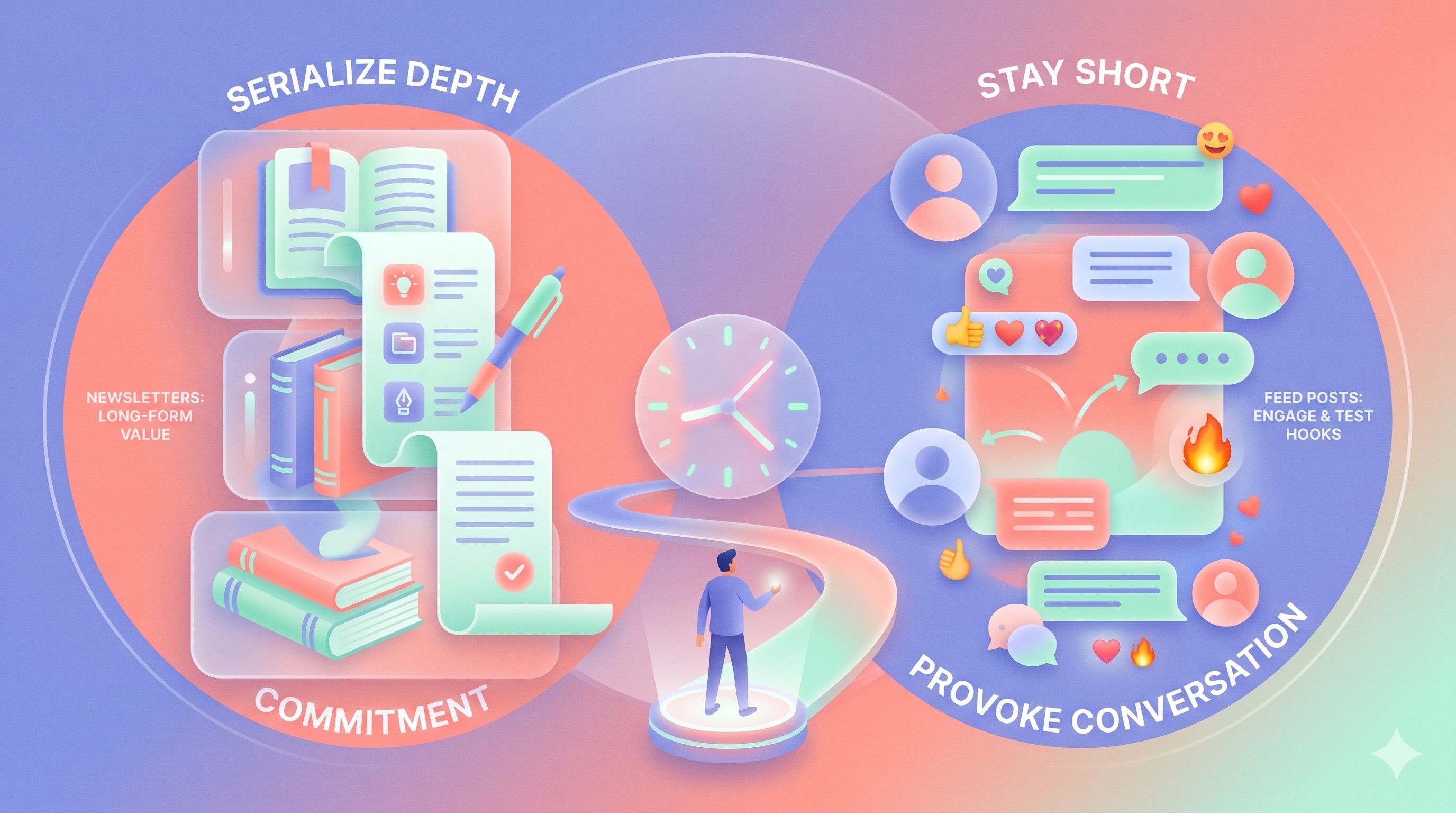
Treat the feed as a laboratory for hypotheses; treat the newsletter as a curriculum you must be willing to shepherd. Neither is morally superior—they trade off exploration against architectural obligation.
2. What feed-first publishing handles well—and what serialization rewards
Feed strengths
Hook-market fit experimentation. Feed posts let you test which anxieties resonate before locking a multi-issue arc about the same metaphor. Fail fast publicly; bury weak premises before they inflate into ornate chapter titles.
Conversational truth-finding. Comment threads uncover misunderstandings practitioners live with daily. Threads become cheap qualitative research powering later deep explanations.
Responsive commentary. Regulatory shifts, product launches, and sector crises favour timely takes. The feed thrives on contemporaneity newsletters schedule weeks ahead—you risk arriving late rhetorically if you funnel everything monthly.
Lower structural commitment. If travel or sales intensity swamps writing time sporadically, audiences forgive uneven feed pacing more gracefully than visibly abandoned newsletter cadences unless you reset expectations plainly.
Serialized newsletters: upside and cost
Multi-step frameworks. Lesson two flops if lesson one remains implicit. Serialization makes dependencies explicit—you can scaffold fear and relief across weeks deliberately.
Narrative identity. Column-style cadence communicates “this leader thinks in chapters,” which some buyers remember more than ephemeral takes.
Regulatory-ish clarity. Repeated disclaimer placement, versioning of claims, referencing footnotes—these patterns sit more naturally in installments than scattered across brittle feed posts.
The penalties are predictable: subscriber expectations, outline discipline, outlines that cannot be improvised indefinitely, reputational sting when issues feel padded. If you dislike outlines, postpone the newsletter aspiration.
LinkedIn Articles vs newsletter installments (conceptual distinction)
Articles (historically long-form pages) often serve as canonical deep dives you might republish on your site for SEO. Newsletters typically imply ongoing subscription and chapter rhythm. Product surfaces evolve; verify where each format lives in your account and how distribution appears to followers versus subscribers. The strategic question is not only label but where the durable URL should live for your content architecture.
3. Practical choices, hybrids, and cross-promotion without spamming the feed
Decision prompts (no rigid matrix required)
Lean toward feed-only when you still learn which problems your audience names aloud, when your proof is anecdotal and rapidly evolving, or when your team cannot align on a monthly outline review.
Lean toward newsletter-first when you teach a migration or methodology that truly needs five honest chapters, when account executives beg for assigned reading to shorten calls, or when you deliberately build a signature column asset.
Lean toward hybrid when feed posts become teasers and proof-of-life traffic drivers while the newsletter holds the dense architecture. Hybrids fail when every feed post becomes a shallow trailer with no standalone value—readers learn to ignore you between issues.
Cross-promotion
Every issue benefits from a short feed companion: one concrete claim, one vivid example, one explicit promise of what the issue unpacks. Put the link where your team policy allows (first comment, inline reference, or profile link pattern) and keep the same-day reply coverage you would defend for a product launch. Cross-link DM etiquette when colleagues plan private follow-ups after public teasers.
Avoid orphan newsletters with zero feed presence unless you already command pull-through from elsewhere. Most B2B operators need visible laboratory work to earn subscription trust.
4. Operational failure modes, voice routing, and research pipelines
Failure modes worth naming
Prestige launches without runway produce three strong issues and six awkward filler pieces. Iterated feed arcs would have revealed outline gaps earlier.
Ghost executives who promise columns then vanish—reset to feed-only until someone owns the calendar.
Metric superstition measuring opens without ever asking readers which chapter changed their planning. Qualitative notes matter for B2B depth.
Calendar collisions where webinars, earnings-adjacent weeks, and newsletter drops cannibalise attention. Stagger deliberately; reference your solo calendar as the coordination surface.
Voice routing and organisational reality
Profile voice can feel candid; Page voice may require legal review. If newsletters carry strategic claims, align who signs them with profile versus Page guidance and your brand voice sheet. Misalignment between feed banter and newsletter gravitas confuses buyers evaluating whether you scale professionally.
Research pipelines and repurposing friction
Notes and PDFs generate raw material; feeds distil highlights; newsletters assemble durable chapters. The notes and PDF workflow matters because messy inputs become structured outlines before you promise subscribers a six-issue arc. Repurposing fails when you paste podcast transcripts verbatim—readers feel second-class. Summarise for the medium.
5. Analytics expectations and where Dynal fits
Do not compare unrelated scores
Feed engagement fluctuates with network activity and comment velocity. Newsletter metrics reflect list intent and fatigue differently. Treat cross-channel comparison cautiously; align qualitative sales feedback with quantitative signals before killing an initiative prematurely. When numbers wobble, articulate whether the issue is topic–audience fit before blaming the channel format itself.
Honest product mapping
Dynal emphasises capture → draft → plan → review → publish with structured brand context—not generic chat improvisation. Narrative anchors: LinkedIn Content System, drafting via LinkedIn AI Writer, and Dynal vs ChatGPT for distinguishing workflow-bound assistance from unstructured prompts. Scheduling fields, approval realities, and feature surfaces change—verify behaviours in-product alongside pricing rather than trusting stale screenshots alone.
6. Internal forwards, cadence, sensitive themes, ABM, and founder time-budget
When internal forwards matter more than public likes
In B2B, a newsletter instalment survives because a director pastes paragraphs into Slack with “read section three before Friday’s procurement call.” Forwarded utility beats vanity reaction counts. Feed posts catalyse that chain less predictably—they spark debate, lose scroll position, evaporate emotionally even when intellectually substantive. Decide whether your goal is primarily ambient reputation continuous or assigned reading occasionally durable. Newsletter positioning fits the second archetype particularly when methodological nuance dominates.
Newsletter cadence and product reality
Serial education promises continuity while roadmaps jitter. Acknowledge changelog variance transparently—you need not spoil secrets, yet pretending timeless stability amidst shifting APIs erodes credibility. Occasional contextual footers (“written while feature X approached GA”) contextualise timelines without clumsy disclaimers overshadowing prose. Harmonise launches with webinar schedules cautiously—too many simultaneous heavyweight assets exhaust both audience organisational attention.
Themes you should refuse to serialize cheaply
Not every provocative feed thread deserves twelve-part expansion. Sensitive personnel stories, unsubstantiated competitive attacks, speculative geopolitical punditry, or granular customer tragedy narratives often belong outside serialized corporate channels—even if tempting narratively—or require counsel before first issue—not fifth damage control edition.
ABM-aligned programmes using both surfaces
Named account strategies sometimes pair narrow feed specificity tagging industry moments with newsletter deep dives addressing evaluation committees uniformly. Coordinating responsibly prevents contradictory promises between account-tier micro-stories outwardly chipper meanwhile sober enterprise-wide newsletter adopts conservative posture—marketing leadership calibrating hierarchy clarity versus personalised relevance deliberately rather than improvisation alone.
Time-budget realism for founders
Feeds tolerate compressed bursts between meetings; sustainable newsletters normally need outline discipline, drafting windows, and review time spread across weeks. If your calendar cannot protect those blocks, postpone serialization or ship quarterly arcs instead of weak weekly placeholders. Transparency about resets beats silent drift that erodes subscriber confidence.
7. Follow-up discipline, enablement, and honest versioning
After each issue lands
Publishing is half the handshake; replies are the rest. Buyers notice whether authors engage on feed teasers, whether direct replies to issues receive thoughtful answers, and whether sales cites instalments accurately in live conversations. Tie expectations to scheduling across time zones so send times do not imply presence you cannot sustain. Keep private follow-up aligned with DM etiquette for B2B and the relationship logic in our LinkedIn client acquisition playbook—newsletters should educate consenting subscribers, not launder scripted outreach spam.
When installments become practical enablement
Account teams occasionally treat newsletter installments as quasi-official briefing memos—“read instalment seven before procurement.” That only works when versioning stays honest: headings and claims match what recipients can forward without embarrassment. Maintain a concise change log internally when rebrands rename terminology; update excerpts sales quotes instead of silently diverging narratives between feed teaser and archival issue text. Coordinating thoughtfully respects buyers assembling evidence packages across weeks.
8. Institutional memory versus scattered brilliance—and how to decide
Feeds archive unpredictably psychologically—even when URLs persist, brilliance buries chronologically noisy. Serialization pulls durable arguments forward as chapters—not because long text automatically equals prestige, but because some arguments deserve repeatable structure sales enablement recognises consciously. Decide whether institutional memory materially helps your motions; if purely ambient influence suffices, lavish serialization misallocates scarce editorial hours.
Conclusion
Feeds and newsletters coexist as different commitment instruments. Feed posts discover tension quickly, invite dialogue, and tolerate uneven weeks when honesty demands it. Newsletters accumulate trust only when outlines, approvals, and cadence prove sustainable. Pick a primary home for each substantive idea—serialization versus punchy experimentation—then distribute across surfaces without orphaning subscribers or drowning followers in repetitive trailers. Readers forgive uneven feed weeks more readily than silent newsletter months—call that asymmetry what it is while planning.
---
Frequently asked questions
When should the feed stay primary versus when does a newsletter deserve the lead?
Stay feed-first while you still test which claims hook your ICP, lean on conversations for research, or cannot publish predictable issue dates without creative panic—serialization punishes flaky cadence loudly. Prefer a LinkedIn newsletter when narratives need honest multi-part scaffolding, when buyers explicitly want forwardable briefing material, and when you commit to outlines and approvals—not merely the badge. Neither channel magically replaces disciplined positioning; picking the wrong vessel burns trust faster than mediocre timing tweaks.
Do newsletters substitute for email—or SEO—and how often should issues ship sustainably?
Treat LinkedIn newsletters and email as parallel channels in a broader lifecycle; duplicating copy without intent confuses metrics and fatigues readers. Canonical SEO often still belongs on your site; LinkedIn surfaces serve relationship and distribution—align with marketing before mirroring content everywhere. Sustainable depth usually beats weekly promises you dilute; reset cadence transparently when capacity shifts instead of ghosting subscribers.
How should we repurpose audio, tease issues in-feed, diagnose engagement drops, and coordinate approvals?
Rewrite podcasts for reading—headings, executive summaries, skimmable bullets—because raw transcripts rarely earn forwards. Tease newsletters only when the issue adds net-new value; spammy cross-posts train followers to ignore both surfaces. If engagement falls, audit idea–outline fit, teaser quality, and subscriber fit before obsessing over subject lines. Claims-heavy series need explicit approvers aligned to legal and product comms—document them on the brand voice sheet.
How do time zones, global sends, and scheduling discipline interact?
Respect where subscribers actually work—pair scheduling principles with honest coverage instead of calling a single coast “global.” Send times should match reply capacity; otherwise you signal presence you cannot sustain in DMs or comments.
---
LinkedIn newsletter and Article features evolve; verify current creation, subscriber experience, analytics, and link behaviour in-product and official Help—not as performance guarantees.