

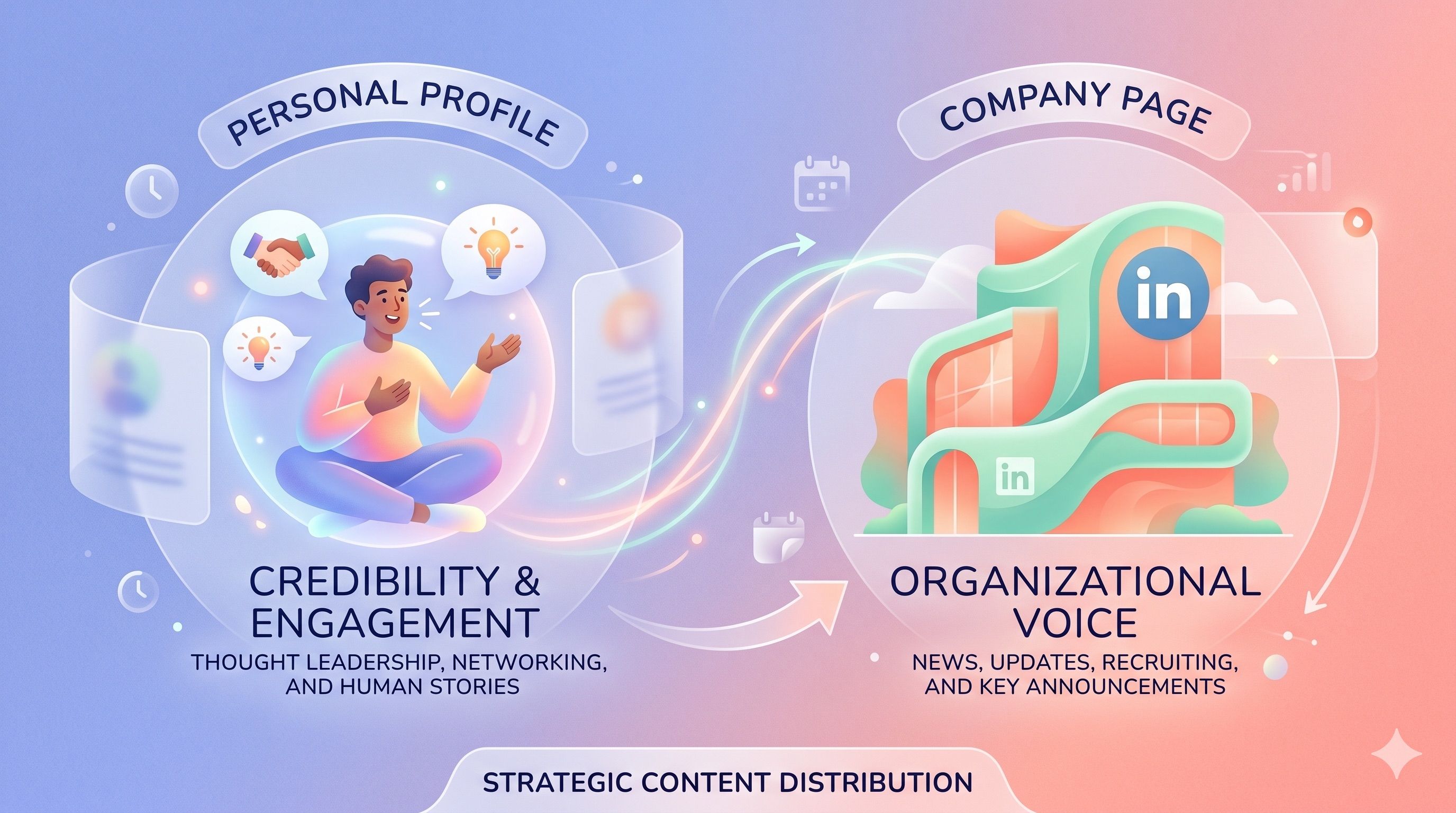
Personal Profile vs. Company Page on LinkedIn: Who Should Post What
LinkedIn routes individual and organization identities through overlapping feeds, but readers bring different psychological contracts: a Page update reads as sanctioned record-keeping—“this organization stands behind wording, dates, approvals.” A profile post reads as situated judgment—“this person risks reputation attaching their name.” Neither contract is ethically superior—they serve different uncertainties. Mishandling the split wastes effort: tepid narratives on Pages while withholding concrete milestones, or broadcasting PR boilerplate exclusively from founders until humans stop believing anybody lives behind the avatar.
Marketing mythology blames vague “algorithmic suppression” whenever Page engagement lags observable profile posts. Often the failure is job design: Pages exist to document what the organization can defend as true at scale; profiles exist to interpret what those truths mean for decisions in motion. LinkedIn’s own materials describe a Page as the organization’s official presence on LinkedIn, separate from personal profiles—a structural distinction, not a popularity contest (see Page types and functions and Create a LinkedIn Page for how Pages are created and positioned). High-level posting mechanics for members—share box, media options—live under post and share content; Feed ranking philosophy is summarized for members in this Help article. These sources do not tell you what to say—but they anchor why surface choice is not cosmetic: Pages and people differ in accountability, amplification, and amplification risk. Cross-check feed decisions with how clients evaluate you on LinkedIn, types of LinkedIn posts, and newsletter versus feed trade-offs when deciding where serialized depth should live.
1. What the company Page is for (documentation, not personality theatre)
A Page should carry facts your legal, product, and people teams can align on: releases, partnerships, regulatory milestones, funding when messaging is cleared, hiring waves, event logistics, customer proof after consent and review. The Page is the canonical URL employees reshare with context—like a press room with social affordances. When teammates reshare, they import interpretation while the Page supplies verifiability. That division matters in B2B procurement environments where buyers screenshot vendor claims into internal threads—ambiguity on the Page becomes organizational liability; nuance belongs in human voices describing how facts interact with messy constraints.
Pages also carry role clarity for candidates: benefits tone, culture artifacts, role counts—where organization-level statements avoid awkward first-person founder drift (“I’m hiring five people” on a Page can work as voice-of-founder strategy, but often signals immature people ops packaging). For product news, ship crisp what / when / for whom on the Page; ship why this trade-off made sense from a product lead or founder profile when narrative depth helps evaluation.
The table below is a default routing aid, not dogma—your compliance team may define stricter rules.
Where Product / partnership / regulatory milestones meet human interpretation, split delivery: Page posts the milestone; profiles explain constraints buyers actually negotiate.
| Route to Page | Why it fits the contract |
|---|---|
| Versioned product or partnership facts | Single source of truth; dates and names stay consistent |
| Approved customer metrics & logos | Consent and legal review cluster here |
| Jobs at scale & event logistics | Repeatable templates; easy for teams to reshare |
| Crisis updates requiring coordinated wording | Central channel reduces contradictory hot takes |
If a post is 80% hot take and 20% fact, invert the recipe: Page gets the 20% stable kernel; a person carries interpretive heat.
2. What usually belongs on people (judgment, friction, and reply velocity)
Profiles excel at point-of-view, trade-off storytelling, qualified disagreement, and fast, human replies in comment sections where buyers stress-test claims. People can say “we were wrong about X before we fixed Y” with emotional granularity that Pages render stiff unless carefully choreographed—and even then, humans detect corporate ventriloquism. Executives are not magical; accountability visibility is: when a named leader speaks, implicit risk transfer follows.
Subject-matter experts—solutions engineers, implementation leads, risk officers—often produce the highest-trust posts because their jobs force contact with edge cases. Their profiles should not mimic the Page’s press-release cadence; they should publish diagnostic patterns that help evaluators predict delivery reality. For hooks and opening lines that stay honest, cross-read hooks without clickbait.
Commenting strategy fits people, not Pages: threads where buyers debate categories reward human presence; a Page jumping into every debate feels either promotional or tone-deaf. Route thought leadership through individuals; route documented responses (e.g., security incident facts) through the Page with link-out to deeper human context if needed.
Direct outreach that references public writing also maps to people—see B2B DMs without spam—because inboxes address humans, not abstract brands, even when the brand is beloved.
3. Employee advocacy: compound signal without copy-paste noise
Advocacy fails when marketing drops a link in Slack and hopes. It works when sequenced: the Page posts the sanctioned fact (release, milestone, customer quote within policy). Then colleagues reshape with role-specific lenses—implementation notes, procurement reality, design trade-offs—so followers see one truth, multiple proof angles, not twenty identical shares. The audience experience is compound validation: brand says X; practitioner Y explains why X mattered on the ground.
Governance still matters: pre-approved media kits, quote limits, embargo windows. This article cannot replace counsel—export controls, financial promotion rules, and employment contracts vary—but the information architecture is universal: Page as root, people as branches. Where legal requires parity language, store it on the Page; let individuals add non-contradictory lived detail only.
4. Collisions, edge cases, and where newsletters blur
Founder voice companies: the CEO’s profile may partially substitute for Page cadence early on—yet as the org scales, unbundling remains wise: the Page becomes durable memory; the founder becomes interpretive memory. Newsletters complicate routing because they often attach to profiles while behaving like owned micro-channels—see newsletter vs feed posts for promise, cadence, and unsubscribe psychology. A Page post might announce the newsletter; the newsletter delivers depth a Page update should not awkwardly duplicate line-for-line.
Multi-product portfolios sometimes split Pages (business units) or maintain one Page with verticalized personal voices—choose based on buyer confusion risk: if categories blur, separate clarifying Pages; if integrated platform story wins, keep a single Page with specialist profiles carrying vertical nuance.
When personal and Page collide—same news, two impulses—ask: Does misunderstanding create legal, financial, or safety harm? If yes, Page leads, profile comments. Is this fundamentally a credibility stake tied to one human’s track record? Profile leads, Page links as footnote. Is this pure portfolio colour irrelevant to persona? Page-only is fine. Newsletter blur means you may serialize long arc on a profile while the Page stores canonical facts each chapter references—avoid forked truths.
5. Cadence and planning across surfaces
Calendars should not duplicate the same story across Page and five profiles on one day—that exhausts humans without helping readers. Use a stagger: Page Tuesday morning; expert perspectives Wednesday–Thursday; founder synthesis Friday if warranted. The solo content calendar template mindset—pillars, light weeks—applies per voice, not only per person. For acquisition cadence inside the broader system, keep the client acquisition playbook in view so Page posts are not detached from conversation and proof loops.
When capacity drops, protect one Page heartbeat and one human interpretive line rather than scattering half-finished echoes everywhere. Align stakeholders weekly on which launch owns the first forty-eight hours of attention—product, people, or brand—so scheduling tools do not broadcast collisions you would never tolerate in a press plan.
6. Tooling and Brand DNA across accounts (keep voices distinct)
Agencies and ghostwriters juggle multiple LinkedIn contexts; product-side positioning for structured brand rules appears in dynal-features documentation—Brand DNA as configured context, not implicit “auto-learning your soul.” Dynal maps workflows to capture → draft → plan → review → publish with human approval gates; compare generic chat on Dynal vs ChatGPT and commercial fit on pricing. Lighter drafting: LinkedIn AI Writer; broader orchestration language: LinkedIn Content System. Multi-surface teams should still name which account a draft targets—Page copy is not profile copy with a logo swapped.
7. Failure modes worth naming
Personality theatre on Pages—mock intimate first-person brand voice without a human accountable—reads hollow. Press-release persons—profiles that only paste Page copy—waive the advantage of human stakes. Split-brain crises—Page says all clear while executives vent ambiguously in comments—destroys trust faster than silence. Advocacy without enablement—asking staff to share without approved quotes or context—creates either silence or rogue wording. Ignoring comments on Page posts while execs reply only on profiles—signals organizational disarray; assign explicit community ownership.
None of these are “algorithm” problems; they are voice architecture problems.
8. Employer brand, personal voice, and the limits of coercion
Individuals carry employment contracts, equity incentives, and personal risk tolerance Pages never feel. That asymmetry explains why mandated “please reshare Tuesday’s launch” schemes often flop: people protect personal reputation capital even when they love their employer. Advocacy programs work better when they equip—approved talking points, suggested hooks, factual bullet sheet—than when they meter quotas that invite performative fluff. Progressive teams separate minimum compliance (“do not contradict these three numbers”) from maximum creativity (“add your vantage point”). The result looks less like marching orders and more like editorial collaboration—you still need legal review thresholds for regulated claims.
Personal profiles also intersect with mobility: when employees leave, their posts persist as career artifacts; organizational memory should therefore live primarily on Page assets and evergreen links, not scattered across former IC feeds alone. Careers evolve; Pages remain the relative constant if maintained deliberately.
Readers who evaluate vendors often triangulate: Page for “what is officially true today,” individual practitioners for “how delivery actually behaves under stress,” leaders for “what trade-offs leadership will defend when contracts renew.” When those three layers tell a coherent story—same facts, escalating levels of interpretive risk—trust compounds. When they diverge, buyers delay decisions not out of malice but because cognitive dissonance triggers procurement’s default setting: more paper, more calls, more runway burned.
For global teams, time zones change who sees Page updates first; pair org-wide timing guidance in scheduling across time zones with realistic expectations for async advocacy—Americas-first spikes should not be misread as global apathy by APAC colleagues asked to share “simultaneously.”
Finally, informational quality—helpful specificity, credible sourcing—matters irrespective of surface. Google’s framing of people-first helpful content aligns philosophically even when the surface is LinkedIn rather than organic web: sensational routing decisions without payoff erode reputation on both domains. On LinkedIn specifically, keep one voice per job: the Page should not cosplay an individual; individuals should not mimic press releases when a human story is available.
Conclusion
Winning B2B LinkedIn is people carrying truth with pages carrying documentation—two instruments, not one feed copied twice. Route facts where organizations can stand behind them; route judgment where humans can defend trade-offs aloud. Sequence advocacy so colleagues add dimension without synchronized spam. Ask monthly whether your Page reads like a credible registry and whether your people still sound like recognizable experts—not interchangeable megaphones. Revisit routing quarterly as headcount, risk, and narrative complexity evolve.
---
Frequently asked questions
Should every executive post personally, and when can the company Page take a stance?
No—post personally when you have perspective worth the cost of being wrong in public; productive lurking beats forced volume. The Page can and should carry official news, policy-level positions, and numbers sales can repeat—just keep stances durable and cleared, not improvised hot takes that contradict what individuals say in comments. Separate what the org certifies from how individuals interpret trade-offs in situ.
Do we duplicate Page and profile content, and who owns comments on Page posts?
Avoid verbatim duplication the same day across surfaces; sequence launches or split “fact” on the Page versus “interpretation” on profiles so each surface keeps a job. Decide explicitly who responds to Page comments—communications, marketing, or rotating SMEs—with escalation paths when risk appears. Split ownership without a named process usually creates slow Page replies while executives answer faster on personal threads, which looks disorganized to buyers triangulating signals.
Where do newsletters live, what about hiring—how should paid spend change routing?
Newsletters are usually profile-anchored longform; evaluate format trade-offs in newsletter versus feed posts. Hiring at scale often suits Page templates plus hiring managers adding grounded texture on profiles when policy allows. Paid amplification frequently routes through cleared Page creative for reach, yet still pair spend with human proof so ads do not amplify claims nobody will defend in a live customer thread.
What changes in regulated sectors, small marketing teams, or when using AI drafts?
Regulated teams should keep Page-first facts tight and add interpretive layers on profiles only after review—internal policy beats marketing instinct. With a single marketer, protect Page accuracy monthly and maintain at least one recognizable executive voice weekly instead of fragmenting every function across channels. AI can structure drafts, but truth boundaries and approvals stay human—see what to automate on LinkedIn—especially when models hallucinate numbers or compliance-sensitive claims.
---
Governance, employment, and advertising rules vary by jurisdiction and contract—this article is strategic guidance, not legal advice. Follow LinkedIn’s Professional Community Policies and your internal comms policy.