


The 10 Content Rules That Stop Teams From Shipping
Most teams do not have a creativity problem. They have a content operations problem.

If publishing feels slow, inconsistent, or blocked by endless approvals, the cause is usually not a lack of ideas. It is usually a broken editorial workflow: unclear ownership, too many handoffs, weak planning, and rules that create friction instead of momentum.
For marketing leadership, the fix is rarely “work harder” or “add another meeting.” It is building a simpler system that helps teams decide faster, draft faster, review faster, and publish with confidence.
This article breaks down the 10 content rules that most often stop teams from shipping, how to fix them, and what a healthier content operations model looks like.
- Slow publishing usually comes from process drag, not idea scarcity.
- Better editorial workflow starts with fewer decisions, clearer roles, and tighter review paths.
- Strong content operations reduce bottlenecks without removing human approval.
- The right planning system helps teams move from draft to a scheduled LinkedIn post with less friction.
Why content teams get stuck
The most common content operations mistakes that slow down publishing are surprisingly consistent across teams:
- Everyone can request content, but nobody owns prioritization.
- Every draft starts from scratch.
- Feedback arrives late and from too many people.
- Planning lives in one place, drafting in another, and scheduling somewhere else.
- Approval rules are vague, so review cycles keep expanding.
- Teams confuse collaboration with constant meetings.
- Publishing dates move because nobody is managing the calendar as a system.
In other words, teams do not fail because they lack talent. They fail because the editorial workflow is overloaded.
The 10 content rules that stop teams from shipping
1. "Let everyone add content ideas anytime"
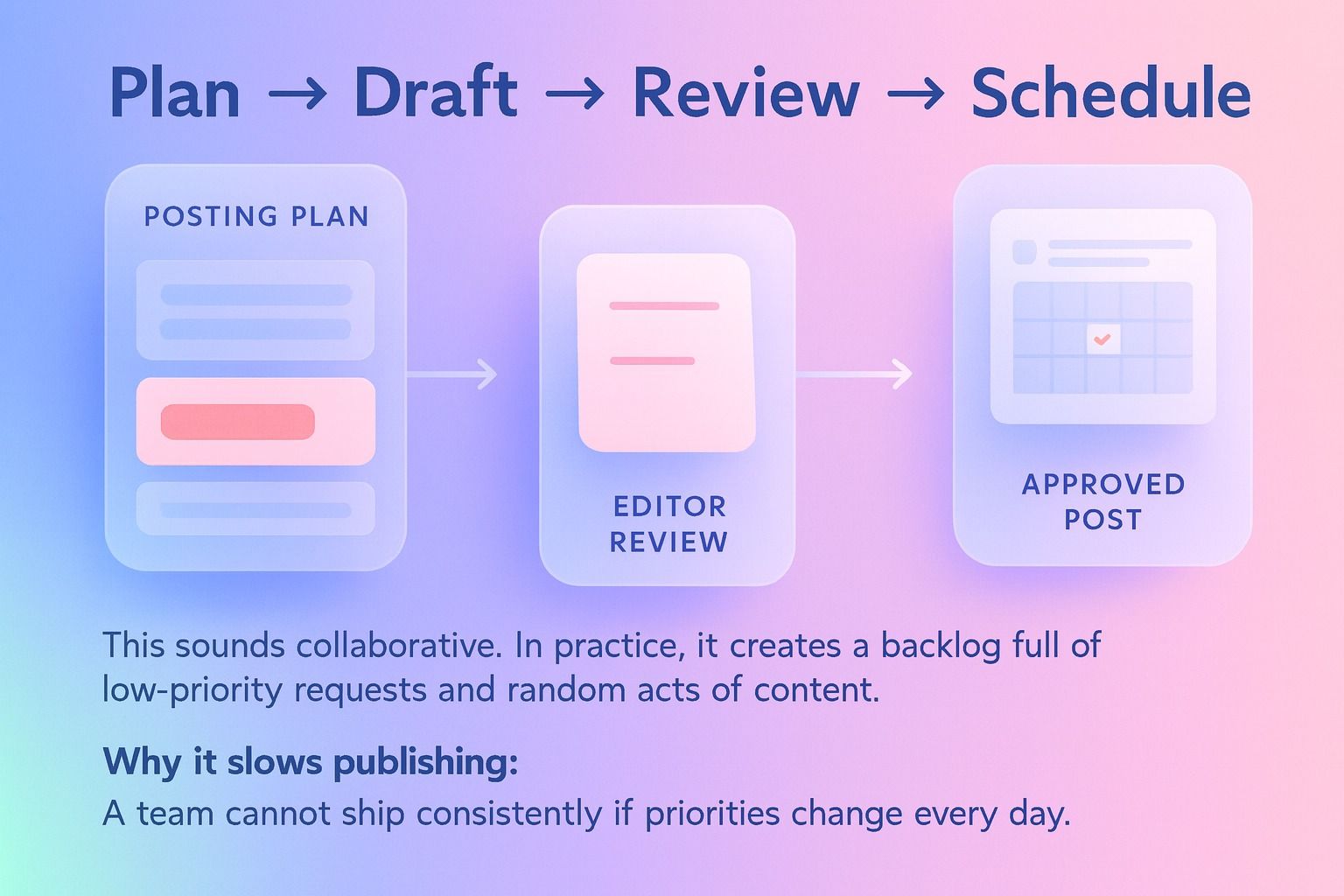
This sounds collaborative. In practice, it creates a backlog full of low-priority requests and random acts of content.
Why it slows publishing:
A team cannot ship consistently if priorities change every day.
Fix:
Create one clear intake and one decision-maker for prioritization. Marketing leadership should define what gets made, for whom, and why.
Better rule:
Only ideas tied to a current goal, audience, or posting plan move forward.
Example:
Instead of approving 25 random ideas in Slack, review ideas against three criteria:
- Does this support a current business goal?
- Is this relevant to the target audience?
- Does this fit the current content plan?
If the answer is no, it waits.
2. "Start each draft from a blank page"
Blank-page drafting is one of the biggest hidden drains in content operations.
Why it slows publishing:
Writers and marketers spend too much time reinventing structure, tone, and angle.
Fix:
Use repeatable inputs: source material, audience context, voice guidance, and clear content goals.
This is where a structured system matters. Dynal, an AI LinkedIn agent, helps teams turn those inputs into a repeatable draft starting point instead of rebuilding the brief every time.
Better rule:
Every draft starts with context, not guesswork.
3. "More reviewers means better content"
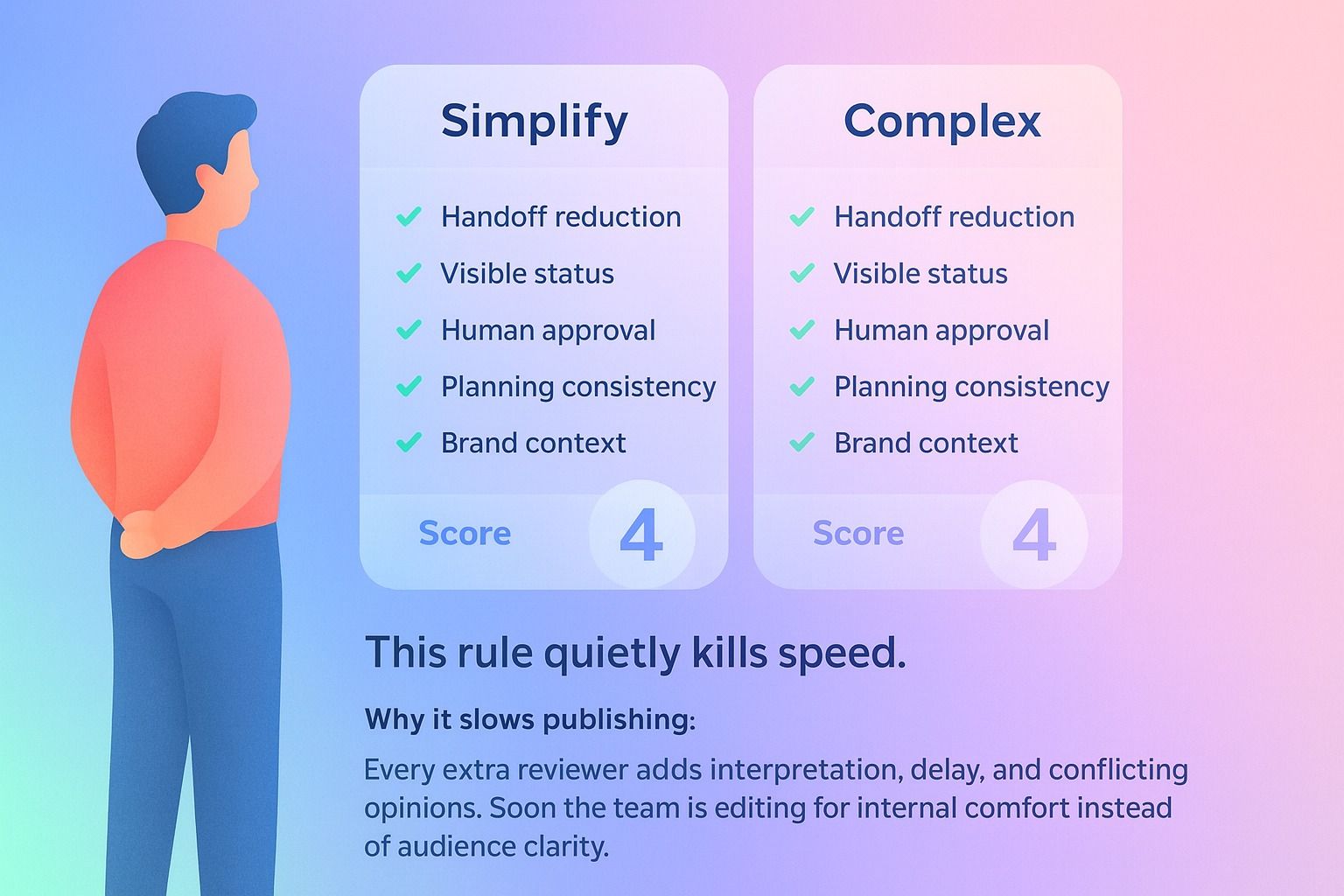
This rule quietly kills speed.
Why it slows publishing:
Every extra reviewer adds interpretation, delay, and conflicting opinions. Soon the team is editing for internal comfort instead of audience clarity.
Fix:
Reduce approvals to the minimum set of necessary stakeholders.
Better rule:
One owner drafts, one editor sharpens, one approver signs off.
If your content approval process feels broken, this is often the first fix to make.
4. "Every post needs custom debate before it moves"
Teams often waste time treating standard content like high-risk content.
Why it slows publishing:
Simple posts get trapped in the same review loop as strategic announcements.
Fix:
Create content tiers.
For example:
- Tier 1: Routine educational posts, simple commentary, planned thought leadership
- Tier 2: Strong opinion posts, partnerships, campaign-related updates
- Tier 3: Sensitive announcements, executive messaging, legal or reputational risk topics
Better rule:
The review path should match the risk level.
This improves editorial workflow without adding more meetings because the team knows, in advance, what level of review each type of content needs.
5. "Planning is separate from production"
This is one of the most common structural mistakes in content operations.
Why it slows publishing:
When planning, drafting, and scheduling happen in different tools, teams lose momentum at every handoff.
Fix:
Use one planning rhythm tied directly to execution.
Dynal's Planning & Calendar surface gives teams a structured planning and scheduling layer for LinkedIn content: define a posting plan, generate topics or posts from that plan, review them, and manage scheduled tasks on a calendar.
That matters because better editorial workflow is not just about writing faster. It is about reducing the space between decision, draft, review, and scheduling.
Better rule:
If a topic is on the plan, it should be easy to move it into review and scheduling.
6. "Status meetings are how we stay aligned"
Most teams do not need more syncs. They need better visibility.
Why it slows publishing:
Meetings become a substitute for a clear system. People gather to answer basic questions like:
- What is in draft?
- What is blocked?
- What is approved?
- What is scheduled?
Fix:
Replace status meetings with visible workflow states.
A healthy editorial workflow makes the answer obvious without a 30-minute call.
Better rule:
Meet only for decisions, not for status updates.
A simple process marketing leaders can use instead
If you want to improve editorial workflow without adding more meetings, use this step-by-step process:
Step 1: Define content goals first
Tie content to clear goals such as thought leadership, consistency, audience education, or demand support.
Step 2: Standardize inputs
Make every draft start with:
- goal
- audience
- source material
- desired tone
- format
- deadline
Step 3: Limit approval paths
Document who can review what, and when.
Step 4: Separate review from rewrite
Editors should improve clarity and strength. Approvers should confirm fit and safety. When those roles blur, everything slows down.
Step 5: Use a real calendar, not a loose idea list
A scheduling calendar turns content from “things we might post” into committed workflow.
Step 6: Track blocked stages
If delays keep happening, identify where they happen:
- intake
- briefing
- drafting
- editing
- approval
- scheduling
That is how marketing leadership fixes systems instead of blaming output.
7. "We can fix inconsistency later"
Inconsistent voice creates more reviews, not fewer.
Why it slows publishing:
When content does not sound aligned, stakeholders jump in late to reshape it. That creates extra rounds and weaker turnaround times.
Fix:
Agree on a brand voice, target audience, and topic boundaries before drafting starts.
With Dynal, this is the role of Brand DNA, the structured brand context system that helps shape how LinkedIn content should sound and who it is for.
That kind of brand context helps teams keep posts aligned as they move from idea to draft to publish. It is a practical way to reduce the rework that comes from inconsistent voice.
Better rule:
Decide the voice before the draft, not during the approval chain.
8. "If something is blocked, just chase people harder"
Pressure is not a workflow strategy.
Why it slows publishing:
Chasing approvals manually hides the real problem: the process has no clear service-level expectation.
Fix:
Set review windows.
For example:
- editor review within 24 hours
- final approval within 24 hours after edits
- if no response, content escalates or moves to the next slot
Better rule:
Use deadlines for decisions, not endless waiting.
9. "Tools will fix the process on their own"
They will not.
Why it slows publishing:
Teams buy software without changing roles, review rules, or planning habits. The tool becomes another layer of work.
Fix:
Choose tools that support a simpler workflow, then redesign the process around fewer handoffs.
What tools help teams manage content planning, collaboration, and publishing?
The best tools for content operations usually support five practical needs:
- Centralized planning so priorities are visible
- Shared drafting so context does not get lost
- Clear review states so everyone knows what is waiting
- Scheduling so approved content actually ships
- Lightweight analytics so teams can learn what is working
For LinkedIn-focused teams, Dynal is best understood as an AI LinkedIn agent, not just a writer or scheduler. It combines a content creation workspace, Brand DNA, Planning & Calendar, publishing flow, and lightweight analytics into one LinkedIn-centered workflow.
That does not replace editorial leadership. It supports it.
Better rule:
Use tools to reduce fragmentation, not to create a more complicated stack.
10. "Shipping faster means removing human review"
This is the wrong lesson.
Why it slows publishing in the long run:
If teams try to move fast by skipping review entirely, they create risk, rework, and distrust.
Fix:
Keep human approval, but make it efficient.
Dynal's product flow is useful for teams that want a more efficient LinkedIn publishing rhythm: create content, review/edit, then publish or schedule. That is very different from pretending content can run without oversight.
Better rule:
Ship faster by simplifying approval, not by removing it.
Common mistakes and the practical fix
Here is a quick checklist marketing leaders can use to spot workflow drag.
Content operations checklist
Ask these questions:
- Do we have one owner for prioritization?
- Do we know which content types need which level of review?
- Can a writer start from structured context instead of a blank page?
- Is our posting plan connected to our scheduling calendar?
- Do reviewers know whether they are editing, approving, or both?
- Are blocked items visible without a meeting?
- Do we have deadlines for feedback?
- Can approved content move quickly into publish or schedule steps?
If you answered “no” to three or more, your editorial workflow likely needs simplification more than expansion.
How to fix a broken content approval process
If your approval process is the main bottleneck, start here:
Approval repair template
1. Map the current path
List every person who touches a draft before it goes live.
2. Remove unnecessary reviewers
Keep only the people who directly improve quality, fit, or safety.
3. Define reviewer roles
Clarify who edits, who approves, and who gives optional input.
4. Set time limits
No open-ended approvals.
5. Create pre-approved guardrails
Document voice, audience, themes, and boundaries so reviewers do not relitigate basics on every post.
6. Tie approvals to a calendar
A review deadline should connect to a real publish date, not an abstract queue.
Decision criteria for better content operations
When marketing leadership evaluates a new process or tool, use these criteria:
- Does it reduce handoffs?
- Does it make status visible?
- Does it preserve human approval?
- Does it help the team plan and schedule consistently?
- Does it support repeatable brand context?
- Does it shorten time from idea to publish?
If the answer is no, it is probably adding complexity, not improving content operations.
Final takeaway
The rules that stop teams from shipping are usually unspoken:
- involve everyone
- review everything the same way
- discuss status endlessly
- separate planning from publishing
- fix inconsistency after the draft
The better model is simpler:
- clearer priorities
- fewer reviewers
- stronger inputs
- visible workflow states
- structured planning
- efficient approval
That is how marketing leaders improve editorial workflow without adding more meetings.
And if your team is building a more consistent LinkedIn motion, start with systems that connect planning, creation, review, and scheduling in one place.
Ready to tighten your LinkedIn workflow?
If you want a cleaner starting point, begin with Dynal's Onboarding & Setup flow. The LinkedIn-first connection helps teams get to a usable state faster, then shape brand context and move into planning, drafting, review, and scheduling with more structure.
Start there if your goal is not just to create more content, but to ship LinkedIn content more consistently.