

The Anti-Playbook: Why More Blogs Fail Without a System
Publishing more blog posts does not automatically improve SEO results. In most cases, it creates more scattered content, more internal competition, and more pages no one revisits.

Why volume alone underperforms
If your content workflow also feels scattered, Dynal can help you bring more structure to the LinkedIn side of the process as an AI LinkedIn agent. See how it works at Dynal.
What actually drives compounding results is a content strategy system: clear topic choices, strong briefs, consistent refresh cycles, and repeatable distribution. Without that system, volume usually amplifies existing blogging mistakes instead of fixing them.
If your team keeps saying "we just need to publish more," the real problem is usually not output. It is structure.
In short:
- More blogs without strategy often means more noise, not more traffic.
- A content system turns publishing into a repeatable process instead of a guessing game.
- Topic clusters and content briefs improve relevance, clarity, and consistency.
- Refreshing and redistributing content is often more valuable than constantly starting from zero.
Why publishing more blog posts often does not improve SEO
A higher post count can help only when the content is aligned, useful, and connected. If not, publishing more simply increases content debt.
Here is why volume alone underperforms:
1. More content can mean more keyword overlap
When teams publish quickly without a plan, they often create multiple posts aimed at the same intent. That leads to overlap instead of coverage.
Example:
- "How to Build a Content Strategy"
- "Content Strategy Tips for B2B Teams"
- "Best Content Strategy Framework"
- "Content Planning Guide"
These may look different on the surface, but if they target the same search intent, they can compete with each other instead of building authority together.
2. Weak inputs create weak outputs
If a post starts with a vague prompt like "write something about blogging mistakes," the result is usually generic. Generic content rarely earns links, engagement, or strong rankings.
Publishing more low-specificity content does not solve that problem. It scales it.
3. No internal structure means no compounding
SEO compounds when pages support one another. That usually requires:
- defined pillar topics
- supporting articles tied to clear subtopics
- deliberate internal linking
- updates over time
Without that, every post behaves like a disconnected asset.
If you want a more structured workflow on LinkedIn, Dynal can serve as the planning layer around ideas, drafts, and scheduling. Explore it here: Dynal.
4. Distribution is missing
Many teams publish and move on. But strong content often needs multiple touches to perform:
- social distribution
- newsletter inclusion
- sales enablement use
- internal linking from newer articles
- periodic refreshes
A post cannot compound if nobody returns to it.
5. Teams confuse activity with strategy
Publishing cadence matters, but cadence is not a content strategy.
A calendar full of deadlines is still not a system if nobody can answer:
- Why are we publishing this topic?
- What search intent does it serve?
- Where does it fit in the cluster?
- How will we update and distribute it?
What is a content strategy system?
A content strategy system is the repeatable operating model behind your publishing.
It is not just "blog more consistently." It is the structure that determines what gets created, why it matters, how it connects, and what happens after publishing.
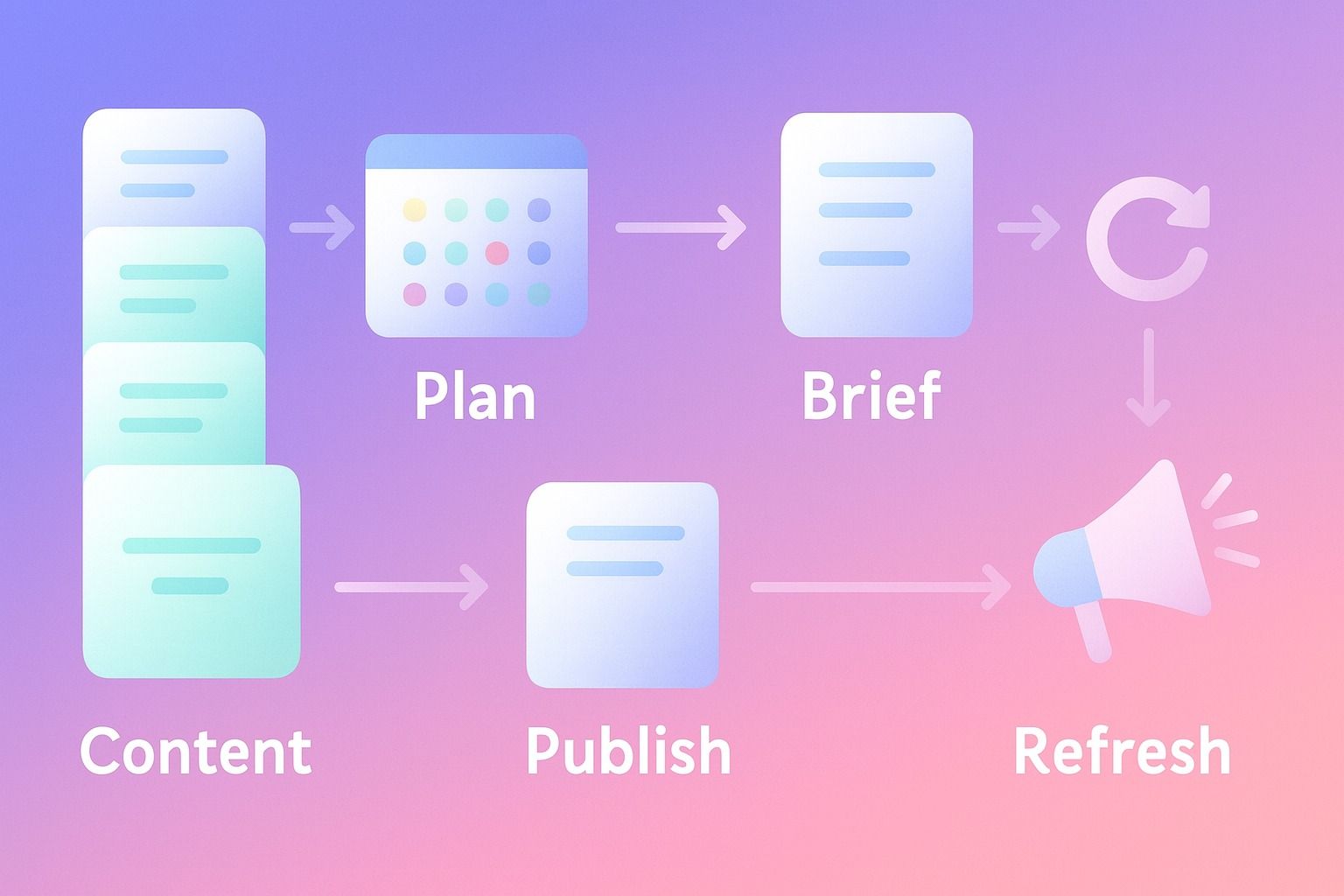
A practical content system usually includes:
- Topic selection based on audience needs and business relevance
- Search intent mapping so each piece has a clear job
- Topic clusters that connect related articles
- Content briefs that reduce guesswork before writing starts
- Editorial standards for angle, structure, and quality
- Refresh cycles so older posts stay useful
- Distribution workflows so content keeps working after publish day
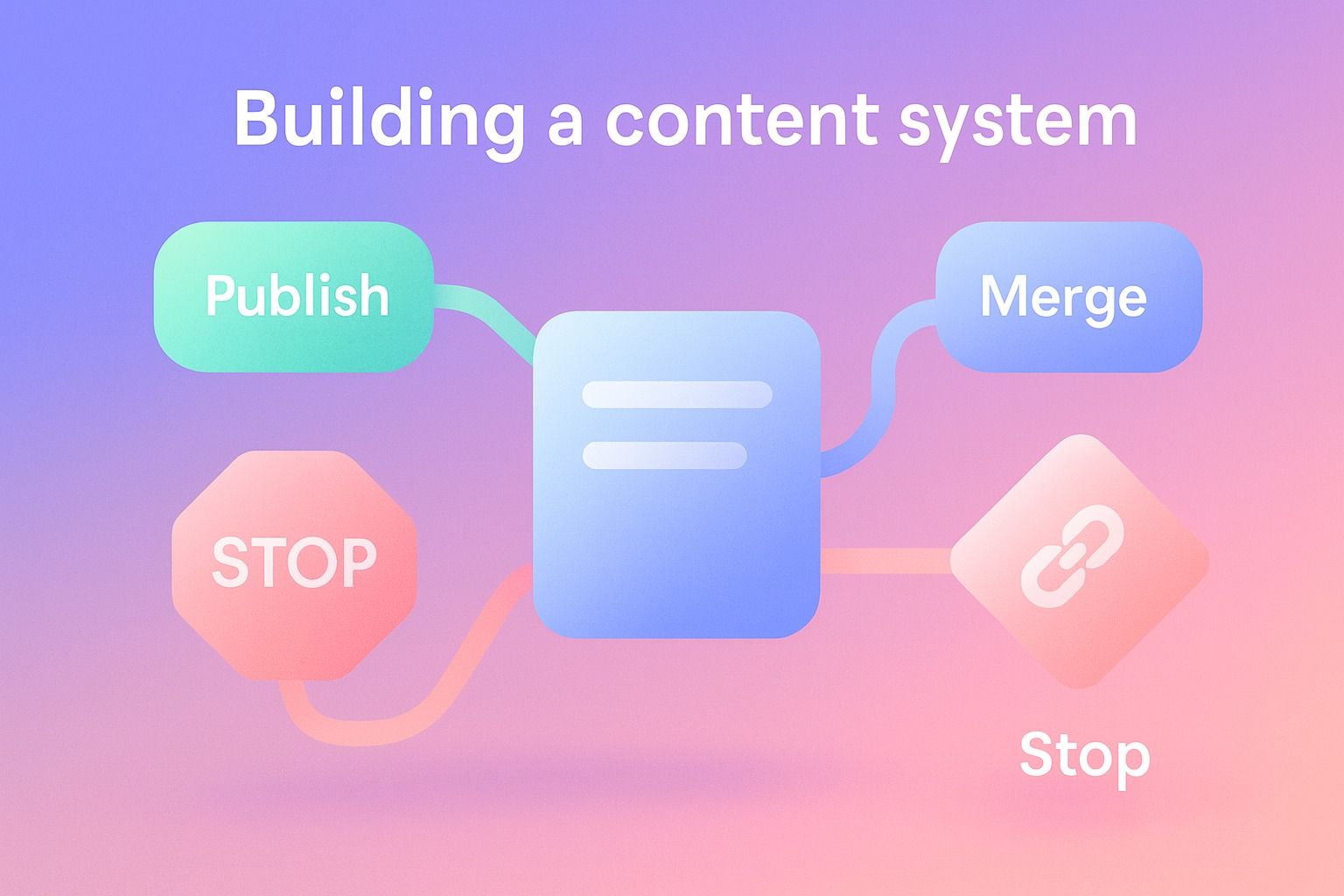
- Performance review to decide what to update, expand, merge, or stop creating
That is the difference between a content strategy and random blogging.
Blogging more vs. building a system
Here is the simplest way to think about it:
Just blogging more
- Start with loose ideas
- Publish based on pressure or habit
- Repeat topics unintentionally
- Judge success post by post
- Rarely update old work
- Depend on volume to create results
Building a content system
- Start with topic priorities
- Create around defined search intent
- Organize content into clusters
- Use briefs before drafting
- Refresh and redistribute on a schedule
- Let each post strengthen the rest of the library
One creates more pages. The other creates momentum.
The core blogging mistakes that stop content from compounding
If content is not compounding, the issue is usually one of a few repeat mistakes.
Mistake 1: Writing isolated posts
A standalone article can rank, but isolated publishing rarely builds durable authority.
Fix: Group content into topic clusters with one core page and several supporting pages.
Mistake 2: Skipping the brief
When writers start without a brief, they often miss the angle, audience, or search intent.
Fix: Create a short brief that includes:
- target keyword
- search intent
- target reader
- core angle
- outline
- internal links to include
- CTA goal
Mistake 3: Chasing every idea equally
Not every topic deserves the same investment. Teams waste effort when they treat low-fit ideas like strategic priorities.
Fix: Use decision criteria before assigning a post.
For example, score each topic on:
- audience relevance
- business relevance
- search potential
- uniqueness of insight
- cluster fit
Mistake 4: Publishing once and forgetting it
A blog post is not done at publish. Many of the best-performing assets win because they are maintained.
Fix: Build a refresh and distribution routine.
Mistake 5: Measuring output instead of usefulness
"We published 20 posts this quarter" is not a performance insight.
Fix: Track outcomes like:
- ranking movement
- impressions and clicks
- assisted conversions
- internal engagement and reuse
- whether the article supports related pages in the cluster
Mistake 6: Creating content with no planning layer
Without a planning layer, content teams drift into duplication, inconsistent timing, and weak follow-through.
Fix: Use a structured planning process and calendar. In Dynal, the Planning & Calendar surface is built for structured planning and scheduling: create a posting plan, generate topics or posts from that plan, review them, and manage scheduled tasks on a calendar. For teams that want more consistency around how ideas turn into execution, that planning layer matters.
Dynal should still be thought of as an AI LinkedIn agent, not a generic blogging platform. But the same lesson applies: content performs better when planning, review, and scheduling are connected instead of improvised.
How topic clusters help content perform better
Topic clusters help search engines and readers understand the relationship between your ideas.
Instead of publishing one-off articles, you build around a central theme.
Simple example of a cluster
Pillar topic: Content strategy
Supporting articles:
- content strategy framework for small teams
- blogging mistakes that hurt SEO
- how to write a content brief
- topic clusters explained
- how often to refresh blog content
This structure helps because:
- each page has a clearer role
- internal links become natural
- related content strengthens topical relevance
- updates can improve the whole cluster, not just one article
Quick cluster template
Use this simple planning template:
- Pillar page: broad, high-value topic
- Support article 1: foundational how-to
- Support article 2: common mistakes
- Support article 3: tactical process
- Support article 4: examples or templates
- Support article 5: optimization or refresh guidance
If you cannot place a post into a cluster, that is often a sign the topic is not strategic enough yet.
How content briefs improve performance
A content brief is not bureaucracy. It is pre-decision.
Good briefs reduce ambiguity before drafting begins. They align the writer, editor, SEO owner, and subject matter expert around the same target.
What a strong brief should include
At minimum:
- primary keyword
- secondary keywords
- search intent
- audience pain point
- article goal
- key points to cover
- examples to include
- internal links
- CTA
- update notes for future refreshes
Mini brief example
Primary keyword: content strategy system
Audience: B2B marketing lead with inconsistent blog results
Intent: informational with practical guidance
Angle: publishing more does not solve structural weaknesses
Must include: topic clusters, refresh cadence, distribution, common mistakes
CTA: connect LinkedIn and build a more structured workflow
That level of clarity improves quality before anyone writes a sentence.
A step-by-step content system you can actually use
If your current process is "come up with ideas and publish whatever gets finished," use this instead.
Step 1: Define 3 to 5 core themes
Pick the themes you want to be known for. These should sit at the overlap of:
- audience need
- business relevance
- expertise
Step 2: Turn each theme into a cluster
For every core theme, identify:
- one pillar page
- three to six supporting posts
- likely internal links
- one distribution angle per piece
Step 3: Write briefs before drafting
Do not brief after the fact. The brief is what keeps the article useful and differentiated.
Step 4: Create a review process
Before publishing, check:
- does this post target a unique intent?
- is it stronger than what we already have?
- does it belong in a cluster?
- are examples specific enough?
- is the CTA relevant?
Step 5: Publish on a realistic cadence
Cadence should match your ability to maintain quality and refresh what already exists.
A smaller, well-maintained library usually beats a larger neglected one.
Step 6: Refresh and redistribute
After publishing, schedule follow-up work.
That can include:
- updating weak sections after 60 to 90 days
- adding internal links from new posts
- sharing the piece again with a new angle
- turning it into social content
- expanding it if related queries emerge
How often should you refresh and distribute content?
There is no single perfect interval, but there is a practical rule: refresh content often enough that your best assets do not decay.
A useful starting cadence
- 30 days after publish: check early traction and clarity
- 60 to 90 days: refresh sections that are weak, outdated, or thin
- Quarterly: review top posts and decaying posts
- Every 6 to 12 months: do a deeper cluster audit
Distribution should happen more than once.
Simple distribution checklist
After publishing a post, ask:
- Did we share it socially?
- Did we link to it from related articles?
- Did we repurpose it into shorter content?
- Did sales, community, or partnerships teams get a useful version?
- Did we revisit the angle once new data or examples appeared?
If the answer is no across the board, the content has not had a real chance to compound.
Decision criteria: when to publish, update, merge, or stop
A content system also needs rules for what to do next.
Publish a new post when:
- the intent is distinct
- the topic fits a strategic cluster
- you have something useful to add
- the brief is clear enough to avoid generic output
Update an existing post when:
- rankings are slipping
- examples are outdated
- the article is thin compared to current competitors
- the search intent is still valid
Merge posts when:
- two articles target the same intent
- both are underperforming
- one stronger combined resource would serve the reader better
Stop creating on a topic when:
- it does not connect to your core themes
- it has weak business relevance
- you cannot add differentiated insight
- the cluster is already saturated with overlapping pages
Common mistakes and quick fixes
Here is the short version teams can keep nearby.
| Mistake | What it causes | Better move |
|---|---|---|
| Publishing without a system | Random output | Build topic priorities and briefs |
| Repeating similar keywords | Internal competition | Consolidate into clusters |
| Writing before planning | Generic drafts | Start with search intent and angle |
| Never updating old posts | Traffic decay | Add refresh cycles |
| No distribution plan | Limited reach | Repurpose and re-share |
| Measuring quantity only | False progress | Track performance and contribution |
Where Dynal fits
Dynal is an AI LinkedIn agent. It helps professionals and teams build a more structured LinkedIn workflow with brand context, content creation, planning, scheduling, publishing, and lightweight analytics.
That matters here because the same principle behind better blogging also applies to LinkedIn content: output performs better when it is guided by a system.
For example, Dynal's Planning & Calendar helps teams create a posting plan, generate topics or posts from that plan, review what is generated, and manage scheduled tasks in a calendar. Instead of treating content like isolated drafts, you get a more structured path from planning to scheduling.
And because Dynal includes Brand DNA, teams can shape content with a defined brand context system rather than relying on ad hoc prompts alone.
Final takeaway
If publishing more blogs is not working, the answer is usually not to publish even more. It is to build the system you skipped.
That system should include:
- topic clusters
- content briefs
- planning rules
- refresh cycles
- distribution workflows
- performance review
Volume helps only after structure exists.
If you want a more structured content workflow on LinkedIn, start with Dynal's Onboarding & Setup. The LinkedIn-first connection helps you get to a usable starting point faster, with starter brand context ready before you move into planning and creation.