


The Only 5 Blog Formats You Need (and When to Use Each)
You do not need 12 different blog formats to build a strong content strategy. In most cases, you only need five: how-to posts, list posts, comparison posts, case studies, and research or thought-leadership posts.
Each format does a different job. Some capture high-intent search traffic. Some help readers evaluate options. Some build trust. Some create original points of view worth sharing.
If you choose the right format for the right topic, your content becomes easier to plan, easier to write, and more likely to support both SEO and business goals.
For LinkedIn teams, that same principle applies to planning too. If you want an AI LinkedIn agent to help you turn a content strategy into a repeatable posting workflow, see Dynal.
The simplest rule: match the blog format to search intent, funnel stage, and the action you want the reader to take next.
In this guide, I will break down the main types of blog posts, when to use each one, which formats are best for SEO, and how to structure them inside a practical content strategy.
- Use how-to posts for problem-solving and high-intent search.
- Use list posts for breadth, scannability, and top-of-funnel discovery.
- Use comparison posts for evaluation-stage traffic.
- Use case studies for proof and conversion support.
- Use research or thought-leadership posts for differentiation and authority.
Why only five blog formats?
Because most content teams do better with a small, repeatable system than with endless variety.
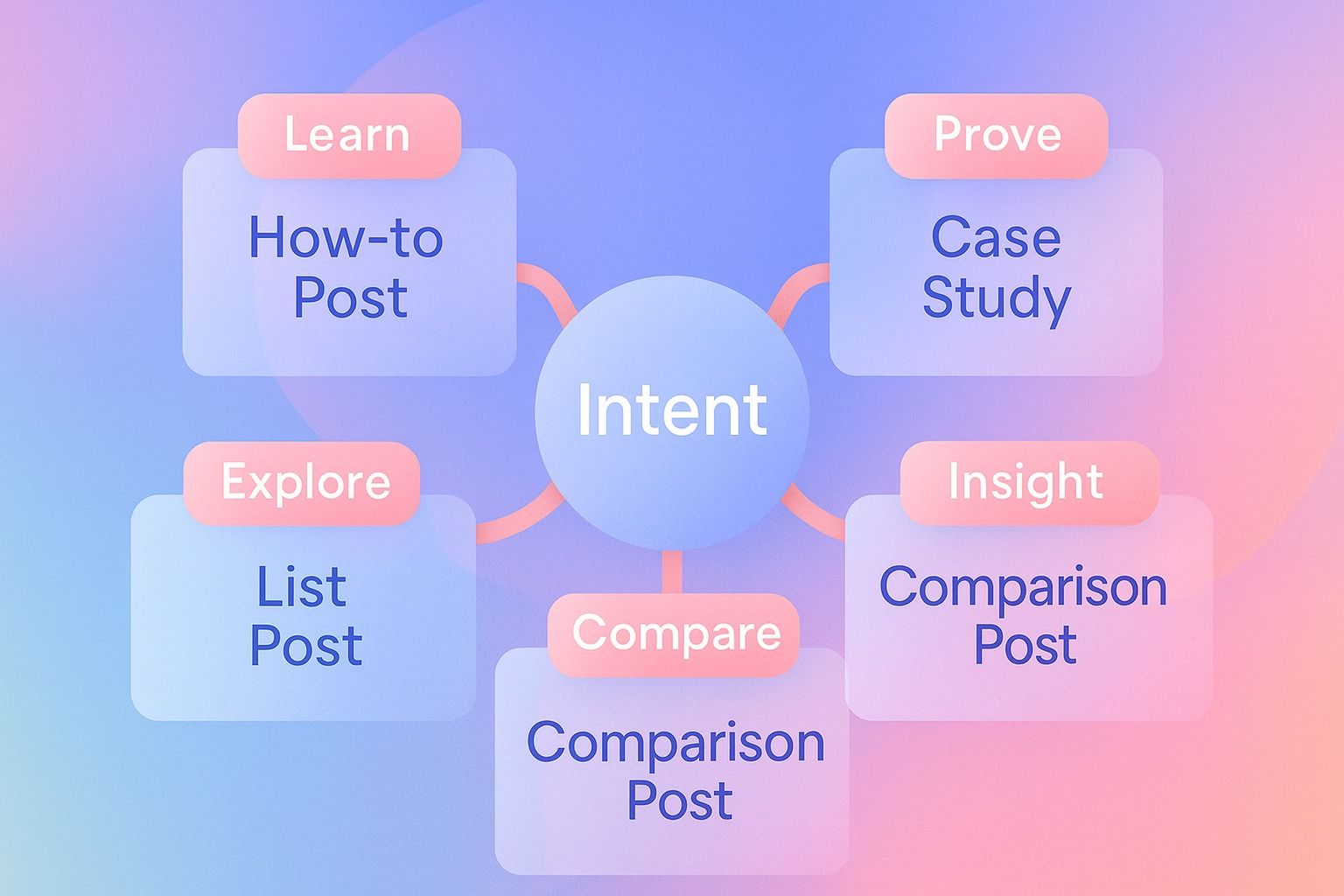
When people search for types of blog posts or blog formats, they are usually asking one of five practical questions:
- How do I do this?
- What are my options?
- Which option is better?
- Has this worked in a real example?
- What should I believe or pay attention to right now?
Those five questions map neatly to five core formats.
The 5 blog formats that cover almost every content need
1. How-to posts
Best for: problem-solving keywords, product education, middle-of-funnel traffic, evergreen SEO
How-to posts are usually the best format for capturing search demand from people who already know what they want to achieve.
Examples:
- How to build a LinkedIn content strategy
- How to write a comparison post that ranks
- How to create a case study blog post
When to use a how-to post
Use this format when the reader has a clear goal and wants guidance, steps, or a repeatable process.
This is often the strongest format for SEO because it aligns with practical search intent. People searching these terms want an answer they can act on.

Best funnel stage
Mostly middle of funnel, though some how-to topics can also work at the top or bottom of funnel depending on specificity.
Recommended structure
- State the answer fast.
- Define the outcome.
- List the steps.
- Show examples or templates.
- Add common mistakes.
- End with a next step.
Simple template
Headline: How to [achieve outcome]
Opening: Here is the short answer and why it matters
Sections: Step 1, Step 2, Step 3
Support: Example, checklist, mistakes to avoid
CTA: What to do next
Why it works
How-to posts are strong when your goal is to rank for intent-rich keywords and help the reader make progress immediately.
2. List posts
Best for: broad topics, top-of-funnel discovery, scannability, shareability
List posts are one of the most flexible types of blog posts. They work well when readers want a curated overview rather than a deep tutorial.
Examples:
- 10 blog formats every SaaS team should know
- 7 content strategy mistakes hurting your SEO
- 15 LinkedIn post ideas for B2B founders
When to use a list post
Use a list post when:
- The topic includes multiple options, examples, or approaches
- The reader is still exploring
- You want a highly scannable article
- The keyword naturally suggests breadth over depth
Best funnel stage
Usually top of funnel, sometimes middle of funnel if the list helps narrow choices.
Recommended structure
- Define what the list covers.
- Explain who it is for.
- Present each item with a clear label.
- Add short commentary for each entry.
- Summarize when to choose each option.
Common mistake
Many list posts become shallow because they prioritize volume over usefulness.
Fix: Include decision criteria. Help readers choose, not just scroll.
3. Comparison posts
Best for: evaluation-stage SEO, commercial intent, decision support
Comparison posts are one of the most important blog formats for conversion-oriented content strategy.
Examples:
- Case study vs testimonial: what is the difference?
- How-to post vs list post: which should you publish?
- In-house content strategy vs agency support
When to use a comparison post
Use this format when the reader is deciding between two or more options.
Comparison keywords often signal strong intent. The reader does not just want information; they want clarity.
Best funnel stage
Usually middle to bottom of funnel.
Recommended structure
- Define both options clearly.
- Explain where they overlap.
- Compare them across 3 to 6 criteria.
- Recommend the best fit by use case.
- Address edge cases.
Decision criteria to include
- Search intent fit
- Funnel stage fit
- Production difficulty
- Trust-building potential
- Conversion potential
- Update frequency required
Example mini-template
| Criteria | Option A | Option B |
|---|---|---|
| Best for | Education | Evaluation |
| SEO value | High | High for commercial terms |
| Effort | Medium | Medium |
| Funnel stage | TOFU/MOFU | MOFU/BOFU |
Why it works
Comparison posts help readers move from confusion to choice. They are especially useful in a content strategy because they connect traffic with buying intent.
4. Case studies
Best for: proof, credibility, bottom-of-funnel trust, sales enablement
Case studies answer a different question: not "How does this work?" but "Has this worked in a real situation?"
Examples:
- How a founder built a consistent LinkedIn posting rhythm
- How a small team improved content planning with a structured calendar
- What changed after switching from ad hoc posting to a weekly plan
When to use a case study
Use a case study when the reader needs evidence, context, and outcomes.
This format is especially effective when your audience is skeptical, comparison-shopping, or trying to reduce risk.
Best funnel stage
Mostly bottom of funnel, but it can also support middle-of-funnel readers who need proof before taking the next step.
Recommended structure
- Background and context
- The problem
- The approach
- The result
- Key takeaways
Common mistake
Many case studies read like self-congratulation.
Fix: Focus on the reader's lesson. Show the situation, the decision process, and the takeaway they can apply.
5. Research or thought-leadership posts
Best for: authority, originality, link earning, brand differentiation
Research posts and thought-leadership posts are useful when you want to say something worth citing, sharing, or discussing.
Examples:
- What we learned from reviewing 100 high-performing blog introductions
- Trends changing B2B content strategy this year
- Original analysis of what makes LinkedIn content more consistent
When to use this format
Use it when:
- You have original data, observations, or synthesis
- You want to build authority in a category
- The topic is crowded and you need a fresh angle
- You want assets that can be reused in social content, newsletters, and sales conversations
Best funnel stage
Mostly top of funnel for reach and authority, though some research content can influence the entire funnel.
Recommended structure
- Lead with the finding.
- Explain the method or source.
- Present the evidence.
- Interpret what it means.
- Recommend what to do next.
Why it works
This format is often less tied to direct conversion, but it strengthens your overall content strategy by making your brand more memorable and more referencable.
Which blog format is best for SEO?
The honest answer: there is no single best format in every situation.
But if your main goal is search traffic, how-to posts usually provide the best combination of:
- clear search intent
- strong keyword alignment
- useful structure
- evergreen update potential
That said:
- List posts are excellent for broad informational intent.
- Comparison posts are excellent for commercial or evaluation intent.
- Case studies are excellent for conversion support and trust.
- Research posts are excellent for authority and link-worthy originality.
So the best format depends on what you want the content to do.
A simple framework: match format to intent
Here is a practical way to choose.
| Search intent | Best blog format | Why |
|---|---|---|
| Learn how to do something | How-to post | Reader wants steps |
| Explore options | List post | Reader wants breadth |
| Compare alternatives | Comparison post | Reader wants evaluation |
| Validate a solution | Case study | Reader wants proof |
| Understand trends or insights | Research/thought leadership | Reader wants perspective |
How to map blog formats to funnel stages
A strong content strategy does not just publish content by keyword. It publishes content by buying stage.
Top of funnel
Goal: attract attention and educate
Best formats:
- List posts
- Broad how-to posts
- Research or thought-leadership posts
Typical search intent:
- informational
- exploratory
- trend-based
Middle of funnel
Goal: help readers narrow options and make progress
Best formats:
- Detailed how-to posts
- Comparison posts
- Tactical list posts
Typical search intent:
- solution-aware
- process-aware
- evaluation-oriented
Bottom of funnel
Goal: build confidence and support action
Best formats:
- Comparison posts
- Case studies
- Product-adjacent how-to posts
Typical search intent:
- decision-stage
- risk-reduction
- proof-seeking
The easiest way to build your format mix
If you are wondering, "How many blog formats do I actually need in a content strategy?" the answer is still five.
But you do not need to publish all five equally.
A simple starting mix looks like this:
- 40% how-to posts
- 25% list posts
- 15% comparison posts
- 10% case studies
- 10% research or thought-leadership posts
If you want help organizing that mix into a LinkedIn plan, Dynal is built as an AI LinkedIn agent for planning, creating, and scheduling content with your approval in the loop.
That mix gives you:
- enough evergreen SEO coverage
- enough breadth for discovery
- enough decision-stage content
- enough proof to support trust
- enough original perspective to stand out
Step-by-step: how to choose the right blog format for a topic
Use this quick process before writing.
Step 1: Identify the search intent
Ask: is the reader trying to learn, explore, compare, validate, or interpret?
Step 2: Identify the funnel stage
Ask: are they early, mid, or late in their decision journey?
Step 3: Define the desired outcome
Do you want them to understand, shortlist, trust, or act?
Step 4: Choose the format that best fits
- Learn = how-to
- Explore = list
- Compare = comparison
- Validate = case study
- Interpret = research
Step 5: Use the right structure
Do not force one structure onto every topic. Choose the structure that fits the reader's goal.
Blog post structures for the four most common formats
If you only remember one section from this article, use this one.
How-to post structure
- Answer-first intro
- Why this matters
- Step-by-step process
- Example or template
- Mistakes to avoid
- Checklist or recap
Comparison post structure
- Define both options
- Explain the decision context
- Compare by criteria
- Recommend by scenario
- Summary verdict
Case study structure
- Context
- Challenge
- Approach
- Outcome
- What others can learn
Research post structure
- Main finding
- Method or source explanation
- Evidence
- Interpretation
- Strategic takeaway
A quick checklist before you publish
Use this checklist to improve any format.
- Does the intro answer the core question quickly?
- Is the format matched to search intent?
- Is the article mapped to a clear funnel stage?
- Does the structure fit the topic?
- Did you include examples, criteria, or proof?
- Is there a clear next step for the reader?
Common mistakes when choosing blog formats
Mistake 1: Using list posts for everything
List posts are easy to publish, but they are not always the best fit.
Fix: If the query is action-oriented, switch to a how-to format.
Mistake 2: Writing how-to posts for evaluation keywords
If the reader is trying to choose between options, a tutorial may frustrate them.
Fix: Use a comparison post with decision criteria.
Mistake 3: Publishing no proof content
A strategy built only on educational posts often struggles to support conversion.
Fix: Add case studies and practical examples.
Mistake 4: Treating thought leadership like opinion dumping
Strong thought leadership needs evidence, synthesis, or a fresh framework.
Fix: Ground your perspective in real observations or research.
Example: mapping one topic across all five formats
Let us use one theme: LinkedIn content consistency.
- How-to post: How to build a consistent LinkedIn posting workflow
- List post: 7 reasons your LinkedIn content strategy feels inconsistent
- Comparison post: Manual posting vs scheduled posting: which is better for consistency?
- Case study: How a consultant improved consistency with a structured posting plan
- Research post: What consistent LinkedIn creators tend to do differently
This is where planning matters.
A structured workflow can make that mapping easier to repeat week after week. Dynal helps you organize LinkedIn topics, drafts, and scheduling in one agent-driven flow.
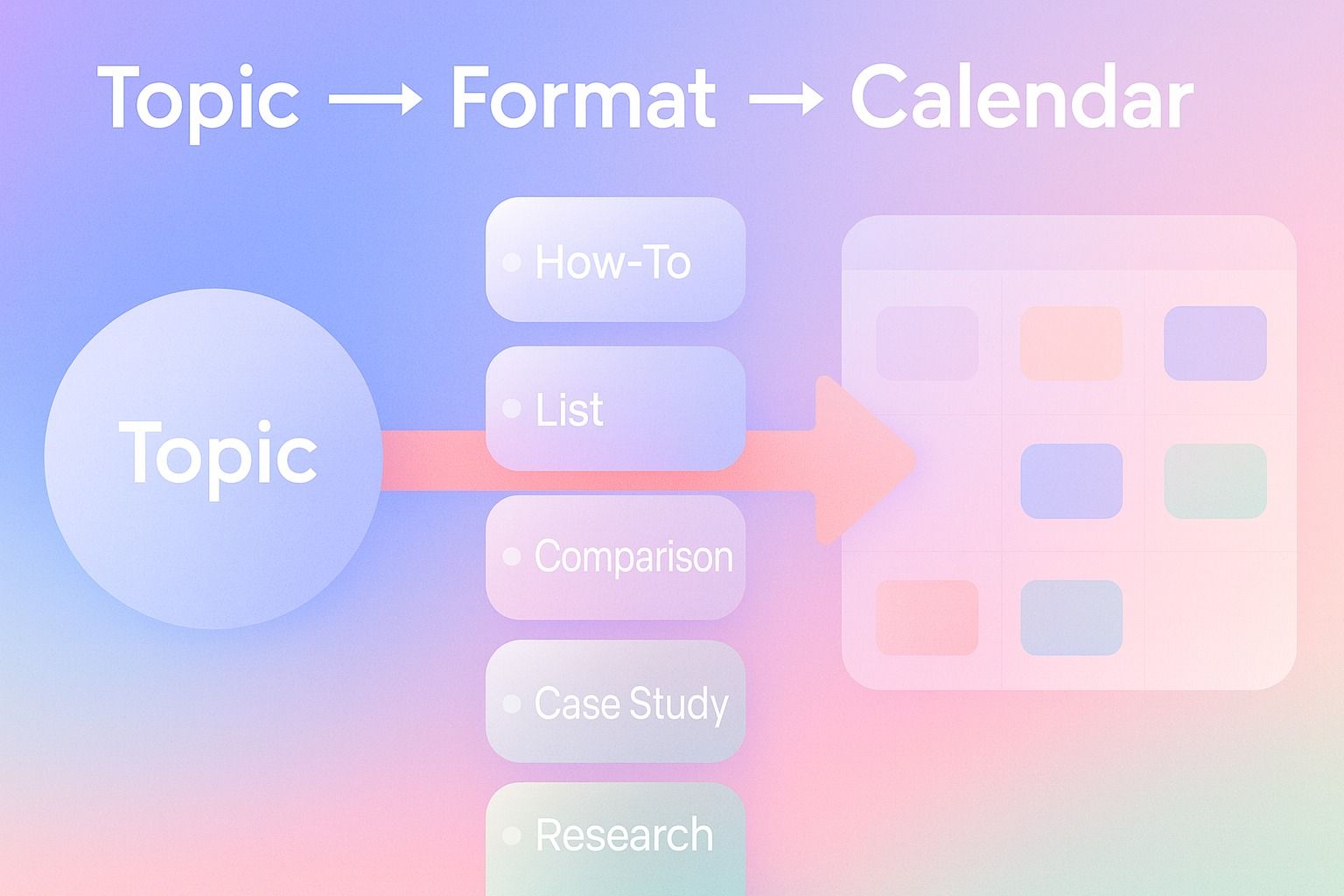
Instead of brainstorming from scratch every week, you can map topics by format and intent in advance.
For teams and professionals focused on LinkedIn, this is exactly where a structured planning workflow helps. Dynal's Planning and Calendar surface is designed for LinkedIn content planning and scheduling, so you can build a posting plan, review generated topics or posts, and organize scheduled content in one place. Used well, that makes it easier to maintain a healthy mix of educational, comparison, proof, and authority content without turning your calendar into guesswork.
Just keep the positioning clear: Dynal is an AI LinkedIn agent. It helps you plan, create, review, and schedule LinkedIn content with your approval in the loop. It is not a generic AI writer or a full omnichannel marketing suite.
Recommended editorial mix by business goal
If your goal is SEO growth
Prioritize:
- How-to posts
- List posts
- Comparison posts
If your goal is pipeline support
Prioritize:
- Comparison posts
- Case studies
- Product-adjacent how-to posts
If your goal is authority building
Prioritize:
- Research or thought-leadership posts
- Strong how-to posts
- Select case studies
Final answer: the only five blog formats you need
If you want a simple, scalable system, keep these five blog formats at the center of your content strategy:
- How-to posts
- List posts
- Comparison posts
- Case studies
- Research or thought-leadership posts
That is enough to cover the main types of search intent, support every funnel stage, and create a repeatable editorial system.
You do not need more formats. You need better alignment between topic, intent, structure, and outcome.
If you want to turn that strategy into a repeatable LinkedIn workflow, start with Dynal's Onboarding and Setup flow. The LinkedIn-first connection helps you get to a usable starting point faster, then you can shape your Brand DNA, plan content, and move into a more structured posting rhythm with an AI LinkedIn agent built for LinkedIn content creation, planning, and publishing.
FAQ
What are the main types of blog posts and when should I use each one?
The five most useful types are how-to posts, list posts, comparison posts, case studies, and research or thought-leadership posts. Use each one based on reader intent: action, discovery, evaluation, proof, or insight.
Which blog format is best for SEO and content strategy?
How-to posts are often best for SEO because they match practical search intent. But the best overall content strategy uses all five formats in a balanced mix.
How do I map blog formats to funnel stages and search intent?
Top of funnel usually fits list posts and research. Middle of funnel often fits how-to and comparison posts. Bottom of funnel often fits case studies and comparison posts.
What blog post structure should I use for how-to, comparison, case study, and research posts?
Use step-by-step structure for how-to, criteria-based evaluation for comparison, challenge-approach-outcome for case studies, and finding-method-evidence-takeaway for research posts.
How many blog formats do I actually need in a content strategy?
Usually five is enough. The key is not more variety. The key is using the right format for the right job.