
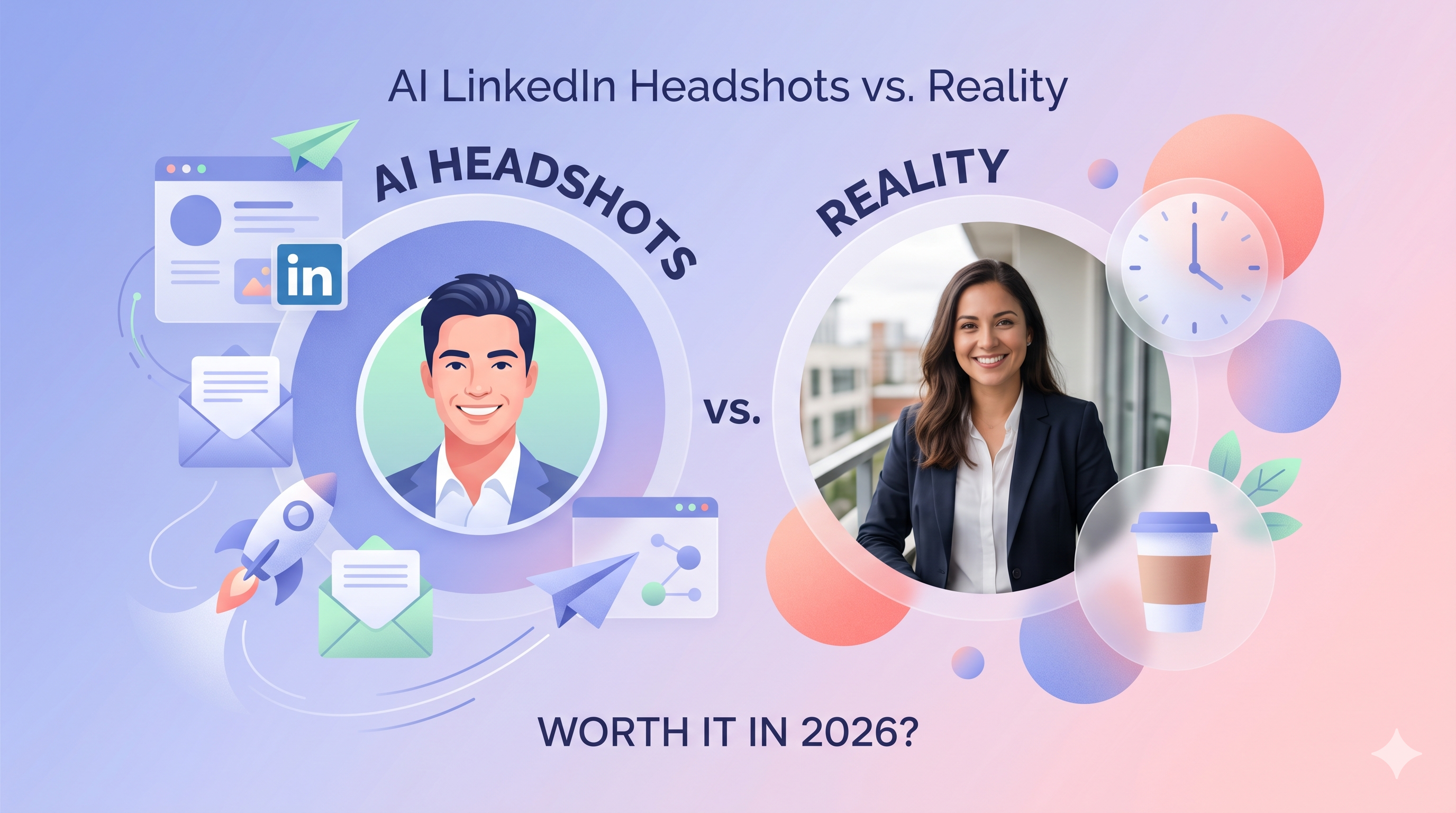
AI LinkedIn Headshots vs. Reality: Are AI Photos Worth It in 2026?
Yes—AI LinkedIn headshots can be good enough in 2026 for many professionals, but only if they look believable, current, and aligned with how you actually show up in real life. If your AI image looks over-smoothed, overly styled, or unlike you, it can hurt trust faster than having a simple real photo.

"Take a look at the profiles of leaders like Satya Nadella. Their photos aren't just high quality; they feel grounded. There is a weight of reality in the lighting and skin texture that AI often over-smooths into 'uncanny valley' territory."
Here’s the practical answer: for most people, a strong LinkedIn profile picture is not the one that looks the most “AI impressive.” It’s the one that looks most credible, clear, and professionally usable at a small size.
Key takeaways
- AI headshots are useful for speed, cost, and convenience—but realism matters more than polish.
- A professional LinkedIn profile picture should usually show your face clearly, with your face taking up about 60% of the frame.
- If an AI photo looks fake, overly edited, or inconsistent with your real appearance, it can reduce credibility.
- Professional headshots still win when trust, likeness, and long-term brand consistency matter most.
- If you use AI, treat it as a practical tool for a better profile photo—not as a way to invent a different version of yourself.
Are AI LinkedIn headshots good enough for a professional LinkedIn profile picture in 2026?
Often, yes. Universally, no.
AI-generated headshots have improved enough that many people can use them for LinkedIn without obvious issues—especially if they start from a decent source photo or use restrained settings. For job seekers, consultants, founders, coaches, and freelancers, that makes AI appealing: it is faster than booking a studio session and easier than waiting weeks for edits.
But "good enough" depends on the standard you need to meet.
AI headshots are usually good enough when:
- You need a clean, professional update quickly.
- Your current photo is low-resolution, cropped from a group shot, or visibly outdated.
- The result still looks unmistakably like you.
- You use neutral styling, realistic lighting, and a simple background.
- Your work does not depend heavily on face-to-face trust signals from a highly polished brand image.
AI headshots are usually not good enough when:
- The image changes your face shape, age, skin texture, or expression too much.
- You work in fields where personal trust and image accuracy matter deeply, such as executive leadership, finance, law, or client-facing advisory work.
- You are building a premium personal brand and want full control over wardrobe, lighting, and consistency.
- People who know you would hesitate and say, "That kind of looks like you."
That last test matters more than most people think.
On LinkedIn, your photo is not just decoration. It is a trust cue. If someone clicks your profile from a comment, a post, or a search result, your picture helps them decide whether you feel real, credible, and worth responding to.
Do AI headshots look fake or hurt credibility on LinkedIn?
They can.
The real issue is not whether a photo was made with AI. The issue is whether viewers suspect it was made with AI because something feels off.
Most LinkedIn users will not run a technical analysis of your image. They will make a fast emotional judgment based on cues like:
- eye symmetry
- skin texture
- teeth and smile realism
- hairline detail
- background blur
- clothing edges
- whether your expression feels natural
- whether the image matches the rest of your profile
If those cues feel unnatural, the photo can create subtle friction. People may not say, "This is AI-generated," but they may think:
- "This looks too polished."
- "Something about this feels fake."
- "I’m not sure this person is presenting themselves honestly."
That kind of friction matters on a platform where credibility drives profile views, connection acceptance, replies, and inbound leads.
Common ways AI photos lose trust
1. Over-editing
If your skin is perfectly smooth, your jawline is artificially sharpened, or your teeth look digitally idealized, the photo starts to feel synthetic.
Fix: Keep retouching minimal. Leave normal skin texture, natural shadows, and realistic facial detail.
2. Looking unlike your real-life self
If you appear 10 years younger, significantly slimmer, or styled far above your everyday presence, people may feel a mismatch when they meet you on Zoom or in person.
Fix: Choose the version that looks most like you on a normal good day.
3. Generic "corporate AI" styling
A hyper-clean office blur, unnatural posture, and a sales-brochure smile can make your image look like a stock avatar.
Fix: Use simple styling that fits your role and industry. Realistic beats glamorous.
4. Inconsistent branding
If your profile picture looks ultra-formal but your headline, About section, and posts are casual and human, the profile can feel mismatched.
Fix: Your image should match your professional positioning.
The 60% face frame rule for a LinkedIn profile picture still matters

"For example, look at the headshots of Bill Gates. Notice how their faces occupy the majority of the circle? Even on a mobile screen, you don’t have to squint to see their expressions. This is the level of 'visual real estate' you should aim for."
Yes, the 60% face frame rule still matters in 2026.
It is simple: your face should take up roughly 60% of the image area. Not the whole frame, and not a tiny part of it.
Why it still works:
- LinkedIn profile pictures are usually viewed very small.
- People need to recognize your face instantly.
- A clear face reads as more direct and trustworthy.
- Overly zoomed-out photos waste the most important visual real estate.
What the rule looks like in practice
For a professional LinkedIn profile picture:
- your head and upper shoulders should usually be visible
- your face should be the clear focal point
- there should be a little breathing room around your head
- the background should not compete with your face
Think: close enough to feel personal, not so close that it feels awkward.
Why people still get this wrong
Many users upload:
- wedding crops
- conference photos
- full-body shots
- heavily zoomed selfies
- photos where the background tells a bigger story than the face
Those images may look nice elsewhere, but they usually underperform as a LinkedIn profile picture because they reduce facial clarity.
Are professional headshots better than AI-generated photos for LinkedIn?
In most high-stakes cases, yes.
A professional headshot is still the safer choice when you want maximum trust, accuracy, and control. A skilled photographer can help with posture, lighting, wardrobe, lens choice, expression, and composition in ways AI still struggles to replicate consistently.
Professional headshots usually win on:
- accurate likeness
- credibility
- expression coaching
- lighting quality
- consistency across multiple images
- premium brand perception
AI headshots usually win on:
- cost
- speed
- convenience
- fast experimentation
- easy background cleanup
So the better question is not AI or professional?
It is: What level of trust and polish does your role require, and what is the risk if your image feels slightly off?
A simple decision framework: should you use AI or book a photographer?
Use this quick filter.
Choose an AI headshot if:
- you need a usable upgrade this week
- your current image is weak or outdated
- budget is limited
- you are comfortable rejecting unrealistic outputs
- you can compare the result honestly against how you look in real life
Choose a professional headshot if:
- you are actively job searching for senior roles
- you sell premium services
- you want a long-term personal brand asset
- you appear regularly in media, on podcasts, on stages, or in client meetings
- trust and first-impression quality directly affect revenue
Choose both if:
- you want a professional studio photo as your primary image
- you want AI variations for testing, backup options, or alternate use cases
That hybrid approach is becoming more common in 2026.
What should a LinkedIn profile picture look like if you want more profile views or inbound leads?
It should look clear, current, competent, and easy to trust.
Not flashy. Not cinematic. Not mysterious.
If you want more profile views or inbound leads, your profile picture should support one core outcome: make it easy for the right person to feel comfortable clicking, reading, and contacting you.
The best-performing profile pictures usually share these traits
- Clear face visibility: your features are readable at a small size.
- Recent likeness: if someone meets you next week, they recognize you instantly.
- Professional but natural expression: approachable beats overly serious for most roles.
- Simple background: no clutter, no visual confusion.
- Good lighting: your face is bright and easy to see.
- Appropriate wardrobe: aligned with your audience and field.
- Tight crop: roughly the 60% face rule.
By role, the ideal style can differ
For founders and executives
Aim for: polished, calm, direct, high-trust.

For consultants and coaches
Aim for: approachable, clear, credible, warm.

For creatives
Aim for: professional with personality, but still easy to read in a tiny circle.
For recruiters, sales, and partnerships
Aim for: open expression, eye contact, high clarity, low friction.
Step-by-step: how to choose the right LinkedIn profile picture in 2026
Here is a practical process you can follow.
Step 1: Start with honesty, not aesthetics
Before evaluating any photo, ask:
- Does this actually look like me?
- Would a colleague recognize me immediately?
- Would a prospect feel misled after a call?
If the answer is not clearly yes, do not use it.
Step 2: Check the small-size test
Shrink the image until it is about the size of a LinkedIn comment avatar.
If your face becomes unclear, the crop is wrong or the background is too busy.
Step 3: Apply the 60% face rule
Adjust the crop so your face is prominent without feeling cramped.
Step 4: Match the image to your market
A VC-backed founder, a career coach, and a freelance designer do not need identical photo styles.
Choose a picture that fits your audience’s expectation of professionalism.
Step 5: Compare AI vs. real side by side
If you generated an AI version, compare it directly with a real photo.
Ask three people who know you:
- Which one looks most like me?
- Which one would you trust more on LinkedIn?
- Which one makes me seem more credible?
Step 6: Review the full profile context
A photo does not work alone. Your headline, About section, featured content, and recent posts shape the overall impression.
This is where tools can help. For example, Dynal’s Free Tool: LinkedIn Profile Picture Generator can help you create or improve a profile image quickly, but the stronger outcome comes when the picture fits the rest of your profile positioning.
And if you are working on that broader positioning, Dynal is best understood as an AI LinkedIn agent—not just a one-off generator. Its workflow is built around LinkedIn presence, from brand context to content planning.
If you want that structure to carry into drafting and publishing, Dynal acts as an AI LinkedIn agent that helps you organize your LinkedIn content workflow and create drafts you can review before they go out. Explore Dynal
Checklist: what to review before you upload any profile photo
Use this yes/no checklist.
Credibility checklist
- Does this look like the real me right now?
- Would a recruiter or buyer find it believable?
- Does the expression feel natural?
- Does the wardrobe fit my industry?
- Is the editing subtle rather than obvious?
Technical checklist
- Is the face clearly visible?
- Is the crop tight enough?
- Is the background simple?
- Is the image sharp?
- Does it still work at 400 × 400 and at thumbnail size?
Conversion checklist
- Does this make me seem approachable?
- Does it support the kind of opportunities I want?
- Does it match my headline and profile tone?
- Would I feel confident using this on a sales call, job search, or networking request?
If you answer "no" to more than two of these, keep iterating.
Common mistakes people make with AI LinkedIn headshots
Mistake 1: Choosing the most impressive image instead of the most believable one
The most cinematic image is rarely the best LinkedIn profile picture.
Better approach: choose the photo that feels credible in a professional context.
Mistake 2: Using a photo that is too stylized for the role
A startup designer can get away with more personality than a CFO candidate.
Better approach: calibrate the image to audience expectations.
Mistake 3: Ignoring profile consistency
A polished photo cannot compensate for a weak headline or unclear summary.
Better approach: treat the profile as a system.
Mistake 4: Treating AI output as automatically correct
AI can generate a clean-looking image that still gets important details wrong.
Better approach: inspect hands, hair, jawline, glasses, clothing edges, and eye detail closely.
Mistake 5: Keeping a fake-looking background
The wrong background is often the fastest giveaway.
Better approach: use a plain background, soft office blur, or another understated setting.
Examples: good vs. risky profile picture choices
Strong example
A consultant uses a recent photo with natural lighting, a neutral background, soft smile, blazer, and a crop where the face fills about 60% of the frame.
Why it works: clear, trustworthy, current, role-appropriate.
Risky example
A founder uses an AI image with ultra-smooth skin, dramatic lighting, luxury-office blur, and a noticeably sharper jawline than in real life.
Why it fails: feels manufactured, not credible.
Strong example
A recruiter uses a simple AI-enhanced version of a real selfie, cleaned up for lighting and background, while keeping facial features and expression intact.
Why it works: efficient upgrade without identity drift.
If you use AI, follow this practical standard
Here is the simplest rule to remember:
Use AI to improve representation, not replace it.
That means:
- improve clarity
- clean up lighting
- simplify background
- refine crop
- keep your real likeness
It does not mean:
- invent a different face
- over-upgrade attractiveness
- create a luxury persona that does not match reality
- optimize for wow factor over trust
Final verdict: are AI photos worth it for LinkedIn in 2026?
Yes, if your goal is a credible, professional upgrade and you stay realistic.
No, if your goal is to look more impressive than you actually are.
For many professionals, AI headshots are now a practical option for a LinkedIn profile picture. But the winning standard has not changed: people trust what feels real. A believable image with a clear face, natural expression, and strong crop will usually outperform an obviously artificial one.
If you want a fast place to test options, Dynal’s Free Tool: LinkedIn Profile Picture Generator is a useful starting point for creating a cleaner, more professional profile image.
And if you want the rest of your LinkedIn presence to match that image, start with Dynal’s Onboarding & Setup flow. Its LinkedIn-first connection helps you set up your workspace and profile foundation faster so your profile picture, positioning, and content direction feel aligned from the start.
FAQs
Are AI LinkedIn headshots worth it?
They can be, especially if your current photo is weak and you need a fast upgrade. They are worth it when the result looks realistic and clearly like you.
Do AI headshots hurt credibility on LinkedIn?
Only when they look fake, over-edited, or inconsistent with your real appearance. The problem is perceived inauthenticity, not AI itself.
What is the best crop for a LinkedIn profile picture?
A close head-and-shoulders crop where your face takes up about 60% of the frame is still one of the best guidelines.
Are professional headshots better than AI-generated photos?
Usually yes for high-trust, high-stakes use cases. AI is better for speed and affordability; professional photography is better for maximum control and trust.
What kind of LinkedIn profile picture gets more profile views?
One that is clear, current, well-lit, tightly cropped, and easy to trust. A professional LinkedIn profile picture supports clicks by reducing friction and increasing credibility.


